
Wedding Readings: Bible Passages, Poems and Prose for Every Ceremony
Most ceremonies have one to three readings, each under two minutes, which is about 280 words read at a clear pace. Check what your officiant allows first, then choose by tone and length. Bible passages from free translations and works published in 1930 or earlier can be printed in full; credit modern poems by title and author.
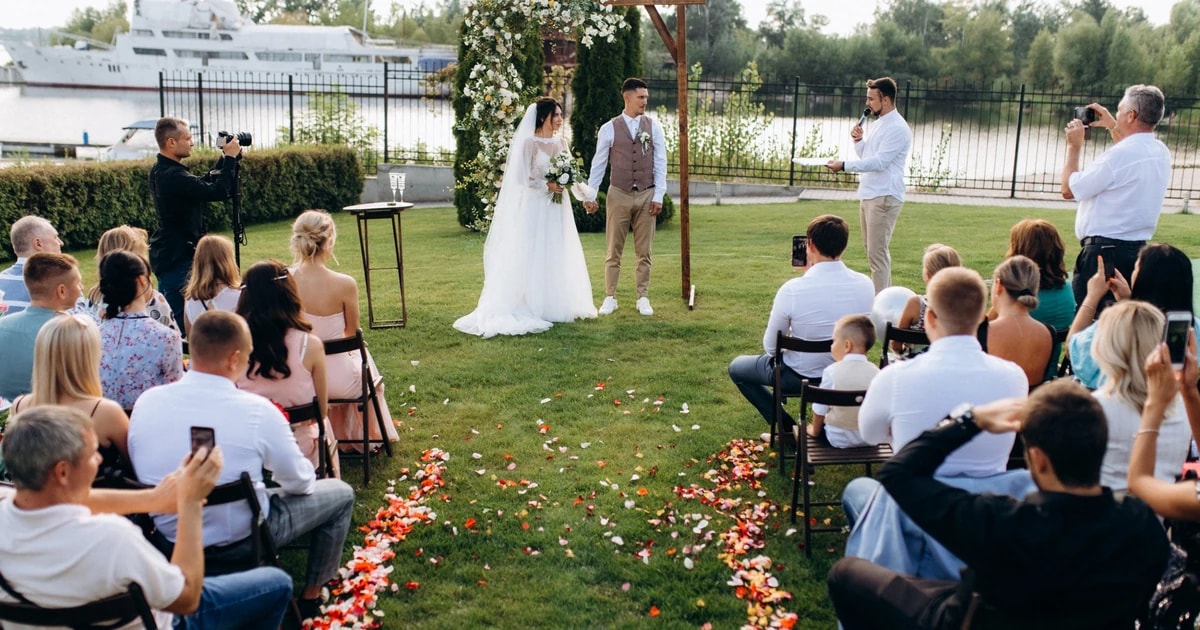
Wedding readings are the part of the ceremony guests actually listen to. One person stands up and says something about love while everyone you know sits still.
Every reading printed in full below is free to copy into your program: a public domain work, a free Bible translation or a court opinion. Each has a word count and reading time. Modern favorites, still under copyright, are listed by title with where to find them.
How do you choose a wedding reading?
Choose a wedding reading in four steps: check what your officiant or church allows, decide on the tone, keep it under about two minutes, and match it to the person reading it. One to three readings is usual, and the rules come first because a Catholic or Episcopal ceremony narrows the list before taste comes into it.
Start with your ceremony’s rules
Catholic weddings use Scripture only, Episcopal weddings draw from the Book of Common Prayer, and Jewish ceremonies have fixed texts. Civil ceremonies are open. How many readings fit depends on where readings fall in the ceremony.
Decide on the tone
Scripture and sonnets sound steady and formal, prose like The Velveteen Rabbit feels warm, and Edward Lear gets a laugh. Many couples pair one serious reading with one lighter one. A line that stays with you can also spark something for writing your own vows.
Check the time
How to time any reading: divide the word count by 140. That’s the length in minutes at a clear pace, the rate Baruch College recommends for being understood. Add about 15 seconds for the walk up and the introduction. Keep each reading under about two minutes, or roughly 280 words.
Match the reading to the reader
A grandparent reading Ruth carries weight; a friend with good timing can carry Edward Lear. Give a nervous reader the shorter passage.
Bible readings for a wedding ceremony
The most chosen Bible readings for a wedding are 1 Corinthians 13:4-8a ("Love is patient, love is kind"), Ruth 1:16-17 and Ecclesiastes 4:9-12, each about 30 seconds long. Counts and times below use the Berean Standard Bible, a modern translation dedicated to the public domain.
Passage | Theme | Words | Time |
1 Corinthians 13:4-8a | What love is and does | 64 | 25 sec |
Ruth 1:16-17 | Wherever you go, I will go | 69 | 30 sec |
Ecclesiastes 4:9-12 | Two are better than one | 73 | 30 sec |
Song of Songs 2:10-13 | Spring and new love | 74 | 30 sec |
Song of Songs 8:6-7 | Love as strong as death | 67 | 30 sec |
Mark 10:6-9 | What God has joined together | 55 | 25 sec |
John 15:9-12 | Remain in My love | 73 | 30 sec |
1 John 4:7-12 | God is love | 122 | 50 sec |
Colossians 3:12-17 | Put on love, the bond of unity | 139 | 1 min |
Genesis 2:18-24 | Not good for the man to be alone | 203 | 1 min 25 sec |
Stop Colossians at verse 17, since verse 18 begins "Wives, submit to your husbands." In Song of Songs 8:6, "Sheol" is the Hebrew word for the grave; tell your reader to say SHEE-ohl.
1 Corinthians 13:4-8a, Ecclesiastes 4:9-12 and Song of Songs 2:10-13 never mention God, so they suit a mixed or secular ceremony where one family would still like Scripture.
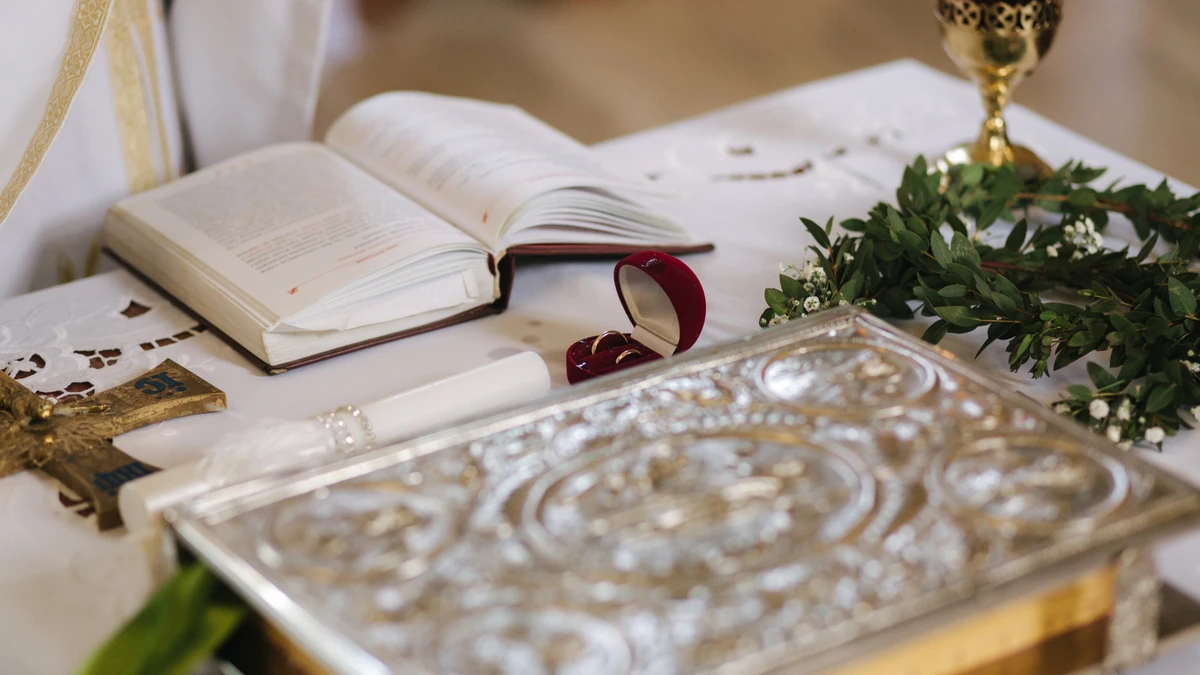
1 Corinthians 13:4-8a
"Love is patient, love is kind" · 64 words, about 25 seconds
Love is patient, love is kind. It does not envy, it does not boast, it is not proud. It is not rude, it is not self-seeking, it is not easily angered, it keeps no account of wrongs. Love takes no pleasure in evil, but rejoices in the truth. It bears all things, believes all things, hopes all things, endures all things. Love never fails.
Berean Standard Bible (BSB). The whole chapter runs 269 words, just under two minutes.
Ruth spoke these lines to her mother-in-law, Naomi, not to a husband, so the promise is loyalty between two families. Verse 17 calls on the Lord, which makes it a religious reading.
Ruth 1:16-17
"Wherever you go, I will go" · 69 words, about 30 seconds
Do not urge me to leave you
or to turn from following you.
For wherever you go, I will go,
and wherever you live, I will live;
your people will be my people,
and your God will be my God.
Where you die, I will die,
and there I will be buried.
May the LORD punish me,
and ever so severely,
if anything but death
separates you and me.
Berean Standard Bible (BSB). For the older "whither thou goest" wording, use the King James Version.
Ecclesiastes 4:9-12
"Two are better than one" · 73 words, about 30 seconds
Two are better than one, because they have a good return for their labor. For if one falls down, his companion can lift him up; but pity the one who falls without another to help him up! Again, if two lie down together, they will keep warm; but how can one keep warm alone? And though one may be overpowered, two can resist. Moreover, a cord of three strands is not quickly broken.
Berean Standard Bible (BSB)
What do Catholic, Episcopal and Jewish weddings allow?
Catholic weddings allow Bible readings only, from an approved list. Episcopal weddings read from a list in the Book of Common Prayer. Jewish ceremonies have fixed texts, so an added reading needs the rabbi’s agreement. Civil and nondenominational ceremonies are open. Whatever your tradition, confirm your readings with the officiant before anything is printed.
Catholic weddings
The US bishops’ For Your Marriage readings page says the readings "are limited to readings from the scriptures (the Bible)". At a Nuptial Mass you choose one Old Testament reading from nine options, a responsorial psalm, one New Testament reading from thirteen and one Gospel from ten. A deacon or priest reads the Gospel, under the General Instruction of the Roman Missal (no. 59).
Friends or family usually read the others, though parishes set their own rules on readers. The parish reads from its own Lectionary translation, so a Catholic program lists citations rather than full texts. See how Catholic and Jewish ceremonies are structured for where each reading falls.
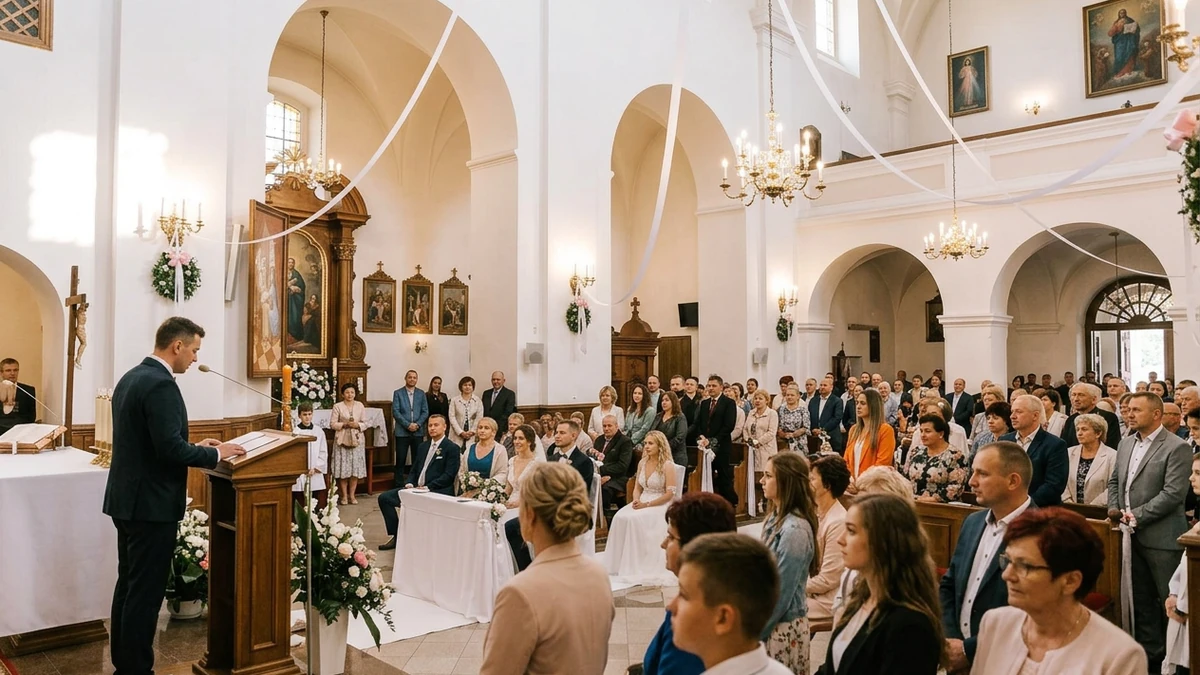
Episcopal weddings
The Book of Common Prayer says "one or more of the following passages from Holy Scripture is read" and lists nine, including Song of Solomon 2 and 8 (one reading), 1 Corinthians 13 and Colossians 3:12-17. If Communion follows, a Gospel passage is read last.
Jewish weddings
The ceremony is built around set texts, the ketubah reading and the seven blessings, with no standard slot for a poem. Ask your rabbi before planning one; some suggest the reception instead.
Everyone else
Civil, interfaith and nondenominational ceremonies are open, though your officiant should still see your readings in advance.
Before you print anything: get your officiant’s yes on every reading. A program printed with a reading the church won’t allow is a program you print twice.
Non-religious wedding readings
The most loved non-religious wedding readings are classics: Shakespeare’s Sonnet 116, Browning’s "How do I love thee?", Gibran’s "On Marriage" and the "What is REAL?" passage from The Velveteen Rabbit. All were published in 1930 or earlier, so they’re free to print. Works from 1930 entered the US public domain on January 1, 2026, according to Duke Law.
Sonnet 116, William Shakespeare
The classic: love defined by what it refuses to do.
Sonnet 116, William Shakespeare
Poetry Foundation · 109 words, about 45 seconds
Let me not to the marriage of true minds
Admit impediments; love is not love
Which alters when it alteration finds,
Or bends with the remover to remove.
O no, it is an ever-fixèd mark
That looks on tempests and is never shaken;
It is the star to every wand’ring bark
Whose worth’s unknown, although his height be taken.
Love’s not time’s fool, though rosy lips and cheeks
Within his bending sickle’s compass come.
Love alters not with his brief hours and weeks,
But bears it out even to the edge of doom:
If this be error and upon me proved,
I never writ, nor no man ever loved.
Sonnets from the Portuguese 43, Elizabeth Barrett Browning
Written to Robert Browning before they married. The last line mentions God, worth knowing for a strictly secular ceremony.
"How do I love thee?", Elizabeth Barrett Browning
Poetry Foundation · 127 words, about 55 seconds
How do I love thee? Let me count the ways.
I love thee to the depth and breadth and height
My soul can reach, when feeling out of sight
For the ends of being and ideal grace.
I love thee to the level of every day’s
Most quiet need, by sun and candle-light.
I love thee freely, as men strive for right;
I love thee purely, as they turn from praise.
I love thee with the passion put to use
In my old griefs, and with my childhood’s faith.
I love thee with a love I seemed to lose
With my lost saints. I love thee with the breath,
Smiles, tears, of all my life; and, if God choose,
I shall but love thee better after death.
"A Red, Red Rose", Robert Burns
The last verse is a goodbye before a journey. To skip it, stop at "While the sands o’ life shall run": 82 words, about 35 seconds.
"A Red, Red Rose", Robert Burns
Poetry Foundation · 107 words, about 45 seconds
O my Luve is like a red, red rose
That’s newly sprung in June;
O my Luve is like the melody
That’s sweetly played in tune.
So fair art thou, my bonnie lass,
So deep in luve am I;
And I will luve thee still, my dear,
Till a’ the seas gang dry.
Till a’ the seas gang dry, my dear,
And the rocks melt wi’ the sun;
I will love thee still, my dear,
While the sands o’ life shall run.
And fare thee weel, my only luve!
And fare thee weel awhile!
And I will come again, my luve,
Though it were ten thousand mile.
"Love’s Philosophy", Percy Bysshe Shelley
Everything in nature pairs up, so why not us? Leave a pause before the last line.
"Love’s Philosophy", Percy Bysshe Shelley
Poetry Foundation · 92 words, about 40 seconds
The fountains mingle with the river
And the rivers with the ocean,
The winds of heaven mix for ever
With a sweet emotion;
Nothing in the world is single;
All things by a law divine
In one spirit meet and mingle.
Why not I with thine?
See the mountains kiss high heaven
And the waves clasp one another;
No sister-flower would be forgiven
If it disdained its brother;
And the sunlight clasps the earth
And the moonbeams kiss the sea:
What is all this sweet work worth
If thou kiss not me?
"On Marriage" from The Prophet, Kahlil Gibran
Published in 1923: closeness with room to breathe. The third line mentions God, worth knowing for a strictly secular ceremony.
"On Marriage" from The Prophet, Kahlil Gibran
Project Gutenberg · 178 words, about 1 minute 15 seconds
You were born together, and together you shall be forevermore.
You shall be together when the white wings of death scatter your days.
Aye, you shall be together even in the silent memory of God.
But let there be spaces in your togetherness,
And let the winds of the heavens dance between you.
Love one another, but make not a bond of love:
Let it rather be a moving sea between the shores of your souls.
Fill each other’s cup but drink not from one cup.
Give one another of your bread but eat not from the same loaf.
Sing and dance together and be joyous, but let each one of you be alone,
Even as the strings of a lute are alone though they quiver with the same music.
Give your hearts, but not into each other’s keeping.
For only the hand of Life can contain your hearts.
And stand together yet not too near together:
For the pillars of the temple stand apart,
And the oak tree and the cypress grow not in each other’s shadow.
The Velveteen Rabbit, Margery Williams
Published in 1922. A toy rabbit asks what it means to be Real, and the answer is about long love that wears you shabby.
"What is REAL?" from The Velveteen Rabbit, Margery Williams
Project Gutenberg · 211 words, about 1 minute 30 seconds
"What is REAL?" asked the Rabbit one day, when they were lying side by side near the nursery fender, before Nana came to tidy the room. "Does it mean having things that buzz inside you and a stick-out handle?"
"Real isn’t how you are made," said the Skin Horse. "It’s a thing that happens to you. When a child loves you for a long, long time, not just to play with, but REALLY loves you, then you become Real."
"Does it hurt?" asked the Rabbit.
"Sometimes," said the Skin Horse, for he was always truthful. "When you are Real you don’t mind being hurt."
"Does it happen all at once, like being wound up," he asked, "or bit by bit?"
"It doesn’t happen all at once," said the Skin Horse. "You become. It takes a long time. That’s why it doesn’t happen often to people who break easily, or have sharp edges, or who have to be carefully kept. Generally, by the time you are Real, most of your hair has been loved off, and your eyes drop out and you get loose in the joints and very shabby. But these things don’t matter at all, because once you are Real you can’t be ugly, except to people who don’t understand."
To end on "It lasts for always.", read on a few lines: 272 words, just under two minutes.
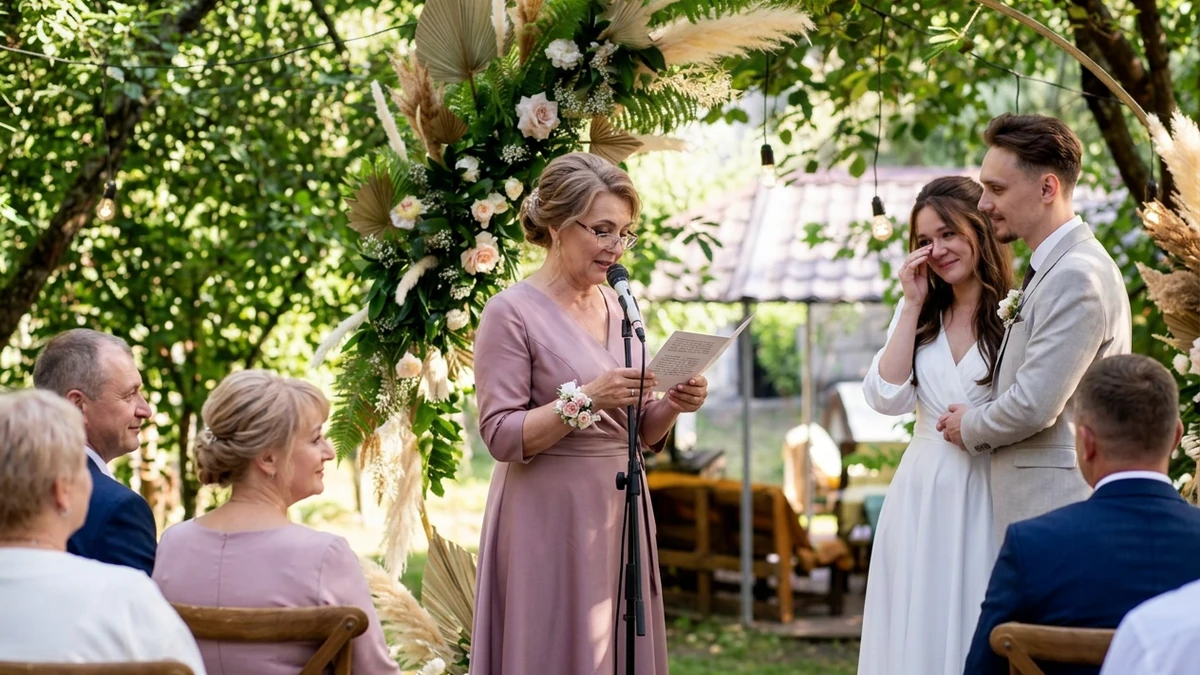
Obergefell v. Hodges (2015), the closing paragraph
The 2015 Supreme Court decision that made same-sex marriage legal nationwide. Its closing paragraph is about what marriage means to any couple.
Court opinions can’t be copyrighted: federal works are excluded under 17 U.S. Code § 105, and the Supreme Court held in Georgia v. Public.Resource.Org that judges aren’t the authors of work they do as judges.
Obergefell v. Hodges, 576 U.S. 644 (2015)
Cornell Law School Legal Information Institute · 124 words, about 55 seconds
No union is more profound than marriage, for it embodies the highest ideals of love, fidelity, devotion, sacrifice, and family. In forming a marital union, two people become something greater than once they were. As some of the petitioners in these cases demonstrate, marriage embodies a love that may endure even past death. It would misunderstand these men and women to say they disrespect the idea of marriage. Their plea is that they do respect it, respect it so deeply that they seek to find its fulfillment for themselves. Their hope is not to be condemned to live in loneliness, excluded from one of civilization’s oldest institutions. They ask for equal dignity in the eyes of the law. The Constitution grants them that right.
Shorter option: stop at "endure even past death" (53 words, about 25 seconds).
Another option is Goodridge v. Department of Public Health (2003), the decision that made Massachusetts the first state to allow same-sex marriage.
Goodridge v. Department of Public Health, 440 Mass. 309 (2003)
Civil marriage is at once a deeply personal commitment to another human being and a highly public celebration of the ideals of mutuality, companionship, intimacy, fidelity, and family. ... Because it fulfils yearnings for security, safe haven, and connection that express our common humanity, civil marriage is an esteemed institution, and the decision whether and whom to marry is among life’s momentous acts of self-definition.
The ellipsis replaces a quotation from an earlier Supreme Court case.
Short wedding readings under a minute
The shortest wedding reading here is the 26-word Pooh passage, at about 10 seconds. Most Bible passages and classic poems run 25 to 55 seconds. Pair a very short reading with a longer one, such as Pooh before Sonnet 116, for a light moment followed by something to sit with.
Reading | Words | Time |
The House at Pooh Corner, A. A. Milne (1928) | 26 | 10 sec |
Obergefell v. Hodges, first three sentences | 53 | 25 sec |
Mark 10:6-9 | 55 | 25 sec |
1 Corinthians 13:4-8a | 64 | 25 sec |
Goodridge v. Department of Public Health | 64 | 25 sec |
Song of Songs 8:6-7 | 67 | 30 sec |
Ruth 1:16-17 | 69 | 30 sec |
Ecclesiastes 4:9-12 | 73 | 30 sec |
John 15:9-12 | 73 | 30 sec |
Song of Songs 2:10-13 | 74 | 30 sec |
"Love’s Philosophy", Shelley | 92 | 40 sec |
"A Red, Red Rose", Burns | 107 | 45 sec |
Sonnet 116, Shakespeare | 109 | 45 sec |
1 John 4:7-12 | 122 | 50 sec |
Obergefell v. Hodges, full closing paragraph | 124 | 55 sec |
"How do I love thee?", Browning | 127 | 55 sec |
Funny and unexpected wedding readings
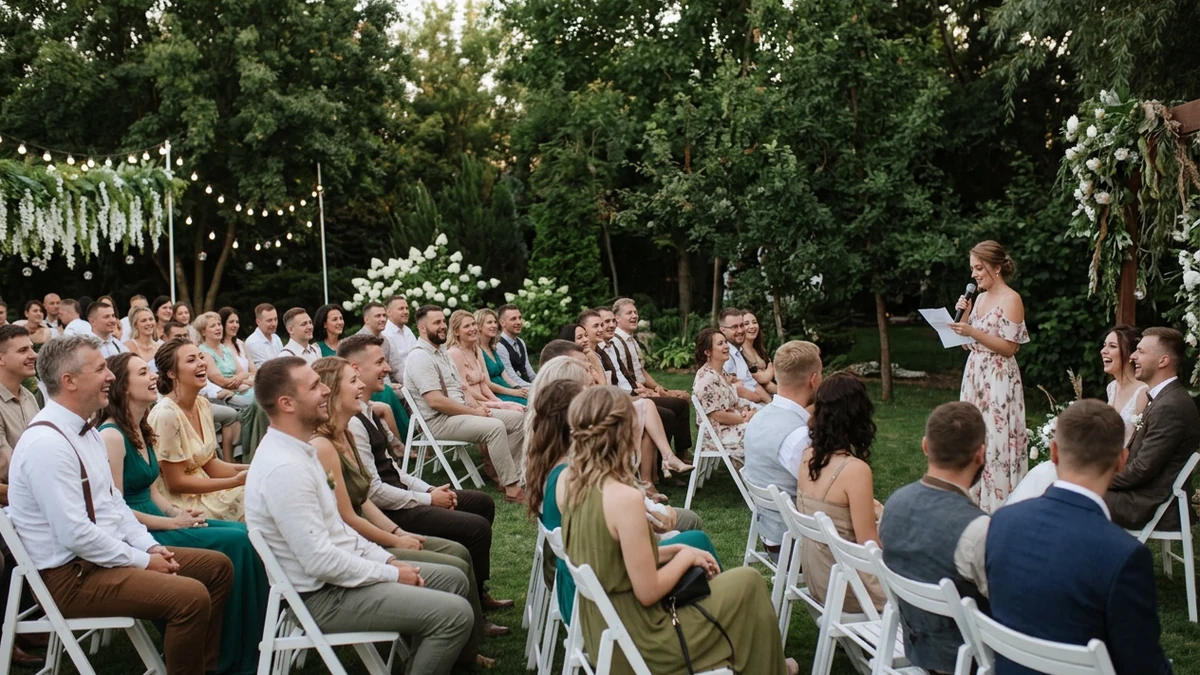
The best funny reading free to print is Edward Lear’s "The Owl and the Pussy-Cat", an 1871 nonsense poem that ends in a wedding. The Winnie-the-Pooh passage is gentler: a soft laugh, then a lump in the throat. Give either to someone with natural timing, and pick a reader who can say "Pussy" six times with a straight face.
"The Owl and the Pussy-Cat", Edward Lear (1871)
Poetry Foundation · 221 words, about 1 minute 35 seconds
The Owl and the Pussy-cat went to sea
In a beautiful pea-green boat,
They took some honey, and plenty of money,
Wrapped up in a five-pound note.
The Owl looked up to the stars above,
And sang to a small guitar,
"O lovely Pussy! O Pussy, my love,
What a beautiful Pussy you are,
You are,
You are!
What a beautiful Pussy you are!"
Pussy said to the Owl, "You elegant fowl!
How charmingly sweet you sing!
O let us be married! too long we have tarried:
But what shall we do for a ring?"
They sailed away, for a year and a day,
To the land where the Bong-Tree grows
And there in a wood a Piggy-wig stood
With a ring at the end of his nose,
His nose,
His nose,
With a ring at the end of his nose.
"Dear Pig, are you willing to sell for one shilling
Your ring?" Said the Piggy, "I will."
So they took it away, and were married next day
By the Turkey who lives on the hill.
They dined on mince, and slices of quince,
Which they ate with a runcible spoon;
And hand in hand, on the edge of the sand,
They danced by the light of the moon,
The moon,
The moon,
They danced by the light of the moon.
The House at Pooh Corner, A. A. Milne (1928), chapter 7
Project Gutenberg · 26 words, about 10 seconds
Piglet sidled up to Pooh from behind.
"Pooh!" he whispered.
"Yes, Piglet?"
"Nothing," said Piglet, taking Pooh’s paw. "I just wanted to be sure of you."
For unexpected rather than funny, the court opinions above surprise most guests, in a good way.
Popular modern readings and where to find them
Popular modern wedding readings include Robert Fulghum’s "Union", the "roots" passage from Captain Corelli’s Mandolin and E. E. Cummings’s "i carry your heart with me". They’re under copyright, so copy them from the book or a licensed site and list only the title and author in your program.
Reading | Author | Where to find it | Tone |
"Union" | Robert Fulghum | His book From Beginning to End: The Rituals of Our Lives | Warm and plain-spoken |
The "roots" passage, Captain Corelli’s Mandolin | Louis de Bernières | The novel (1994) | Love after the first rush; in the story, a father speaks to his daughter |
"i carry your heart with me(i carry it in" | E. E. Cummings | His collected poems | Intimate and lyrical |
"Sonnet XVII" | Pablo Neruda | One Hundred Love Sonnets; a translation is on Poetry Foundation | Quiet and intense |
"How Falling in Love Is Like Owning a Dog" | Taylor Mali | The poet’s own website | Funny, then sincere |
The dedication to Ann Druyan | Carl Sagan | Cosmos (1980) | One sentence; pair it with a longer reading |
"A Blessing for Wedding" | Jane Hirshfield | Poetry Foundation | Gentle and hopeful |
Poetry Foundation’s wedding poems collection is a reliable legal source. Avoid quote sites, which often misquote lines or credit the wrong author.
How do you credit and introduce a wedding reading?
Credit a wedding reading in your program with its title, author and reader’s name, or with the book, chapter and verses for Scripture. The officiant introduces each reader by name and relationship to the couple, or the reader opens with the title and author before beginning.
Credits in the program
The Emily Post Institute says a program should "include the title and author" of readings, along with who performs them. Three sample lines:
Sample program lines
Fictional names
Reading: Sonnet 116, William Shakespeare. Read by Nora Whitlock, friend of the bride
First Reading: Ecclesiastes 4:9-12. Read by Daniel Reyes, brother of the groom
Reading: "Union", Robert Fulghum. Read by Grace Abernathy, aunt of the couple
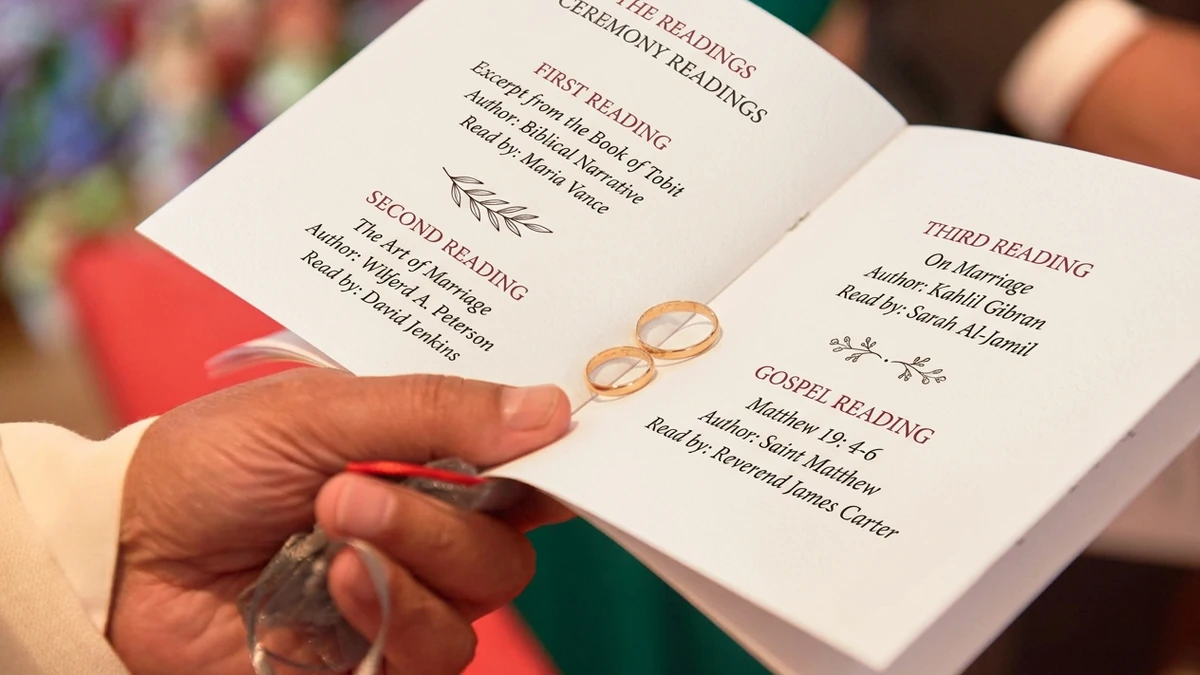
These lines drop straight into our editable wedding programs, and you’ll find complete program wording for every kind of ceremony in our program examples. To print a Bible passage in full, the translation decides what you can do:
Berean Standard Bible: public domain since April 30, 2023, under its publisher’s terms.
King James Version: public domain in the US, as Bible Gateway notes.
ESV: in an order of service, Crossway asks only for "(ESV)" at the end of the quotation.
NIV: Biblica allows up to 500 verses without written permission, as long as they make up less than a quarter of your program and each use carries its copyright notice.
Introducing each reader
The officiant usually hands over in one line, such as "Nora Whitlock, a friend of the bride, will now share a reading." Our wedding ceremony script has that line ready to use. Catholic readers follow a set form: on For Your Marriage, each reading opens with "A reading from the Book of..." and closes with "The word of the Lord."
Helping your readers
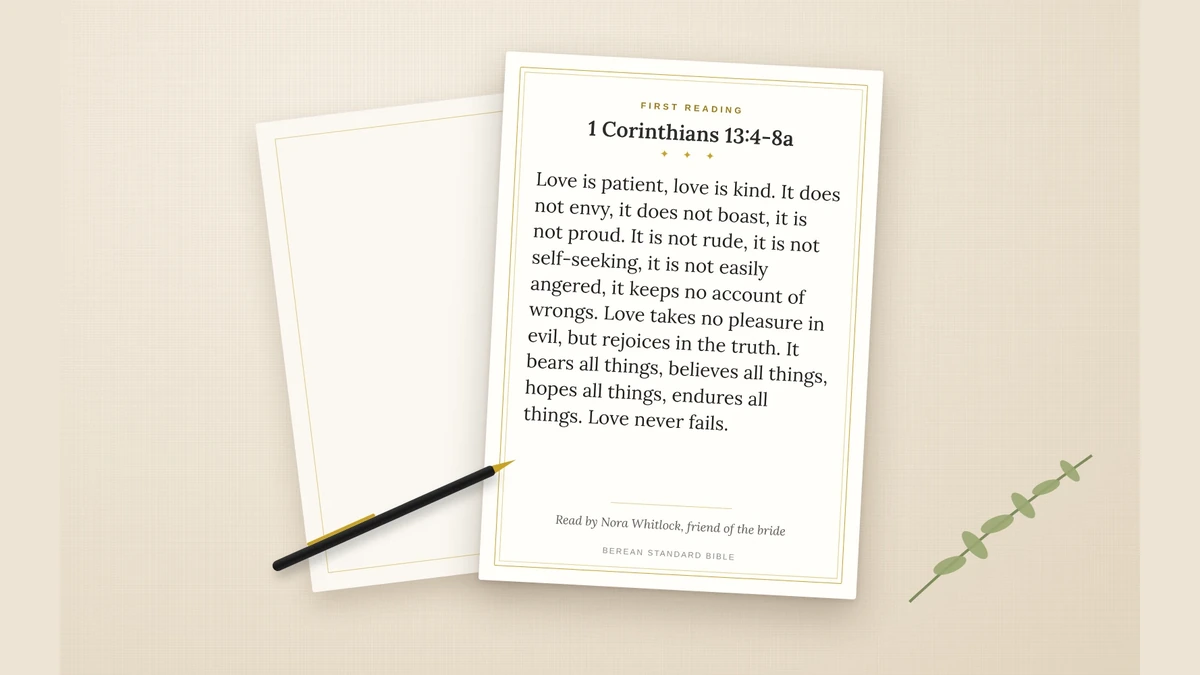
Print each reading on a card in 18 point type, the size the American Council of the Blind recommends for large print. A phone dims mid-sentence; a card doesn’t. Ask readers to read it aloud twice at home and to aim for about 140 words a minute, which feels slow to them and sounds right to everyone else.
Key Takeaways
Divide a reading’s word count by 140 to get its length in minutes at a clear, unhurried speaking pace.
Catholic weddings use Bible readings only, and a deacon or priest always reads the Gospel at a Nuptial Mass.
1 Corinthians 13:4-8a, Ecclesiastes 4:9-12 and Song of Songs 2:10-13 never mention God, so they suit mixed and secular ceremonies.
Court opinions such as Obergefell v. Hodges are not protected by copyright and can be printed in full.
Program credits list the title, author and reader, with Bible citations by book, chapter and verse.
Readers need a printed card in 18 point type and two read-throughs aloud before the wedding.
Frequently Asked Questions
What are some good readings for a wedding ceremony?
Good wedding ceremony readings include 1 Corinthians 13:4-8a or Ruth 1:16-17 for a church wedding, Sonnet 116 or Gibran’s "On Marriage" for a secular one, and the Velveteen Rabbit passage for warmth. Check your ceremony’s rules first, then keep each reading under two minutes.
What is a beautiful poem to read at a wedding?
Shakespeare’s Sonnet 116, Elizabeth Barrett Browning’s "How do I love thee?" and Robert Burns’s "A Red, Red Rose" are beautiful and free to print in full. For a modern poem, look up Pablo Neruda’s "Sonnet XVII" or E. E. Cummings’s "i carry your heart with me" and credit it by title.
What Bible readings are appropriate for a wedding ceremony?
Common choices are 1 Corinthians 13:4-8a, Ruth 1:16-17, Ecclesiastes 4:9-12, Song of Songs 2:10-13, Colossians 3:12-17 and John 15:9-12. Catholic couples choose from the Church’s approved list and Episcopal couples from the Book of Common Prayer, so confirm with your officiant first.
What Bible readings are appropriate for non-religious weddings?
Choose passages that never mention God: 1 Corinthians 13:4-8a, Ecclesiastes 4:9-12 and Song of Songs 2:10-13. They read as reflections on love and partnership rather than worship, which suits a secular ceremony where one family would still like Scripture. Each takes about 30 seconds.
How many readings are done at a Catholic wedding?
A Nuptial Mass has three readings and a psalm: one Old Testament reading, a responsorial psalm, one New Testament reading and a Gospel, which a deacon or priest reads. A wedding without Mass often has fewer, but parishes vary, so ask yours how many it uses.
How to introduce readings in a wedding ceremony?
The officiant names the reader, their relationship to the couple and the reading: "Nora Whitlock, a friend of the bride, will now read Sonnet 116 by William Shakespeare." Or the reader opens with the title and author. Catholic readers begin with "A reading from" and the name of the book.
What are some funny readings I can use for my wedding ceremony?
Edward Lear’s "The Owl and the Pussy-Cat", which ends in a wedding, and the 26-word Pooh passage are both funny and free to print. Taylor Mali’s "How Falling in Love Is Like Owning a Dog" is a modern favorite to credit by title. Give funny readings to someone with good timing.
What are some good readings for a queer wedding ceremony?
Obergefell v. Hodges, the 2015 Supreme Court decision that made same-sex marriage legal nationwide, is a favorite: its closing paragraph runs about 55 seconds and is free to print. Goodridge v. Department of Public Health is another. Sonnet 116, "On Marriage" and the Velveteen Rabbit passage suit any couple, because none of them assumes a bride and groom.
Can you print a wedding reading in your program?
Yes, if the text is public domain or freely licensed. Works published in 1930 or earlier, court opinions, the King James Version and the Berean Standard Bible can be printed in full, and the ESV with "(ESV)" after it. For copyrighted poems and prose, print only the title and author.
Ready to put your readings in the program?
Once your readings and readers are settled, they go in the program beside the order of service and the wedding party. Designing everything at once? Our programs, menus and place cards in one design keep your day-of stationery matching, with room for every reading and reader’s name.