
How to Write Wedding Vows: A Template, Examples and Tips
Most couples can write their own wedding vows, but check with your officiant first, because Catholic and some other religious ceremonies use set texts. Keep each set to one or two minutes, roughly 150 to 300 words, and build it in five parts: their name, what you love, one story, three to five promises and a short closing line.
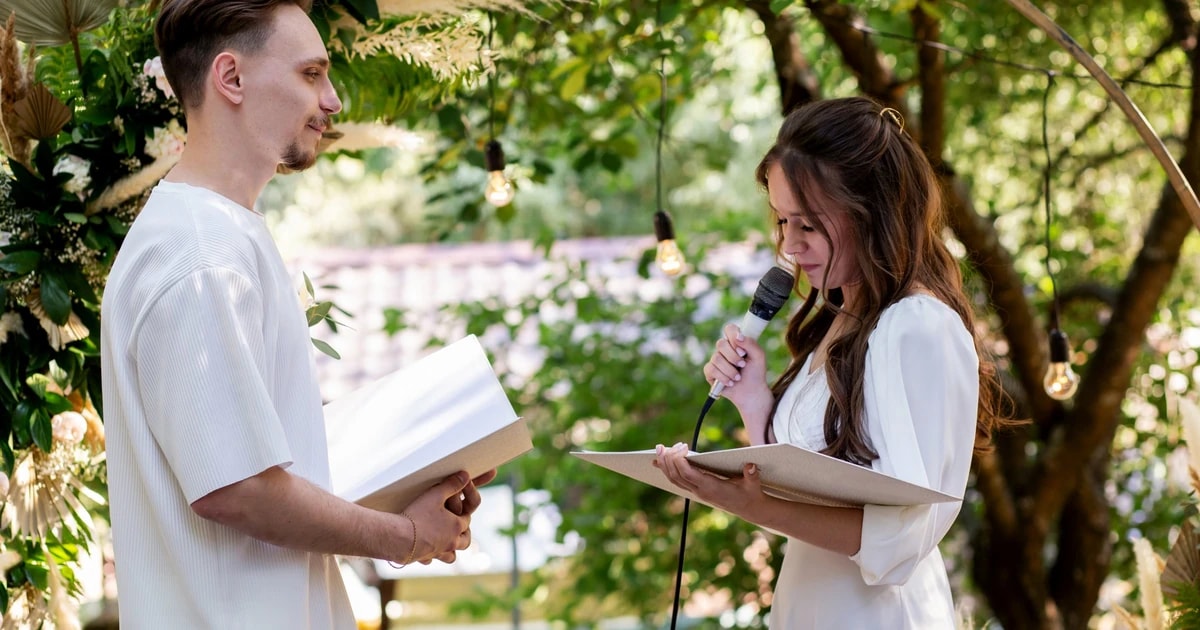
Most advice on how to write wedding vows stops at "be yourself" and "keep it short." Neither helps much in front of a blank page a few weeks before the wedding.
This is the practical version: what your ceremony allows, eight steps from first notes to final card, a template you can fill in tonight, a word count that fits the time, and twelve examples to borrow structure from.
Can you write your own wedding vows?
Usually, yes. Civil and nonreligious ceremonies leave the wording to you, as long as you keep the legal declaration of intent. Religious ceremonies vary: Catholic and Episcopal weddings use set vow texts, and a traditional Jewish ceremony centers on the ring declaration rather than personal vows.
Ask your officiant before you write a word. They know what your ceremony allows and whether your vows need approval in advance.
Your vows are one short slot in a service your officiant leads from welcome to pronouncement, and our full ceremony script shows exactly where they fall.
Catholic ceremonies
Catholic couples don’t compose their own vows. As Msgr. William J. King puts it in Simply Catholic, "the couple is not free to compose their own vows in a Catholic wedding." You choose from the consent texts the US bishops publish, four forms in all. There is still room for your own words, though: the same article notes that couples can write a prayer or reflection for the rite, and share personal reflections at the rehearsal or reception.
Episcopal ceremonies
Episcopal weddings use the vows in the Book of Common Prayer, which close with "This is my solemn vow." The prayer book gives them as set text, so ask your priest whether personal words can be added. If not, the rehearsal dinner or reception is an easy home for them.
Jewish ceremonies
In a traditional Jewish ceremony, the legal heart is the ring declaration: "Behold, you are betrothed unto me with this ring, according to the law of Moses and Israel." Aish describes it as "the central moment of the wedding ceremony." Personal vows aren’t part of that tradition, so ask your rabbi whether you can add your own words.
Civil and nonreligious ceremonies
These are the most open. Write whatever you like, but keep the declaration of intent, where each of you states that you take the other in marriage, because the law requires it in some form. Your personal vows sit alongside it rather than replacing it.
Traditional, personal or both
There are three common formats. Traditional vows use a set text, often repeated after the officiant. Personal vows are words you write yourselves. Both mean traditional vows followed by a short personal promise, for couples who want the familiar words and something of their own.
What if only one of you wants to write vows?
One partner can say traditional vows while the other reads personal ones, or you can both say traditional vows and add one personal sentence each. Just agree on it together, so neither of you gives two sentences right after the other gives two minutes.
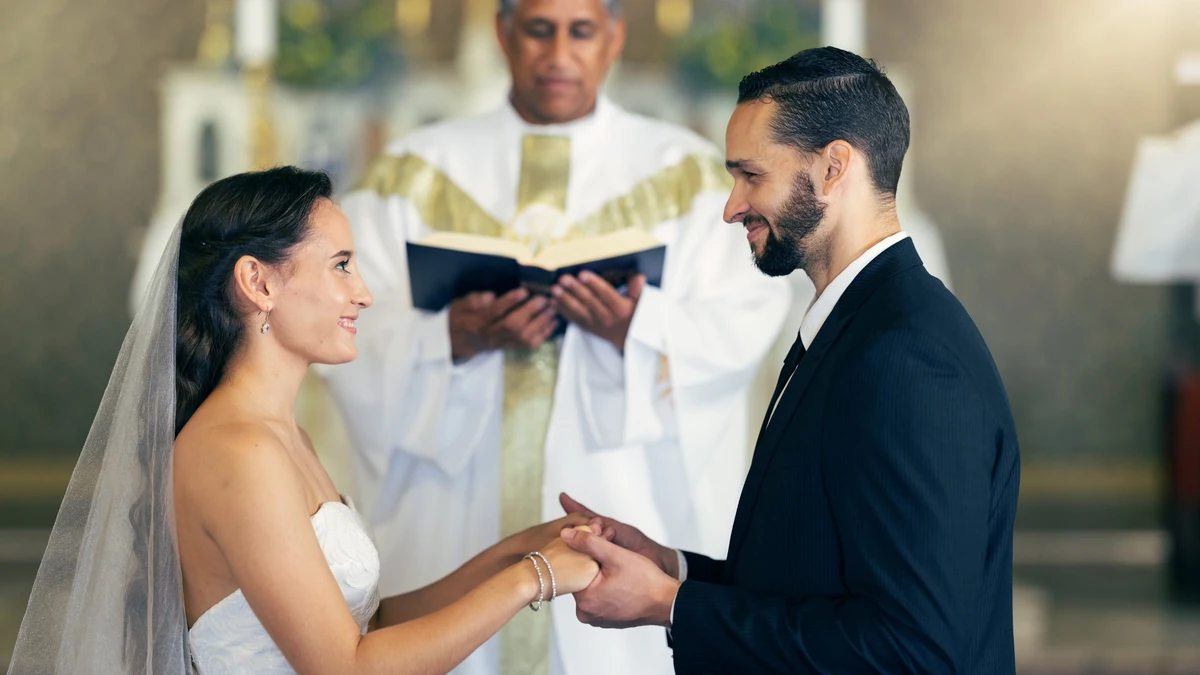
How to write wedding vows, step by step
Write your vows in eight steps: agree on the ground rules with your partner, brainstorm with a set of questions, choose one story, write three to five promises, add an opening and closing, time it aloud, practice in the final week, and copy the finished version onto a card. Spread it over a few weeks, not one late night.
Agree on the ground rules. Settle three things together first: roughly how long, how funny or serious, and whether you’ll share drafts.
Brainstorm with questions. Answer the ten questions below, fast and unedited. You’ll use maybe a fifth of it.
Pick one story. One specific moment says more than five summarized ones. Choose the one that shows who your partner is.
Write three to five promises. Mix one big, one everyday and one light, using the promise ideas below.
Write your opening and closing. Open with their name and one true sentence, and end on a short line that sounds finished.
Read it aloud and time it. Past two minutes, cut, starting with anything guests would need explained.
Practice aloud in the last week. Three or four times is enough. The aim is familiarity, not memorizing.
Copy the final version onto a card or into a vow book. Not your phone: a card can’t light up with a text mid-sentence, and you get to keep it.
Ten questions to get you started
When did you first notice them, and what were they doing?
When did you know this was the person?
What do they do that nobody else in your life does?
What small, ordinary moment with them do you want to remember at 80?
How have you changed since you met?
What have they taught you without trying?
What’s the hardest thing you’ve been through together?
What do you admire in them that they don’t see?
What are you most looking forward to?
What are you scared to promise, and why?
If a line from a poem or one of your favorite wedding readings says it better than you can, borrow it and name where it comes from.
Ten promise ideas to choose from
There is no official list of ten marriage vows. Pick the three to five that are true for you and put them in your own words.
To be honest with you, even when it would be easier not to be
To listen first and argue second
To choose you on the ordinary days, not just the big ones
To keep making you laugh, especially when things go wrong
To back your dreams, including the ones that scare me
To ask for help instead of keeping score
To look after you when you’re sick, and to let you look after me
To keep growing, and to make room for you to grow
To protect our time together from everything that tries to crowd it
To always save you the last bite
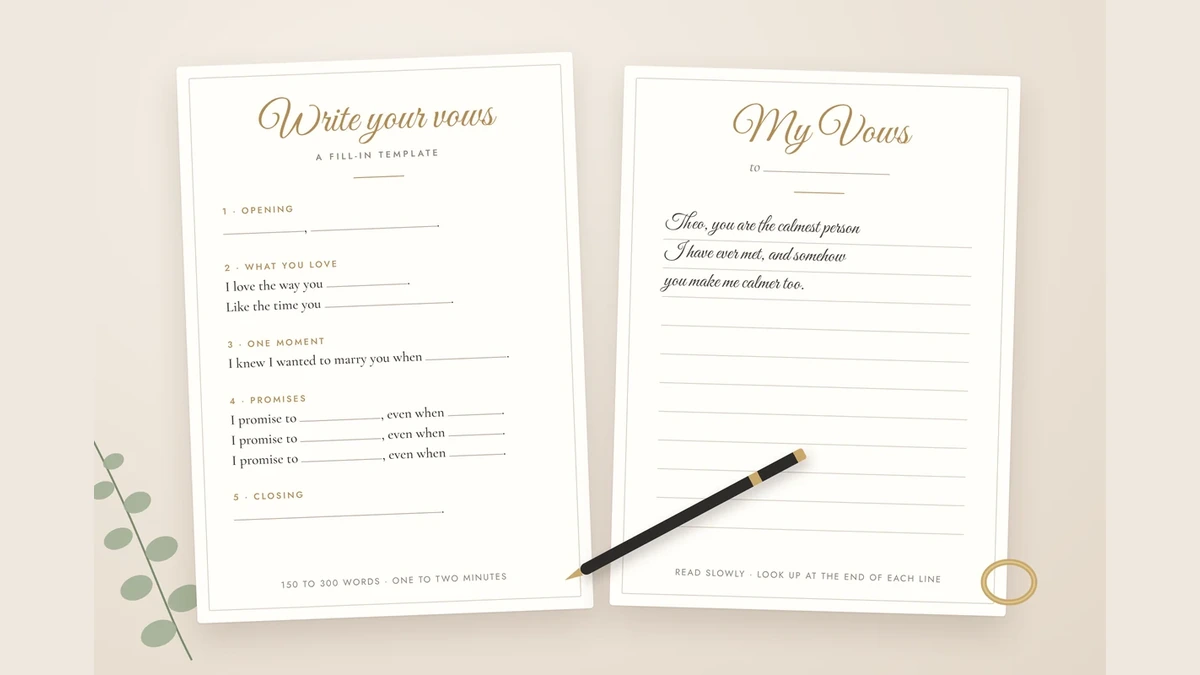
Wedding vow template: fill in the blanks
A good wedding vow template has five parts: an opening with their name, what you love about them, one moment, your promises, and a closing line. Fill in the blanks, then read it aloud and rewrite anything that still sounds like a template.
WEDDING VOW TEMPLATE
1. Opening
________ (their name), ________ (one sentence about who they are to you).
2. What you love
I love the way you ________. Like the time you ________.
I love that you ________, even when ________.
3. One moment
I knew I wanted to marry you when ________.
4. Promises
I promise to ________, even when ________.
I promise to ________, even when ________.
I promise to ________, even when ________.
5. Closing
________ (one short final line).
Here it is filled in. It runs about 130 words, under a minute at a calm pace.
Theo, you are the calmest person I have ever met, and somehow you make me calmer too.
I love the way you fix things quietly, before anyone notices they were broken. Like the time you spent a whole Saturday rebuilding my grandmother’s bookshelf and never mentioned it. I love that you still ask how my day was, even when yours was worse.
I knew I wanted to marry you when you drove four hours through the snow to bring me soup.
I promise to tell you the truth, even when it’s awkward. I promise to slow down, even when I’m sure I’m right. I promise to make your coffee, even when you leave it on the roof of the car.
I choose you, today and every day after.
The "even when" half of each promise is what makes it believable. It shows you have thought about the day it will be hard to keep.
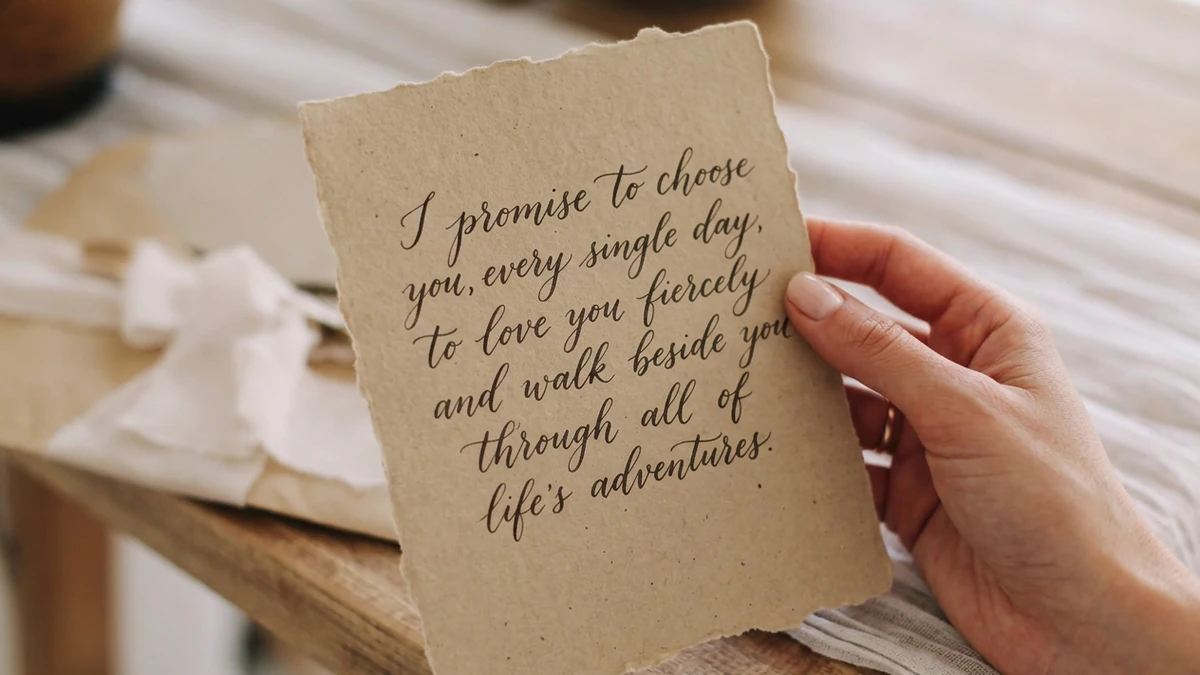
Prefer paper? Print the template and questions, then copy your final vows onto a card like this one.
How long should wedding vows be?
Wedding vows should run one to two minutes each, which is about 150 to 300 words. Average English speech runs at about 150 words a minute, and Baruch College’s speaking-rate guidance suggests aiming for about 140 to be clearly understood, which is the pace a nervous speaker at a microphone needs.
Speaking time | Approximate words |
1 minute | 140 to 150 words |
90 seconds | 210 to 225 words |
2 minutes | 280 to 300 words |
Both sets of vows usually take two to four minutes together in a typical wedding ceremony order, so treat two minutes each as the ceiling rather than the target.
Aim to finish within about 30 seconds of each other. Otherwise every guest notices the gap, and so does the partner who went short.
Time yours out loud, at a pace that feels slightly too slow. Nerves speed most people up.
Wedding vow examples for every style
These twelve sample wedding vows run from traditional to funny, elopement and blended family. The two traditional vows are quoted exactly from their published sources. The other ten were written for this guide, so borrow their structure rather than copying them word for word.
Traditional vows
1. Episcopal vow, from the Book of Common Prayer (1979):
In the Name of God, I, N., take you, N., to be my wife, to have and to hold from this day forward, for better for worse, for richer for poorer, in sickness and in health, to love and to cherish, until we are parted by death. This is my solemn vow.
Source: The Book of Common Prayer (1979), The Celebration and Blessing of a Marriage. The other partner says "husband."
2. Catholic vow, one of the four approved consent formulas:
I, (name), take you, (name), to be my wife/husband. I promise to be faithful to you, in good times and in bad, in sickness and in health, to love you and to honor you all the days of my life.
Source: For Your Marriage, United States Conference of Catholic Bishops, "The Exchange of Consent."
Short and sweet vows
3. Short and sweet
Sam, you are my favorite person to do nothing with. I promise to keep showing up: for the big days, the bad days and the ordinary Tuesdays. I promise to tell you the truth and to listen to yours. I’m yours, for all of it.
4. Short and sweet
Jordan, I was never good at waiting for anything, but I would have waited years for you. I promise to love you loudly, argue fairly and always come home. That’s the whole list, and I mean every word of it.
Romantic vows
5. Romantic vows for her
Elena, the first time I heard you laugh, I was across a crowded kitchen and forgot what I was saying mid-sentence. I still do that. I promise to keep finding new reasons to love you, and to tell you each one out loud. I promise to hold your hand through every hard thing, and to let go when you need to fly. You are my home, and today I’m making it official.
6. Romantic vows for him
Marcus, you once told me you weren’t a romantic. Then you read to me every night the winter I got sick. You are the most romantic person I know. You just do it quietly. I promise to notice. I promise to be your safe place, the way you have always been mine, and to love you with the same steady patience you have shown me.
Funny but sincere vows
7. Funny but sincere
Priya, I promise to respect all 47 of your houseplants, every one of which has a name. I promise to let you have the last dumpling at least sixty percent of the time. And, in all seriousness, I promise to be the person you can count on, every single day, for the rest of my life.
8. Funny but sincere
Dev, when we met, you told me you were a great cook. That was not true. But you were right about everything else, so I’m letting it go. I promise to laugh at your jokes, even the second time. And I promise to love you, honestly and completely, for as long as we both shall live.
Vows for an elopement
9. Elopement
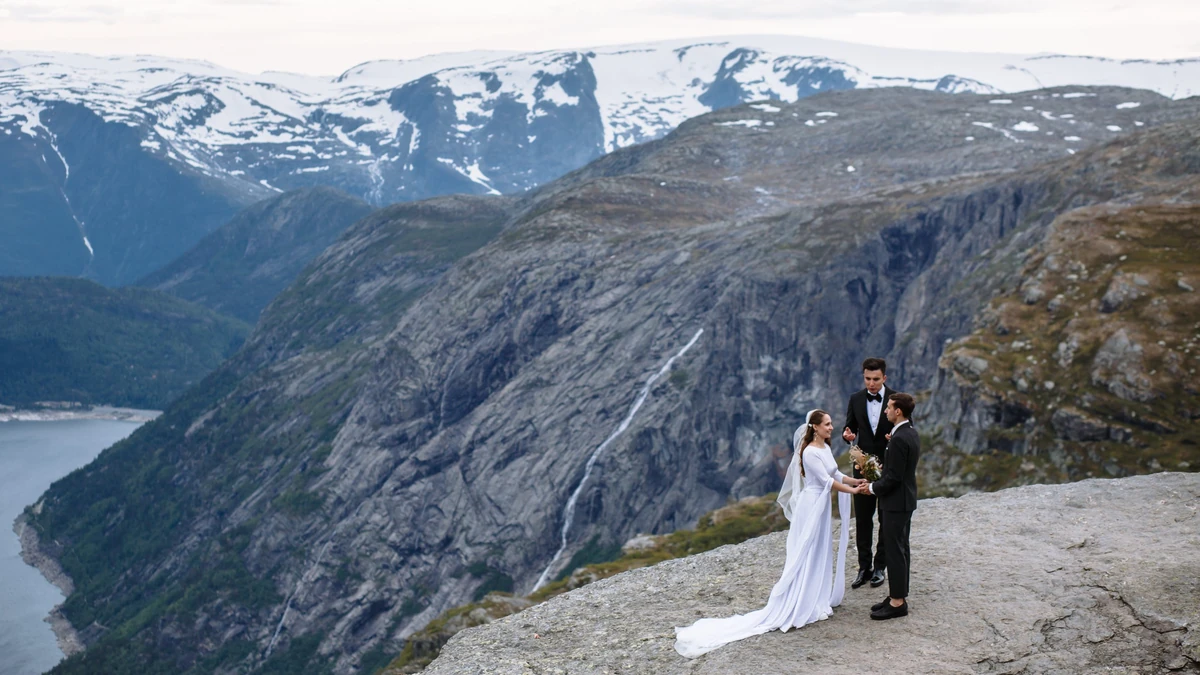
It’s just us and the view, so I can say this plainly. Riley, I never needed a crowd to know this was right. I only needed you. I promise to keep choosing adventures with you, big ones and small ones, and to make ordinary mornings feel a little like this one. Wherever we end up, I’m going there with you.
Vows for a blended family
10. With promises to children
Anna, I promise to love you with patience and honesty, in the chaos and in the quiet. Lily and Noah, I’m not here to replace anyone. I’m here to join your team. I promise to show up for the school plays and the bad days, and to be someone you can count on. Today I’m marrying Anna, and I’m making a promise to all three of you.
Nonreligious vows
11. Nonreligious
Jamie, I don’t believe in fate, but I believe in us, because we built this on purpose. I promise to keep building it: to stay curious about who you’re becoming, to give you room and to stand beside you. I promise to treat our life together as the most important thing I will ever make. Every day, I choose you.
Personal religious vows
12. Personal religious
Grace, I thank God for the day our paths crossed, and for every day since. I promise to love you the way I have been loved: patiently, faithfully and without keeping score. I promise to pray for you and with you, and to forgive quickly. With God’s help, I am yours for life.
How do you start and end your vows?
Start with your partner’s name and one true sentence about them, a memory, or the moment you knew. End with your biggest promise or a line that calls back to your opening, and keep that final line short. That way your officiant knows you’ve finished.
Five ways to start
"[Name], from the day I met you, I knew my life was about to get louder."
"[Name], I have been trying to write this for weeks, and every draft started with your laugh."
"Before I met you, I thought I knew what home felt like."
"[Name], you asked me once what I was most sure of. This is the answer."
"I want to start with the night you [moment], because that’s when I knew."
Five ways to end
"I choose you, today and every day after."
"I’m yours. That’s my promise."
"For all of it, and for always."
"And that is why I’m marrying you."
"You are my home. Let’s go home together."
If your last line trails off, your officiant won’t know whether to move on, and you’ll both stand in a pause nobody planned.
How do you deliver your wedding vows?
Read your vows from a card or vow book rather than memorizing them, and hand your officiant a spare copy. Agree on who goes first, slow down to about 140 words a minute, and look up at your partner at the end of each line. When guests laugh, pause and let it finish rather than talking over it.
Give your officiant a spare copy. If your card blows into the grass or your mind goes blank, they can quietly feed you the next line.
Agree who goes first. In Catholic and Episcopal ceremonies the groom speaks first. For personal vows there’s no rule, so decide in advance and let the officiant announce it.
Pause for laughter. Wait for it to settle so your next line isn’t lost.
It also helps to ask guests to put phones away, so they watch your vows instead of filming them. A printable unplugged sign at the entrance does the asking for you.
On a printed program, list this moment as "Exchange of personal vows" and never print the words, since your partner should hear them first. Our wedding program examples show how to word the rest.

Key Takeaways
Catholic couples choose from four approved consent texts, but they can write a prayer or reflection for the rite and share personal words at the rehearsal or reception.
Speaking at about 140 words a minute, slightly slower than everyday conversation, keeps vows clear to guests.
Partners who finish within about 30 seconds of each other avoid one set of vows sounding noticeably shorter.
Promises written as "I promise to ____, even when ____" are more convincing because they name the moment the promise will be tested.
Starting four to six weeks before the wedding leaves time to draft, cut and practice aloud three or four times in the final week.
Vows read from a printed card are safer than memorized ones, especially with a spare copy in the officiant’s pocket.
Frequently Asked Questions
What is a good structure for wedding vows?
Use five parts: open with your partner’s name and one sentence about them, say what you love with a small example, tell one short story, make three to five promises, and close with a line that ties it all together. The fill-in template earlier in this guide follows exactly that order.
How long before the wedding should you write your vows?
Start four to six weeks before the wedding and aim to finish a full draft two weeks out. That leaves time to cut, rewrite and compare length with your partner. Keep the final week for practicing aloud rather than rewriting, so the words already feel familiar on the day.
What are some common vow mistakes?
The most common mistakes are running long, leaning on inside jokes guests won’t get, telling embarrassing stories, making promises you can’t keep, and reading from a phone. A big mismatch with your partner in length or tone is the other one, and agreeing on both early avoids it entirely.
How should you start your vows?
Start with your partner’s name and one sentence about them, a memory, or the moment you knew. For example: "Ava, you are the bravest person I know, and you would never say so yourself." Or: "I knew on the drive home from our first dinner, and I haven’t stopped knowing since."
What are the basic wedding vows?
The best-known traditional form promises "to have and to hold, from this day forward, for better, for worse, for richer, for poorer, in sickness and in health, to love and to cherish until death do us part." That wording is one of the Catholic consent formulas published by the United States Conference of Catholic Bishops.
What is a short but sweet wedding vow?
A short vow still makes a specific promise. Try this one: "Noor, you make ordinary days feel like good news. I promise to be honest with you, to be patient when it’s hard, and to keep choosing you every single day. Whatever comes next, we’ll face it together. I’m yours."
Should you memorize your wedding vows?
No. Read them from a card or vow book instead. Nerves can wipe out lines you know by heart, and a pause while you search for a word feels far longer at the altar than it does at home. Look up at the end of each line, and give your officiant a spare copy.
Does husband or wife go first in vows?
Traditionally the groom goes first: in the Catholic and Episcopal rites, he says his vows before the bride. For personal vows there’s no rule, so any couple can choose. Decide together and tell your officiant, who will announce who starts. Some couples let the more nervous partner go first, so they can relax and listen.
How do you end your wedding vows?
End with your biggest promise or a line that calls back to your opening, and keep it short so everyone knows you’ve finished. For example: "Every day, for the rest of my life, it’s you." Or: "So here is my last promise: you will never have to wonder."
Ready to write yours?
Block out one evening this week, answer the ten questions and let the template carry the structure. Then give the final words a home that isn’t your phone, and build the rest of the day’s paper around them with our ceremony and reception templates.