
Wedding Ceremony Script: 3 Complete Officiant Scripts, Word for Word
A wedding ceremony script is the full spoken text of your ceremony, line by line, with who says what. Whatever the style, it must include one legal moment: both partners declaring, in front of the officiant and witnesses your state requires, that they take each other as spouses. Below are three complete scripts you can read word for word.
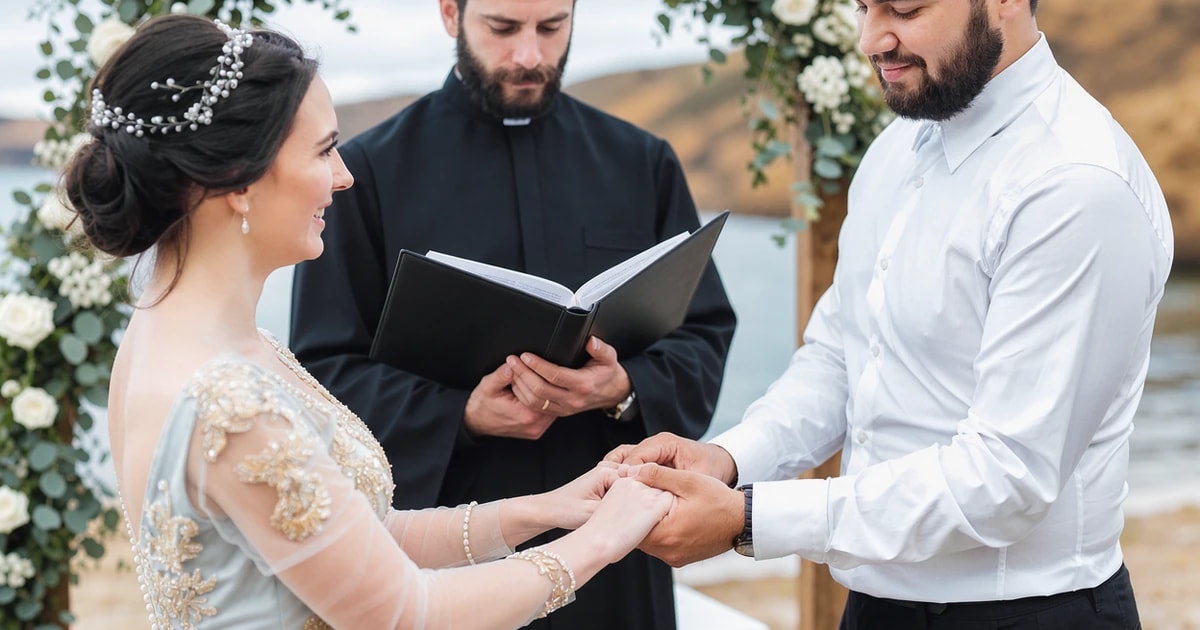
Most ceremony advice explains what happens at the altar. Very little gives you the words, and the words are what someone has to stand up and say, often a friend who has never officiated before. Each script here can be read aloud with nothing added but names.
What a wedding ceremony script is?
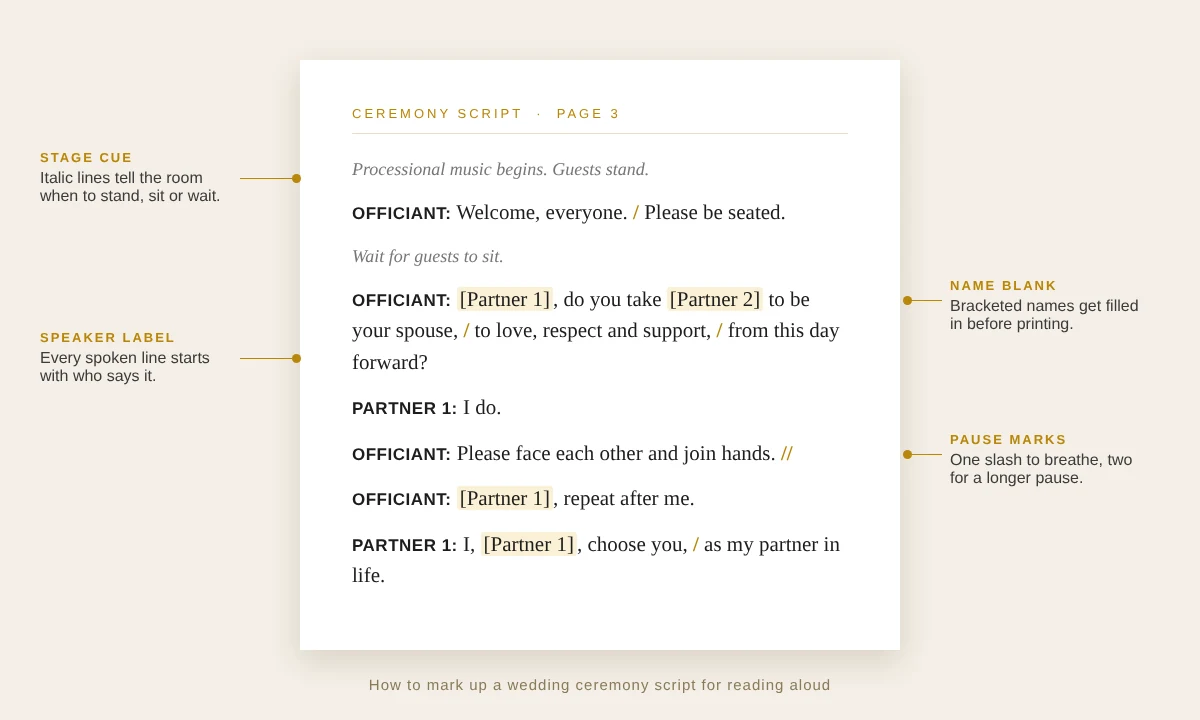
A wedding ceremony script is the complete spoken text of a ceremony, written out in order with a speaker label on every line. The officiant reads most of it. The couple speaks the declaration of intent, the vows and the ring lines, and any readers have their own marked slots.
Unlike an outline, which only lists the parts, a script gives the words and the stage cues: when the music starts, when guests stand and sit, when the rings come out.
What does every wedding ceremony script need legally?
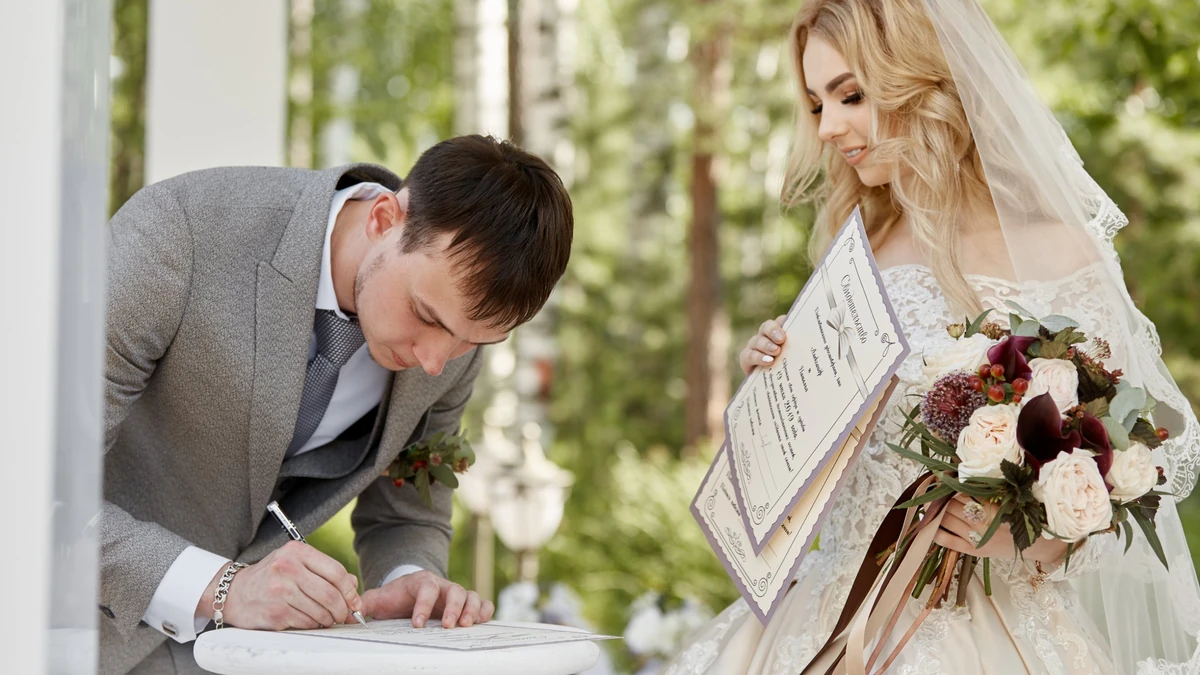
Every script needs one legal moment: both partners declaring that they take each other as spouses, in front of the officiant and the witnesses your state requires. The marriage license is signed afterward. Almost everything else is your choice.
California’s Family Code §420 says “no particular form for the ceremony of marriage is required,” provided the couple makes that declaration in the physical presence of the officiant and the necessary witnesses. New York’s Domestic Relations Law §12 sets the same rule, with at least one witness besides the officiant.
The officiant must be legally allowed to marry people where the wedding takes place. New York, for example, lets a town or city clerk issue a one-day marriage officiant license, so a friend can officiate a single ceremony.
Some states let couples marry themselves. For Colorado self-solemnization, the Denver Clerk and Recorder says “neither witnesses nor officiant are required.” Pennsylvania’s self-uniting license lets the couple officiate their own ceremony, with two witnesses signing.
Rules vary by state and county, so confirm the details with the county clerk who issues your license.
The one line you can’t cut: each partner saying they take the other as their spouse. All three scripts below include it.
What goes into a ceremony script, and how long does it run?
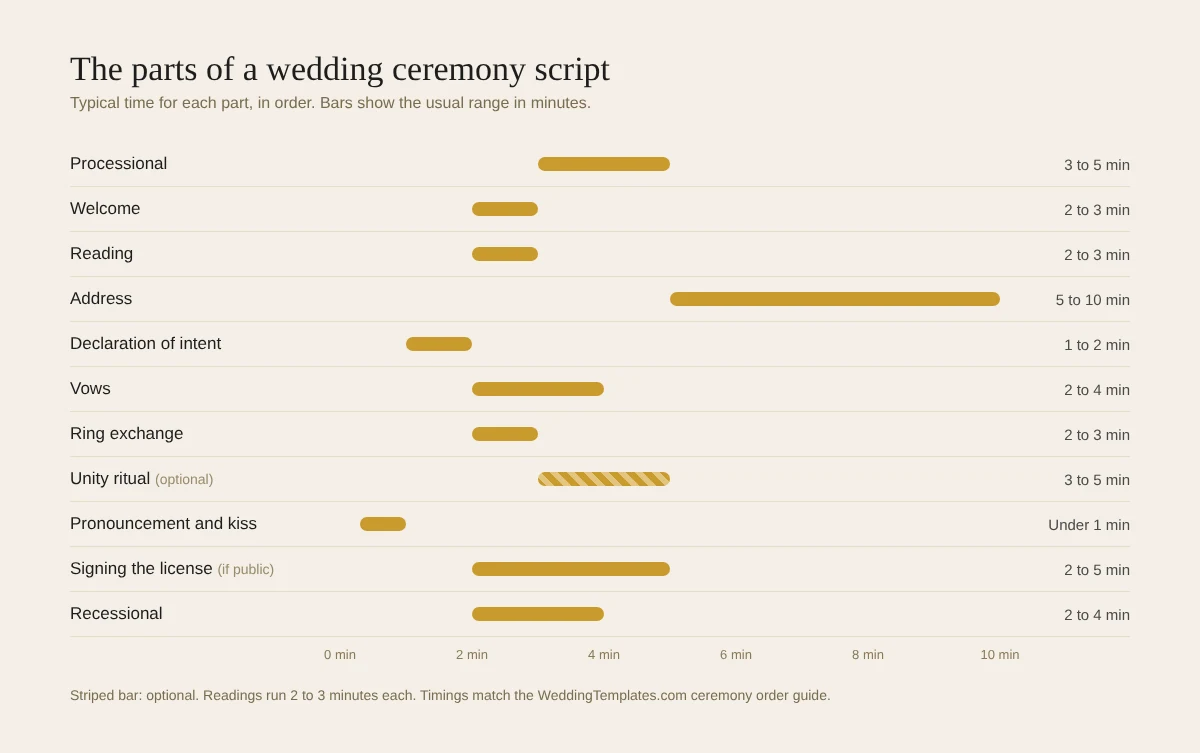
Most scripts run through the same parts, from processional to recessional, and the table below gives the usual minutes for each. Read aloud, the words of the three scripts that follow take about 3 to 7 minutes. Music, walking and pauses fill the rest of the ceremony.
Part | Typical time |
Processional | 3 to 5 min |
Welcome | 2 to 3 min |
Reading | 2 to 3 min each |
Address | 5 to 10 min |
Declaration of intent | 1 to 2 min |
Vows | 2 to 4 min |
Ring exchange | 2 to 3 min |
Unity ritual (optional) | 3 to 5 min |
Pronouncement and kiss | Under 1 min each |
Signing the license (if public) | 2 to 5 min |
Recessional | 2 to 4 min |
For the full sequence, including seating the parents, see our guide to wedding ceremony order.
Conversational speech runs about 150 words a minute, according to the National Center for Voice and Speech. Ceremonies run slower, with pauses for laughter and vows fed a phrase at a time, so each script shows a reading time measured aloud at a calm pace. Music cues appear in italics, and choosing the songs is covered in our guide to ceremony music.
Traditional wedding ceremony script
Reading time: about 6 minutes at a calm ceremony pace, plus the reading
Built on the 1662 Book of Common Prayer, the source of “Dearly beloved” and “to have and to hold,” lightly updated for an American ceremony. It doubles as a Christian ceremony script; drop the lines marked [Optional] for a less religious version. Where a traditional line doesn’t suit every family, an alternative sits beneath it.
Prelude music plays as guests are seated. The officiant and the groom take their places at the front.
Processional music begins. The wedding party enters, then the bride with her escort. Guests stand.
Officiant: Dearly beloved, we are gathered together here in the sight of God, and in the presence of these witnesses, to join together this man and this woman in holy matrimony.
Alternative: “…to join together [Bride] and [Groom] in holy matrimony.”
Officiant: Marriage is an honorable estate, not to be entered into lightly, but reverently, thoughtfully and with a full heart. Into this holy estate [Bride] and [Groom] now come to be joined.
Officiant: Who gives this woman to be married to this man?
Escort: Her mother and I do.
Alternative: “Who supports [Bride] and [Groom] in this marriage?” Both families answer: “We do.”
The escort places the bride’s hand in the groom’s and takes a seat.
Officiant: Please be seated.
Officiant: [Optional] Let us pray. Gracious God, bless [Bride] and [Groom] as they make their promises today. Give them patience with each other, joy in each other, and a love that grows deeper every year. Amen.
Officiant: [Reader’s name] will now read from [book and passage].
Reader: [Reading]
Officiant: [Bride] and [Groom], marriage asks a great deal of two people. It asks you to be patient when patience is hard, honest when honesty costs something, and faithful on ordinary days as well as on this one. The promises you make today don’t finish that work. They begin it.
Officiant: [Groom], will you have [Bride] to be your wife, to live together in holy marriage? Will you love her, comfort her, honor and keep her, in sickness and in health, and, forsaking all others, be faithful to her as long as you both shall live?
Groom: I will.
Officiant: [Bride], will you have [Groom] to be your husband, to live together in holy marriage? Will you love him, comfort him, honor and keep him, in sickness and in health, and, forsaking all others, be faithful to him as long as you both shall live?
Bride: I will.
This exchange is the declaration of intent, the part the law requires. Keep it in every version.
Officiant: Please face each other and join hands. [Groom], repeat after me.
The officiant reads the vow a phrase at a time, and the groom repeats each phrase.
Groom: I, [Groom], take you, [Bride], to be my wife, to have and to hold from this day forward, for better, for worse, for richer, for poorer, in sickness and in health, to love and to cherish, till death do us part.
Officiant: [Bride], repeat after me.
Bride: I, [Bride], take you, [Groom], to be my husband, to have and to hold from this day forward, for better, for worse, for richer, for poorer, in sickness and in health, to love and to cherish, till death do us part.
The 1662 wording added “and to obey” to the bride’s vow. Most couples now make the same promise to each other.
Officiant: May I have the rings?
Officiant: [Groom], place the ring on [Bride]’s finger and repeat after me.
Groom: With this ring I thee wed.
Officiant: [Bride], place the ring on [Groom]’s finger and repeat after me.
Bride: With this ring I thee wed.
Modern alternative for either partner: “With this ring, I marry you.”
Officiant: [Optional] The Lord bless you and keep you. The Lord makes his face shine upon you and be gracious to you. The Lord lifts up his countenance upon you and gives you peace. Amen.
Officiant: Those whom God has joined together, let no one put asunder.
Officiant: [Groom] and [Bride] have given themselves to each other by solemn vows, by the joining of hands, and by the giving and receiving of rings. By the authority vested in me by the State of [state], I now pronounce you man and wife.
Alternatives: “husband and wife,” or, for any couple, “I now pronounce you married.”
Officiant: You may kiss the bride.
Alternative: “You may now kiss.” The officiant steps to one side so the photographer has a clear shot.
Officiant: Ladies and gentlemen, it is my honor to present, for the first time, Mr. and Mrs. [Surname].
Alternative: “Friends and family, please welcome the newlyweds, [Bride] and [Groom]!”
Recessional music begins. The couple leaves first, followed by the wedding party.
After the ceremony, the couple, officiant and witnesses sign the marriage license.
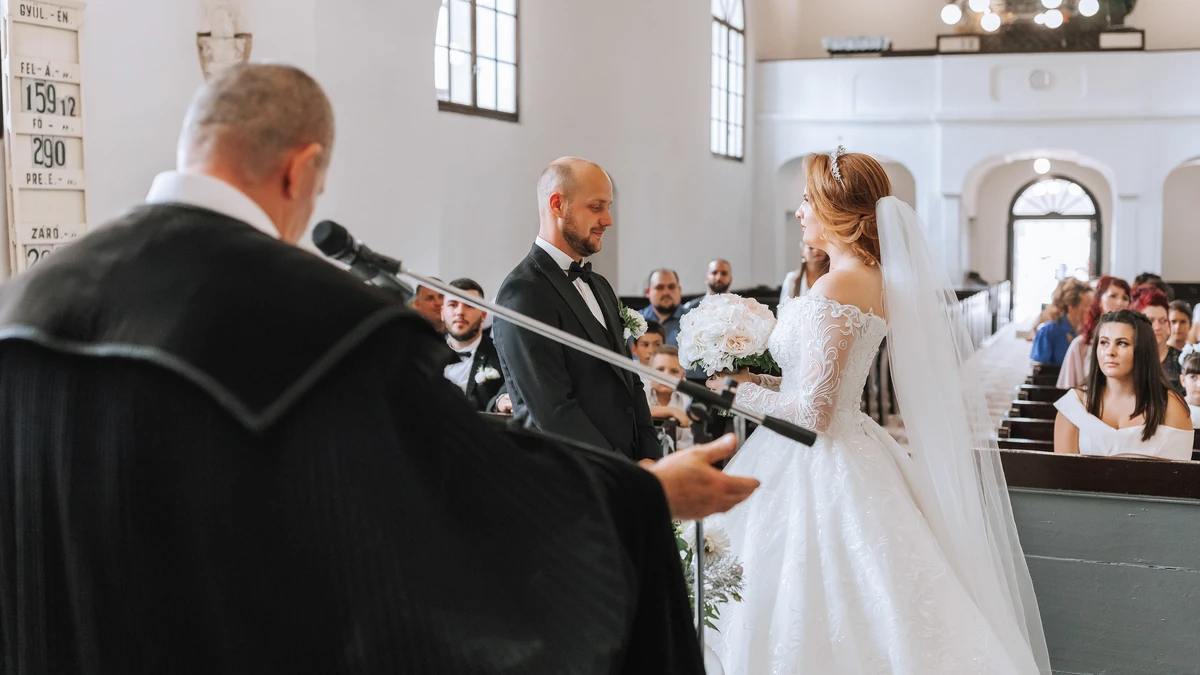
Non-religious wedding ceremony script
Reading time: about 7 minutes at a calm ceremony pace, plus the reading
No religious content, so it suits secular, modern and non-denominational ceremonies. The bracketed prompts are where the officiant tells the couple’s story, and specifics only their friends would recognize are what stop it sounding generic.
Processional music begins. Guests stand as [Partner 1] and [Partner 2] enter and take their places.
Officiant: Welcome, everyone. Please be seated.
Officiant: My name is [Officiant], and I’ve known [Partner 1] since [how you know them]. On behalf of [Partner 1] and [Partner 2], thank you for being here. Some of you traveled a long way to be in this room, and every one of you has played a part in getting them to this day. When they pictured making these promises, they pictured you here to hear them.
Officiant: [Partner 1] and [Partner 2] met [where and how they met]. [One or two sentences about an early moment: a first date, a first impression, or the moment one of them knew.]
Officiant: Since then, they’ve [a milestone or two: moved cities, bought a house, adopted a dog, survived a kitchen renovation]. What I notice most about them together is [a quality you’ve seen in them as a couple], like the time [a short, specific example].
Officiant: They’ve asked [Reader’s name], [Partner 1]’s [relationship], to share a reading.
Reader: [Reading]
Officiant: Thank you, [Reader’s name].
Officiant: Neither of them is perfect, and neither expects the other to be. What they have is better: they make each other braver and kinder, and they laugh at the same terrible jokes.
Officiant: Marriage isn’t one promise made once. It’s the same promise, kept in a thousand small ways: coffee made for someone who’s running late, listening when you’d rather talk, kindness when you’re tired. Today [Partner 1] and [Partner 2] make that promise out loud, in front of the people who will help them keep it.
Officiant: [Partner 1], do you take [Partner 2] to be your spouse, to love, respect and support, from this day forward?
Partner 1: I do.
Officiant: [Partner 2], do you take [Partner 1] to be your spouse, to love, respect and support, from this day forward?
Partner 2: I do.
Officiant: And will all of you, their family and friends, support [Partner 1] and [Partner 2] in their marriage? If so, please answer, “We will.”
Guests: We will.
Officiant: Please face each other and join hands. [Partner 1], repeat after me.
Partner 1: I, [Partner 1], choose you, [Partner 2], as my partner in life. I promise to love you, to laugh with you, to support your dreams and to stand by you when things are hard. I will be honest with you, I will listen to you, and I will keep choosing you, today and every day after.
Officiant: [Partner 2], repeat after me.
Partner 2: I, [Partner 2], choose you, [Partner 1], as my partner in life. I promise to love you, to laugh with you, to support your dreams and to stand by you when things are hard. I will be honest with you, I will listen to you, and I will keep choosing you, today and every day after.
Personal vows replace the repeat-after-me vows here. Each partner reads from a card that the officiant has kept safe until this moment.
Officiant: Rings have no beginning and no end. [Partner 1] and [Partner 2] will now exchange them as a sign of the promises they’ve just made.
Officiant: [Partner 1], place the ring on [Partner 2]’s finger and repeat after me.
Partner 1: [Partner 2], I give you this ring as a symbol of my love. Wear it and know that I am yours.
Officiant: [Partner 2], place the ring on [Partner 1]’s finger and repeat after me.
Partner 2: [Partner 1], I give you this ring as a symbol of my love. Wear it and know that I am yours.
Officiant: [Partner 1] and [Partner 2], you’ve made your promises in front of the people who love you most. By the authority vested in me by the State of [state], it is my great joy to pronounce you married.
Officiant: You may kiss.
The officiant steps to one side for the photo.
Officiant: Everyone, please stand and welcome, for the first time as a married couple, [Partner 1] and [Partner 2]!
Recessional music begins.
Officiant: [Optional] Please join the couple at [venue] for drinks, dinner and dancing.
After the ceremony, the couple, officiant and witnesses sign the marriage license.
In The Knot’s 2026 Real Weddings Study of 10,474 couples married in 2025, 61% wrote their own vows. If you’re doing the same, here’s how to [write your own vows].
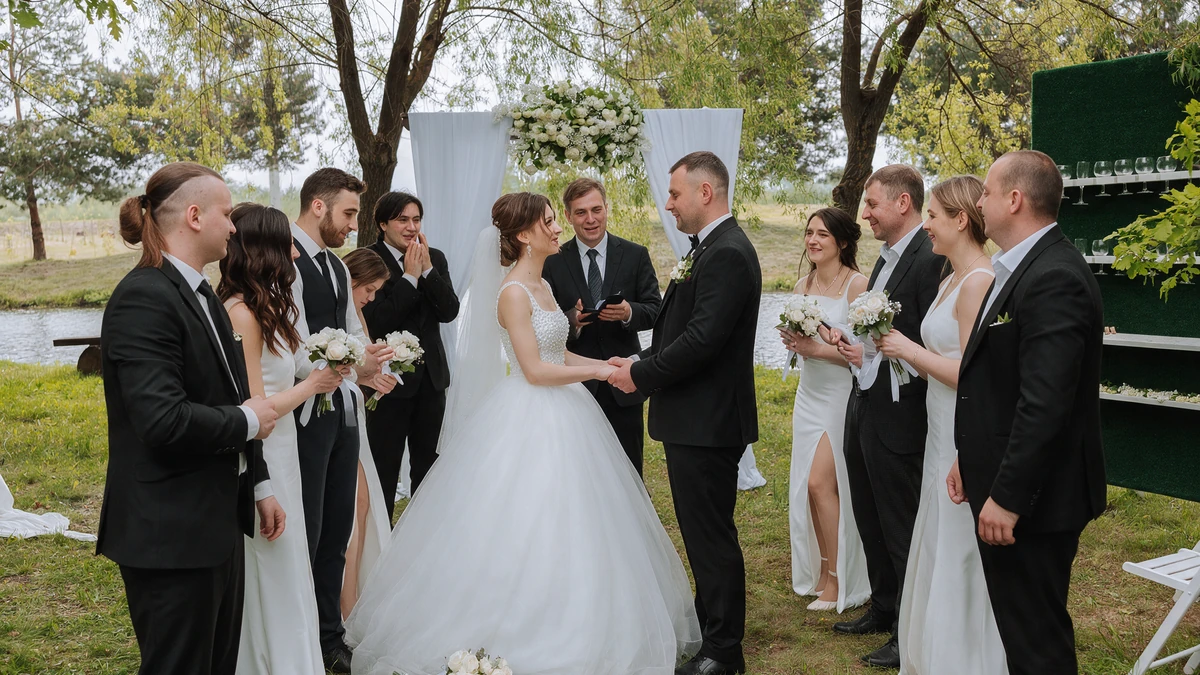
Short and sweet wedding ceremony script
Reading time: about 3 minutes at a calm ceremony pace
The legal core with a warm welcome and close, for courthouse weddings, elopements and small ceremonies. With a short processional, the whole ceremony takes about 10 minutes. At a courthouse, ask whether the judge or clerk will use your wording.
Processional music begins, if there is one. The couple takes their places.
Officiant: Welcome, everyone, and thank you for being here. We’re here to witness the marriage of [Partner 1] and [Partner 2], and to celebrate with them.
Officiant: A marriage doesn’t need a big room or a long speech. It needs two people who mean what they say, and that is exactly what we have here. [Partner 1] and [Partner 2], you’ve already built a life together. Today you make it official, in front of the people you love most.
Officiant: [Partner 1], do you take [Partner 2] to be your spouse, to love and to cherish, from this day forward?
Partner 1: I do.
Officiant: [Partner 2], do you take [Partner 1] to be your spouse, to love and to cherish, from this day forward?
Partner 2: I do.
Officiant: Please face each other and join hands. [Partner 1], repeat after me.
Partner 1: I promise to love you, to support you, and to be your partner in everything, for the rest of our lives.
Officiant: [Partner 2], repeat after me.
Partner 2: I promise to love you, to support you, and to be your partner in everything, for the rest of our lives.
Officiant: [Partner 1], place the ring on [Partner 2]’s finger and repeat after me.
Partner 1: With this ring, I marry you.
Officiant: [Partner 2], place the ring on [Partner 1]’s finger and repeat after me.
Partner 2: With this ring, I marry you.
Officiant: [Partner 1] and [Partner 2], you’ve made your promises to each other, and we’ve all heard them. By the authority vested in me by the State of [state], I now pronounce you married. You may kiss!
Officiant: Friends and family, please welcome the newlyweds, [Partner 1] and [Partner 2]!
Recessional music begins.
After the ceremony, the couple, officiant and witnesses sign the marriage license.
Free printable scripts: all three, in large type with pause marks and blanks for names, ready to read from at the altar.
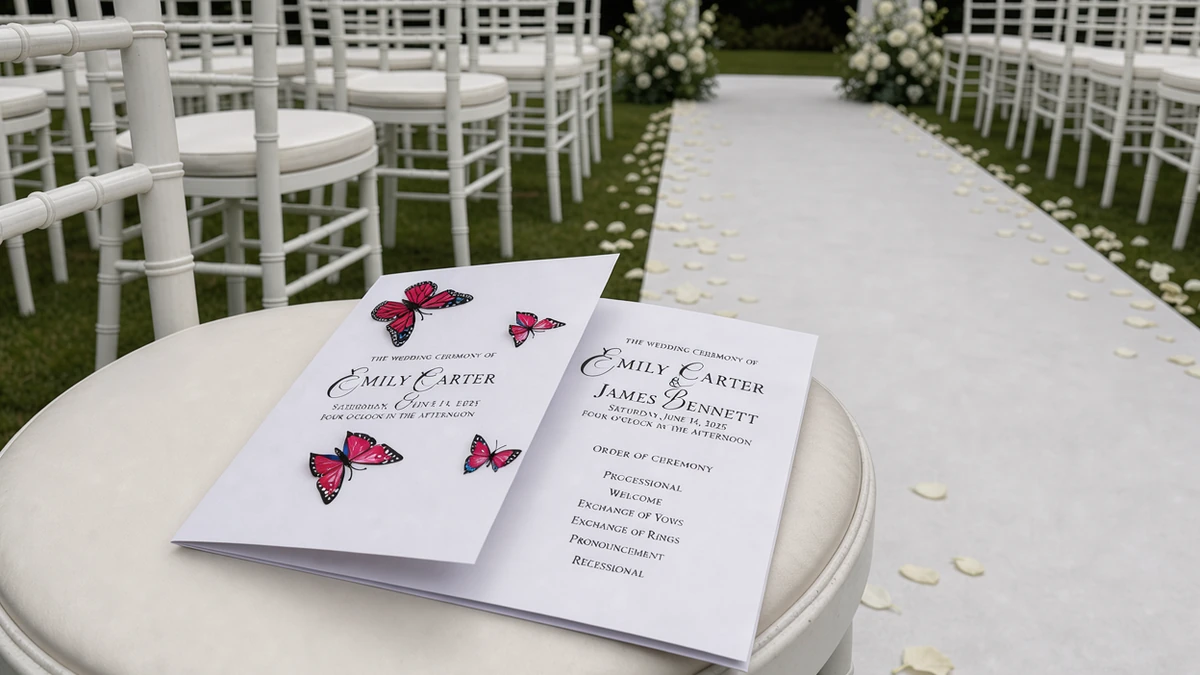
For a matching program, minimalist wedding programs suit a short running order.
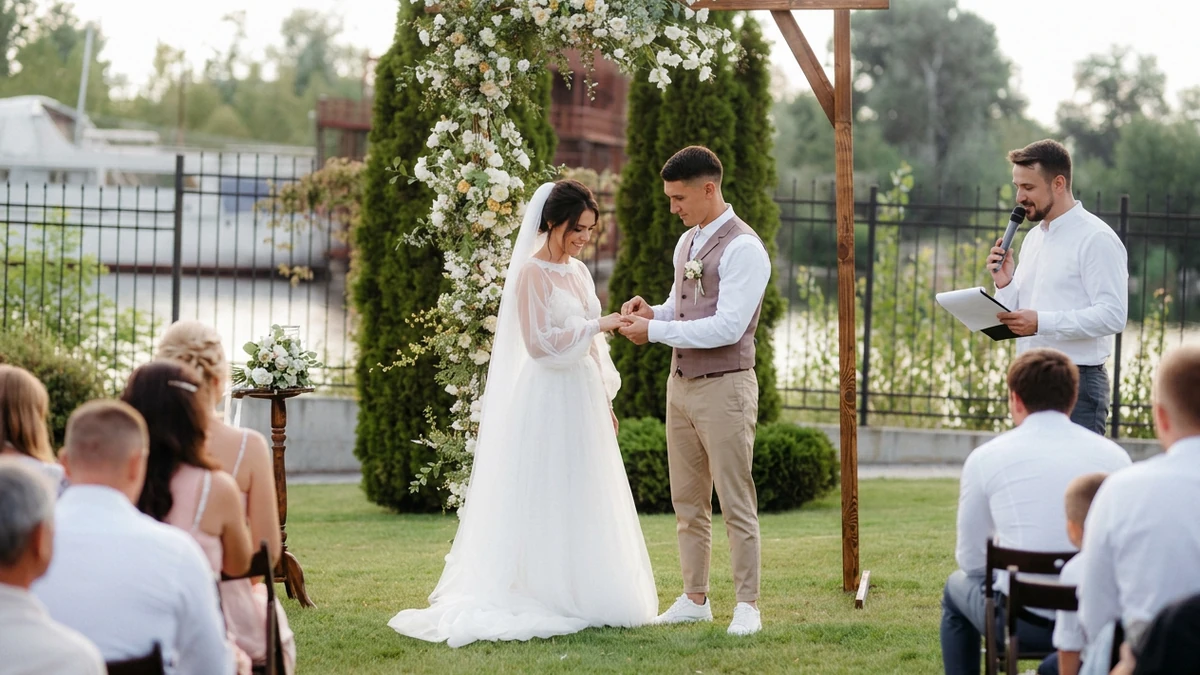
What lines can you swap into any ceremony script?
Each line below drops into any of the three scripts, replacing a line or adding a moment: an opening, an unplugged request, an alternative to the giving away, a remembrance, a reading or unity introduction, ring lines, a pronouncement for any couple, or a little humor.
Openings and an unplugged request
Officiant: Good afternoon, everyone. You’re about to hear two people make the biggest promise of their lives.
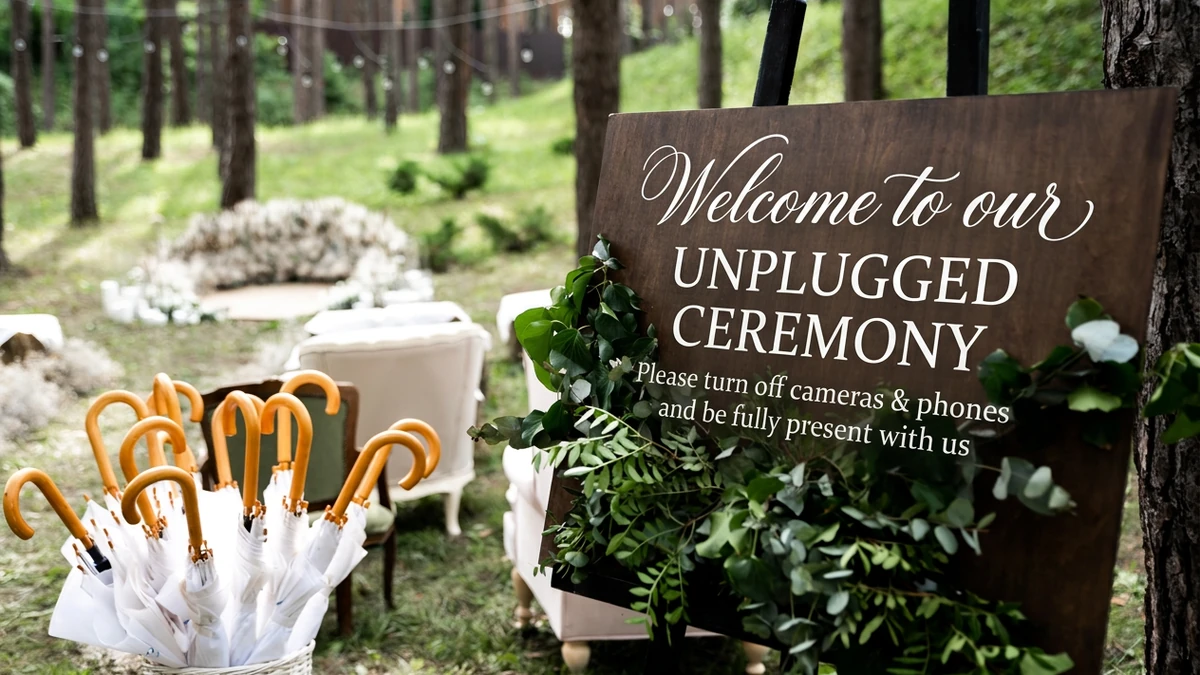
An unplugged ceremony sign at the entrance does half the work; the officiant finishes it after the welcome:
Officiant: [Partner 1] and [Partner 2] have asked for an unplugged ceremony. Please put your phones away. The photographer has it covered, and the couple would rather see your faces than your screens.
Instead of “Who gives this woman”
Officiant: Who supports [Partner 1] and [Partner 2] in this marriage? Both families answer: “We do.”
Officiant: Will both families please stand? Do you give your blessing to this marriage? Families answer: “We do.”
If the bride walks with her mother or alone, skip the question. Both are perfectly acceptable, according to the Emily Post Institute.
Remembering someone who has died
Spoken tribute: Before we begin, we remember [Name], [Partner 1]’s [relationship], who is deeply missed today.
Moment of silence: Let’s take a quiet moment to remember those who can’t be with us.
Reserved seat: The seat in the front row holds [a photo or flowers] for [Name], so they are with us today.
Many couples carry the same tribute onto their invitations; here’s how to word it when honoring a parent who has died.
Readings, unity and rings
Officiant: [Reader’s name], [Partner 1]’s [relationship], will now share a reading.
For what to read, see our collection of wedding readings.
Officiant: [Partner 1] and [Partner 2] will now pour two colors of sand into one vase. Like the grains, their lives from today can’t be separated.
For candles, handfasting and more, see our unity ceremony ideas.
For the ring exchange, either line works in any script:
Partner: I give you this ring as a sign of my love and faithfulness.
Partner: With this ring, I choose you, today and every day.

Pronouncements, presentations and a little humor
Officiant: By the authority vested in me by the State of [state], it is my honor to pronounce you married.
Officiant: For the first time as a married couple, please welcome [Partner 1] and [Partner 2]!
Officiant: [Partner 1] and [Partner 2] asked me to keep this short. I said yes. We’ll see how that goes.
Officiant: If anyone objects, speak now or forever hold your peace. And while you’re holding it, hold your phone too.
Sending guests to the reception
Officiant: Please stay seated until the wedding party has left, then join [Partner 1] and [Partner 2] at [venue] for dinner and dancing.
For what happens next, see our reception timeline.
What if your faith sets the script?
In many religious ceremonies, the words aren’t yours to write. Catholic, Jewish, Episcopal and many Protestant weddings follow their tradition’s rite, and couples choose among set options rather than drafting new text. Ask the officiant early what can change, and see how religious and civil ceremonies differ.
Catholic
The couple declares consent using one of four Church-approved formulas, two spoken by the couple and two asked by the priest, and does not write custom vows. The U.S. Conference of Catholic Bishops publishes the approved consent formulas. The texts are copyrighted, so don’t reprint them in a program.
Jewish
A rabbi or cantor leads the ceremony. Reform Judaism lists the core rituals: the betrothal blessings over wine, the ring declaration (“Behold, you are consecrated to me with this ring, in accordance with the laws of Moses and Israel”), the ketubah reading, the seven blessings and breaking the glass. Wording varies by community, so the rabbi sets it.
Episcopal and Protestant
Episcopal weddings use “The Celebration and Blessing of a Marriage” from the 1979 Book of Common Prayer (page 423), with much of the wording fixed. Many Protestant churches have their own order of service, and the traditional script above is close to what many pastors use. Hindu, Muslim, Sikh, Orthodox and other ceremonies follow their own rites too; start with the officiant, not a template.
How do you finalize, rehearse and print the script?
Agree on tone and length with the officiant, then draft from the closest script above. Read it aloud, time it, and rewrite anything that trips you up. Send the final version to the officiant four to six weeks before the wedding, rehearse it once with everyone who speaks, and print a large-type copy for the altar.
Tips for reading the officiant script aloud
In The Knot’s 2026 study, 67% of couples who spent under $12,000 relied on a friend officiant. If that’s you:
• Print it big: 16- to 18-point type, double-spaced, in a plain folder held at chest height.
• Mark the page: a slash (/) to breathe, and cues such as “Guests stand” in a second color.
• Practice every name with the couple until the pronunciation is automatic.
• Step aside for the kiss, so the photo shows the couple, not you.
• Bring a pen for the license, and ask the county clerk in advance who returns it and by when.
Once the script is final, the program almost writes itself: the parts become its running order, and readers get their names in print. Start with our printable wedding programs, or see how other couples lay theirs out in our wedding program examples. The free printable scripts sit alongside them.
Key Takeaways
Conversational speech runs about 150 words a minute, but ceremony delivery is slower, so time any script by reading it aloud.
An officiant can replace “Who gives this woman to be married to this man?” by asking who supports the couple and letting both families answer “We do.”
Catholic couples declare consent using one of four formulas approved by the Church and do not write their own vows.
The final ceremony script should reach the officiant four to six weeks before the wedding, leaving time to rehearse it aloud.
A friend officiant should step to one side before the kiss so the photo shows only the couple.
Frequently Asked Questions
What does the officiant say when marrying two people?
The officiant welcomes guests, then leads the declaration of intent (“Do you take [Partner 2] to be your spouse?”), the vows, the ring exchange and the pronouncement: “By the authority vested in me by the State of [state], I now pronounce you married.” Readings fit around that core.
What words are legally required in a wedding ceremony?
No particular words, in states such as California and New York. Both partners must declare that they take each other as spouses, in front of the officiant and the required witnesses, and the license is then signed. Rules vary, so confirm with the county clerk who issues your license.
How long should a wedding ceremony script be?
Most scripts run about 300 to 900 words, which takes roughly 3 to 7 minutes to read aloud at a ceremonial pace. Conversation runs about 150 words a minute (National Center for Voice and Speech), but altar delivery is slower, and music and the processional add time the script doesn’t show.
Who writes the wedding ceremony script?
Usually the officiant drafts it with the couple. Clergy work from their tradition’s rite. When a friend officiates, the couple often writes the script and the officiant adjusts it so it sounds like them. Either way, the couple approves the final version before the rehearsal.
What are the traditional vows for a Baptist wedding?
There’s no single required wording, because each Baptist church is “an autonomous local congregation,” in the words of the Baptist Faith and Message. Many use the traditional Protestant vow, “I take you to be my wife (or husband), to have and to hold… till death do us part.” Confirm with your pastor.
Can you write your own vows in a Catholic wedding?
No. Catholic couples declare consent using one of the Church’s approved formulas, published by the U.S. Conference of Catholic Bishops. Personal words still have a place: exchange letters before the ceremony, share them in a toast at the reception, or ask the priest whether anything else can be included.
What do you say during the ring exchange?
Each partner places the ring and repeats a short line after the officiant. The traditional line, from the 1662 Book of Common Prayer, is “With this ring I thee wed.” A modern version: “I give you this ring as a symbol of my love.”
What can the officiant say instead of “Who gives this woman”?
Ask “Who supports [Partner 1] and [Partner 2] in this marriage?” so both families answer “We do,” or invite both families to stand and give their blessing. Or drop the question. Being escorted by a mother, or walking alone, is also acceptable, according to the Emily Post Institute.
Ready for the rest of your ceremony stationery?
Your script sets the running order for the day, and everything guests hold should match it. Our matching wedding day stationery pairs programs, place cards, menus and table numbers in one style, so the ceremony and reception look like one day.