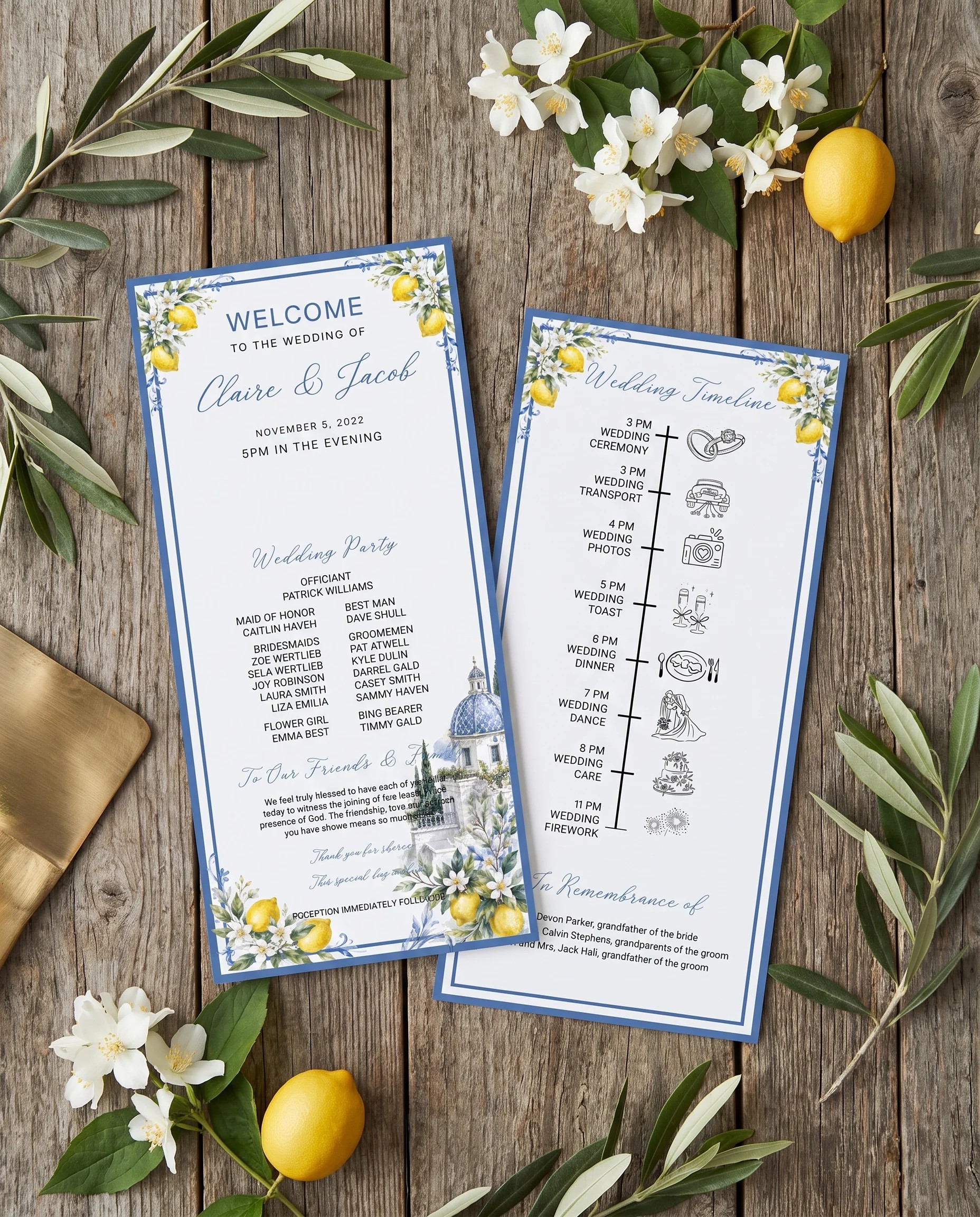
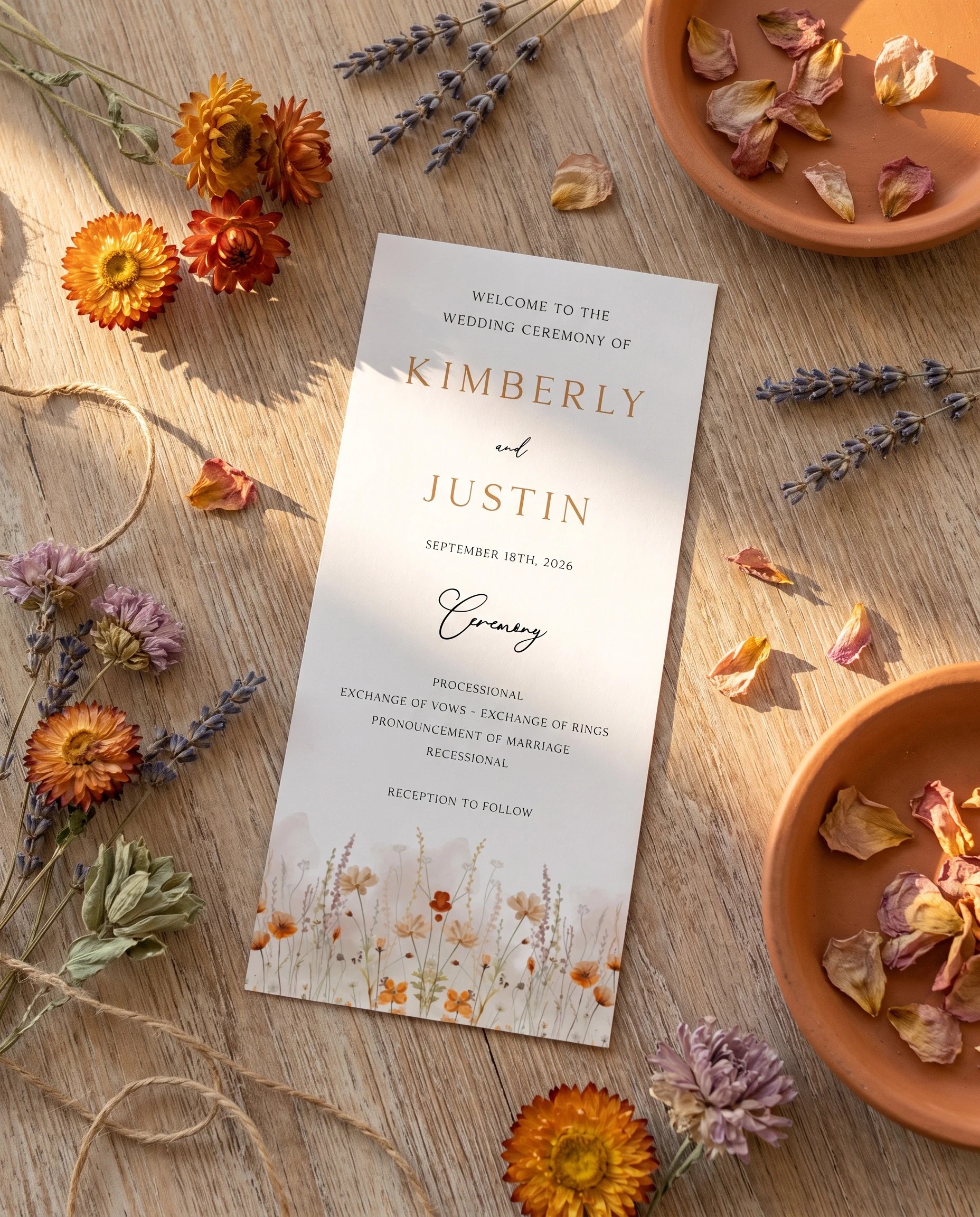
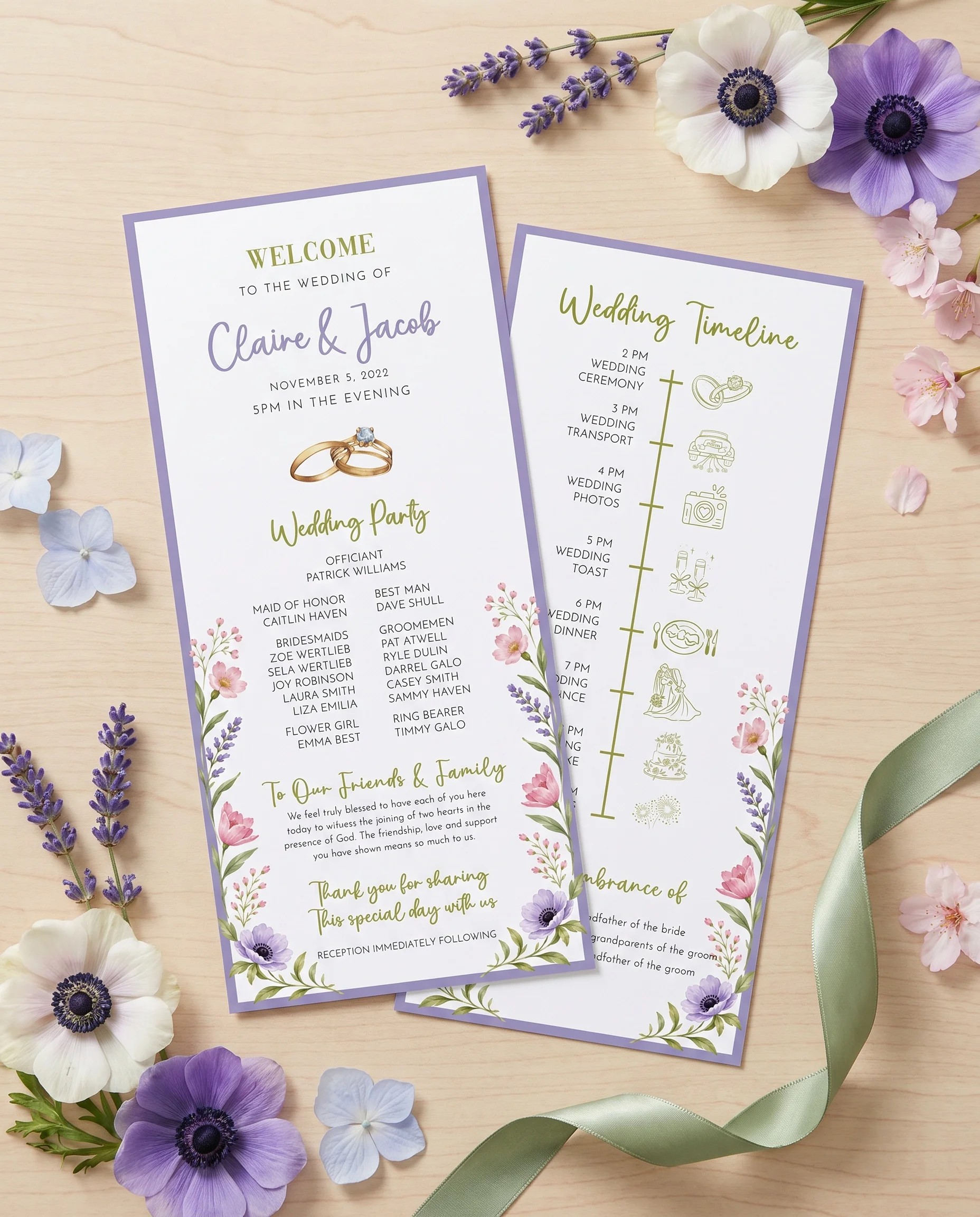
Wedding Program Examples: Sample Programs for Every Ceremony
A wedding program lists your names, the date and venue, the order of ceremony, everyone taking part, and the titles and authors of readings and music. Add the words of anything guests say or sing. A flat card holds a 20-minute ceremony; a Catholic Mass or several readings needs a folded booklet.
Most programs get written in the last month, often late at night, by someone who has just noticed the officiant’s outline uses words like Collect and Kiddushin. These wedding program examples are written out in full, so you can copy the one closest to your ceremony and change the names.
There are six: civil, Protestant, Catholic with and without Mass, Jewish and interfaith. Each sample program follows the order set by the church or faith body behind it, linked so you can check it. After them come 30 short lines for each part of a program, the formats that suit each ceremony, and the steps to make your own.
What should a wedding program include?
A wedding program should include your names, the date and venue, the order of events, who performs each part, and the titles and authors or composers of any readings and music. Print the words of anything guests are asked to say or sing. Everything else, from a welcome note to a tribute, is optional.
That list follows the Emily Post Institute’s guidance on printed items for your wedding, which also notes that programs aren’t required.
Part | Required or optional | What goes in it |
Your names | Required | First and last names, as you want guests to read them |
Date and venue | Required | Day, date, time, venue, city and state |
Order of events | Required | Each part, in the order your officiant gives you |
Who performs each part | Required | Officiant, readers, musicians, anyone leading a ritual |
Readings and music | Required | Title and author or composer; citation for scripture |
Words guests say or sing | Required | Responses, hymn verses, a shared reading |
Welcome note | Optional | Two or three sentences |
Wedding party | Optional | Names only on a formal program |
Explanations of traditions | Optional | One line per ritual |
In memory | Optional | One line or a short paragraph |
Thank-you | Optional | One or two sentences, signed with first names |
Unplugged note | Optional | One sentence |
Registry and website details stay off. Our ceremony order guide covers what belongs on a program and what to leave off.
Wedding program examples for every ceremony
Each program below runs in the order a guest reads it: cover, welcome, order of ceremony with everyone taking part, wedding party, a note for guests and a thank-you. Copy the one closest to your ceremony, swap in your names, and keep the order your officiant gives you.
Orders vary by church and officiant. Confirm yours with whoever is marrying you before printing. Our ceremony script guide shows how the spoken words and the printed order line up.
Civil or secular wedding program
A civil or secular ceremony runs about 20 minutes, which fits one side of a flat card with the wedding party on the back.
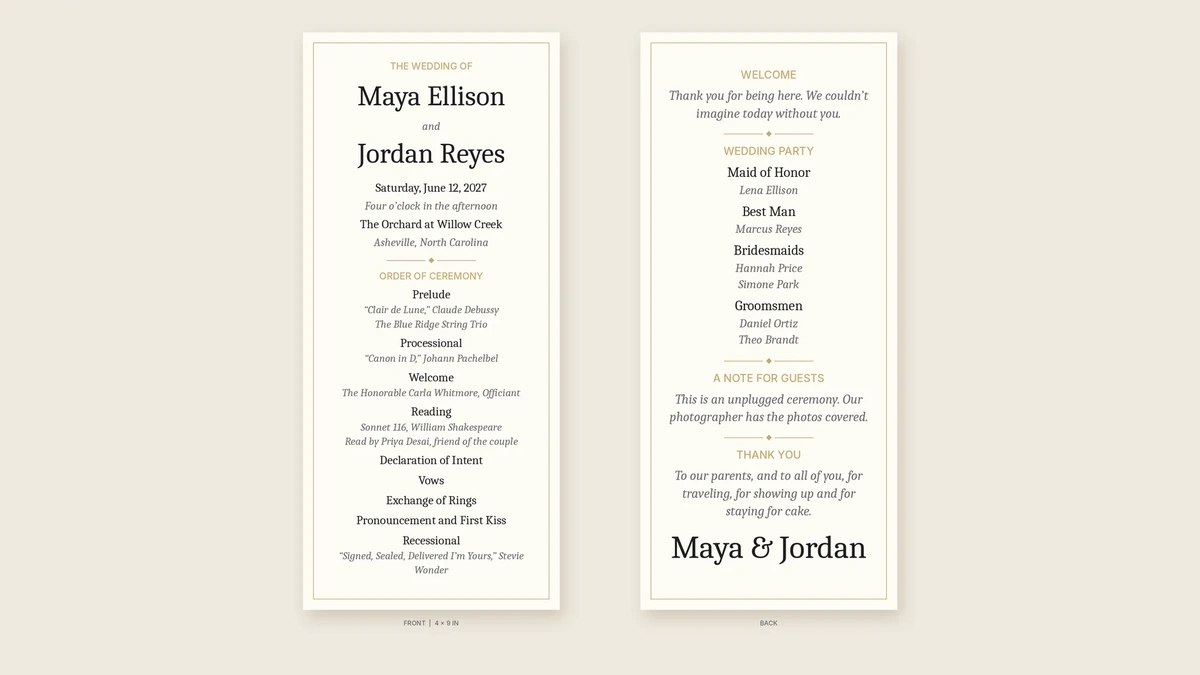
Maya Ellison and Jordan Reyes Saturday, June 12, 2027 | Four o’clock in the afternoon The Orchard at Willow Creek | Asheville, North Carolina WELCOME Thank you for being here. We couldn’t imagine today without you. ORDER OF CEREMONY Prelude “Clair de Lune,” Claude Debussy | The Blue Ridge String Trio Processional “Canon in D,” Johann Pachelbel Welcome The Honorable Carla Whitmore, Officiant Reading Sonnet 116, William Shakespeare | Read by Priya Desai, friend of the couple Declaration of Intent Vows Exchange of Rings Pronouncement and First Kiss Recessional “Signed, Sealed, Delivered I’m Yours,” Stevie Wonder WEDDING PARTY Maid of Honor: Lena Ellison | Best Man: Marcus Reyes Bridesmaids: Hannah Price, Simone Park | Groomsmen: Daniel Ortiz, Theo Brandt A NOTE FOR GUESTS This is an unplugged ceremony. Our photographer has the photos covered. THANK YOU To our parents, and to all of you, for traveling, for showing up and for staying for cake. Love, Maya and Jordan |
Protestant wedding program, using the Episcopal order
Protestant churches each use their own service book, so this example follows one of the most widely used: The Celebration and Blessing of a Marriage in the Book of Common Prayer (1979). Other churches’ orders differ, so use the one your minister gives you. The 1979 prayer book is in the public domain, so the congregation’s response can be printed in full.
The Celebration and Blessing of a Marriage Grace Whitfield and Samuel Okoro Saturday, May 22, 2027 | Two o’clock in the afternoon Church of St. Columba | Lexington, Kentucky The Reverend Anne Delacroix, Celebrant WELCOME Thank you for witnessing our marriage and praying with us today. ORDER OF SERVICE Entrance Hymn: “Praise, My Soul, the King of Heaven,” words by Henry Francis Lyte, music by John Goss Opening Words The Declaration of Consent When asked to uphold this marriage, please answer: We will. The Presentation Ruth and Daniel Whitfield, parents of the bride The Ministry of the Word Song of Solomon 2:10-13; 8:6-7 | Read by Elise Whitfield, sister of the bride Psalm 128 | Sung by the choir 1 Corinthians 13:1-13 | Read by Kwame Mensah, friend of the groom Homily The Marriage The Vows The Blessing and Giving of Rings The Pronouncement The Prayers Led by Joseph Okoro, brother of the groom The Blessing of the Marriage The Peace Recessional Hymn: “Joyful, Joyful, We Adore Thee,” words by Henry van Dyke, music by Ludwig van Beethoven WEDDING PARTY Maid of Honor: Elise Whitfield | Best Man: Joseph Okoro Bridesmaids: Naomi Hart, Clara Benson | Groomsmen: Kwame Mensah, Peter Lowe A NOTE FOR GUESTS At the Peace, Grace and Samuel greet each other first; then greet the people around you. THANK YOU Thank you for the years of friendship that brought each of you here. Grace and Samuel |
If Holy Communion follows, add it after the Peace and end the readings with a Gospel.
Catholic wedding program within Mass
A wedding Mass follows the Order of Celebrating Matrimony within Mass, set out part by part on the US bishops’ For Your Marriage page on the rite within Mass. At 60 to 90 minutes, it needs a folded booklet. List readings by citation; at least one must speak of marriage.
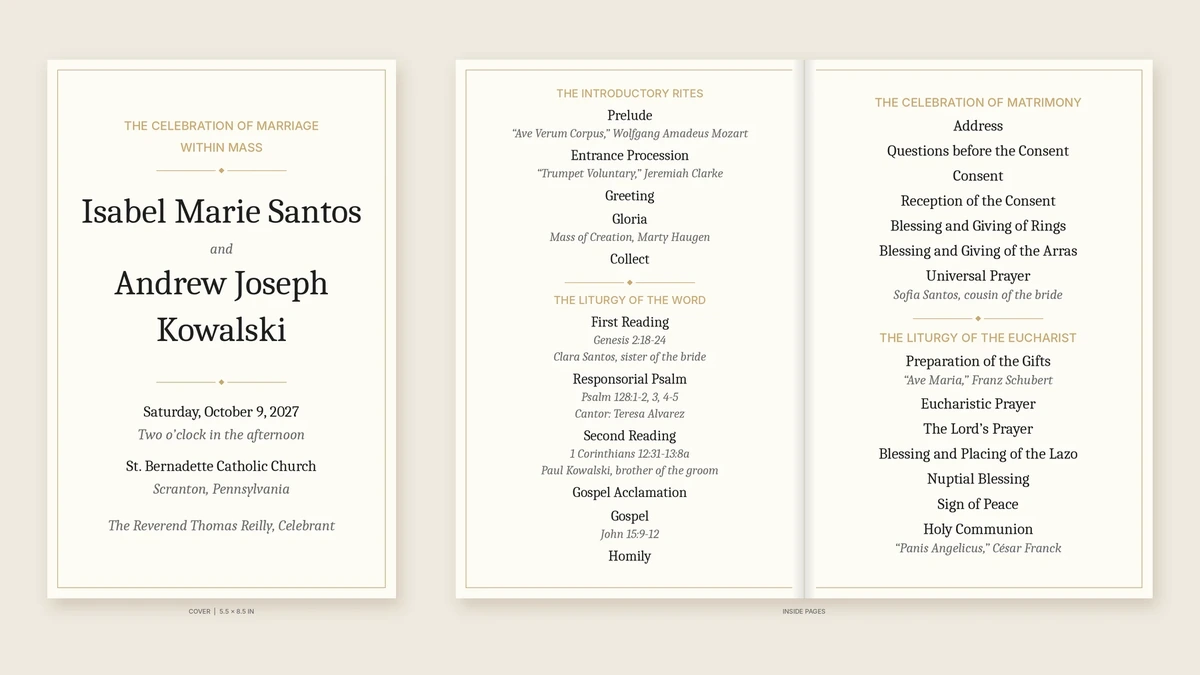
The Celebration of Marriage within Mass Isabel Marie Santos and Andrew Joseph Kowalski Saturday, October 9, 2027 | Two o’clock in the afternoon St. Bernadette Catholic Church | Scranton, Pennsylvania The Reverend Thomas Reilly, Celebrant WELCOME Thank you for praying with us as we begin our married life. THE INTRODUCTORY RITES Prelude: “Ave Verum Corpus,” Wolfgang Amadeus Mozart Entrance Procession: “Trumpet Voluntary,” Jeremiah Clarke Greeting Gloria: Mass of Creation, Marty Haugen Collect THE LITURGY OF THE WORD First Reading: Genesis 2:18-24 Clara Santos, sister of the bride Responsorial Psalm: Psalm 128:1-2, 3, 4-5 Cantor: Teresa Alvarez Second Reading: 1 Corinthians 12:31-13:8a Paul Kowalski, brother of the groom Gospel Acclamation Gospel: John 15:9-12 Homily THE CELEBRATION OF MATRIMONY Address Questions before the Consent Consent Reception of the Consent Blessing and Giving of Rings Blessing and Giving of the Arras Universal Prayer Sofia Santos, cousin of the bride THE LITURGY OF THE EUCHARIST Preparation of the Gifts: “Ave Maria,” Franz Schubert Eucharistic Prayer The Lord’s Prayer Blessing and Placing of the Lazo Nuptial Blessing Sign of Peace Holy Communion: “Panis Angelicus,” César Franck THE CONCLUSION OF THE CELEBRATION Solemn Blessing Dismissal Recessional: “Wedding March,” Felix Mendelssohn GUIDELINES FOR THE RECEPTION OF COMMUNION For Catholics | For our fellow Christians | For those not receiving Holy Communion | For non-Christians (Print the full text of all four sections here, copied from the US bishops’ page or from your parish’s version.) WEDDING PARTY Maid of Honor: Clara Santos | Best Man: Paul Kowalski Bridesmaids: Sofia Santos, Julia Novak | Groomsmen: Matthew Kowalski, Diego Ramos OUR TRADITIONS The arras, thirteen coins, promise a shared life. The lazo, a cord placed around the couple, is a sign of their union. THANK YOU Thank you to Father Reilly, our parents and all of you. Isabel and Andrew |
A wedding Mass program should carry the Communion guidelines. The US bishops’ Guidelines for the Reception of Communion are “to be included in missalettes and other participation aids,” and a wedding program is one.
Catholic wedding program without Mass
The bishops’ page on the rite outside of Mass says this form is used when a Catholic marries a baptized Christian of another denomination, when many guests aren’t Catholic, or when no priest is available. At 30 to 45 minutes, it fits a trifold.
Claire Dubois and Nathan Brooks Saturday, September 25, 2027 | Eleven o’clock in the morning Holy Family Catholic Church | Burlington, Vermont Deacon Robert Hale, Officiant WELCOME A special welcome to Nathan’s Methodist family. This is a Catholic wedding without Mass, so there is no Communion, and everyone is invited to pray with us. THE INTRODUCTORY RITES Entrance Procession: “Air on the G String,” Johann Sebastian Bach Greeting Collect THE LITURGY OF THE WORD First Reading: Tobit 8:4b-8 Amélie Dubois, sister of the bride Responsorial Psalm: Psalm 33:12 and 18, 20-21, 22 Second Reading: Romans 12:1-2, 9-18 Grant Brooks, brother of the groom Gospel Acclamation Gospel: Matthew 5:13-16 Homily THE CELEBRATION OF MATRIMONY Address Questions before the Consent Consent Reception of the Consent Blessing and Giving of Rings Universal Prayer The Lord’s Prayer Nuptial Blessing THE CONCLUSION Blessing Dismissal Recessional: “Ode to Joy,” Ludwig van Beethoven WEDDING PARTY Maid of Honor: Amélie Dubois Best Man: Grant Brooks THANK YOU Thank you to Deacon Hale, both our families and all of you. Claire and Nathan |
Communion isn’t usually given without Mass, so this program needs no Communion guidelines.
Jewish wedding program
This order follows Aish’s guide to the Jewish wedding, where the ketubah reading separates the betrothal from the seven blessings. Customs differ between movements and families, so confirm it with your rabbi or cantor. The one-line explanations come from the Union for Reform Judaism’s rituals you may see at a Jewish wedding.
Rachel Adler and Benjamin Stern Sunday, June 20, 2027 | Five-thirty in the evening The Glasshouse at Lake Mira | Evanston, Illinois Rabbi Deborah Klein | Cantor Aaron Feld WELCOME Welcome! This program explains each part of the ceremony, so you can follow along. BEFORE THE CEREMONY Signing of the Ketubah The marriage contract, signed by witnesses Joshua Weiss and Miriam Cohen. Bedeken Benjamin lowers Rachel’s veil, recalling Rebecca and Leah. UNDER THE CHUPPAH Processional: “Erev Shel Shoshanim,” Josef Hadar The Chuppah A canopy for God’s presence and the couple’s new home, open on every side. Circling Rachel circles Benjamin seven times, for the seven days of creation. Betrothal (Erusin) A blessing over wine, and the exchange of rings. Reading of the Ketubah Read aloud by Rabbi Klein. The Seven Blessings (Sheva Brachot) Over a second cup of wine, by Cantor Feld and honored guests. Breaking of the Glass A reminder of loss amid joy. Shout “Mazel tov!” Recessional: “Siman Tov u’Mazal Tov,” traditional Yichud A few private minutes for the couple before they join you. HONORS Seven blessings: Ruth Adler, David Stern, Naomi Gold, Ari Stern, Leah Adler, Jonah Feld THANK YOU Thank you for being part of the story we’ll tell for years. Rachel and Benjamin |
Interfaith wedding program
There is no standard interfaith order. Build yours from your officiants’ outline, label each element’s tradition, and explain every ritual in one line. The Emily Post Institute calls the program the best place to explain ceremony traditions, and at an interfaith wedding, half the room is new to the other half’s customs.
Hannah Levin and Owen Gallagher Sunday, August 22, 2027 | Five o’clock in the evening Riverside Gardens | Portland, Maine Rabbi Miriam Asher and The Reverend Kevin Doyle WELCOME Today joins Hannah’s Jewish family and Owen’s Methodist one. Each tradition is labeled below. ORDER OF CEREMONY Prelude Processional The Chuppah (Jewish tradition) A canopy opens on every side, like the home it stands for. Welcome: Rabbi Miriam Asher and the Reverend Kevin Doyle Circling (Jewish tradition) Hannah and Owen circle each other three times, then once together. Reading (Christian tradition): 1 Corinthians 13:4-8a Siobhan Gallagher, sister of the groom Reading (Jewish tradition): Ruth 1:16-17 Ezra Levin, brother of the bride Vows Exchange of Rings The Seven Blessings, in Hebrew and English (Jewish tradition) Over a cup of wine, by Rabbi Asher and family Blessing of the Marriage (Christian tradition): the Reverend Kevin Doyle Pronouncement Breaking of the Glass (Jewish tradition) Shout “Mazel tov!” Recessional THANK YOU Thank you for learning a little of each other’s traditions today. So will we, for the rest of our lives. Hannah and Owen |
For a ritual from neither tradition, a unity ceremony such as a candle or sand ceremony fits after the rings.
Wedding program wording for every section
Every part of a program has a short, conventional wording. Covers carry your names, date and place. Welcome and thank-you notes run one to three sentences, and the wedding party can be names only or a line about each person. The 30 examples below run from formal to relaxed.
Cover lines
The Marriage of Isabel Marie Santos and Andrew Joseph Kowalski | Saturday, the ninth of October, two thousand twenty-seven
Maya and Jordan | June 12, 2027 | Asheville, North Carolina
The Wedding Ceremony of Grace Whitfield and Samuel Okoro
Two families, one celebration | Hannah Levin and Owen Gallagher
Claire and Nathan are getting married | Holy Family Church, Burlington
Welcome notes
Welcome, and thank you for being here as we begin our married life together.
Settle in. The ceremony is short, and dinner is worth the wait.
Thank you for traveling so far to be with us. It means more than we can fit on this card.
Welcome to our wedding Mass. We’re grateful to pray with the people who have shaped our faith.
Wedding party
Emily Post recommends names only; relaxed ceremonies can say more.
Names only: Maid of Honor: Lena Ellison | Best Man: Marcus Reyes
Names with relationship: Lena Ellison, Maid of Honor, sister of the bride
Meet the wedding party: Lena Ellison, Maid of Honor. Maya’s sister and the reason the cake arrived on time.
In memory lines
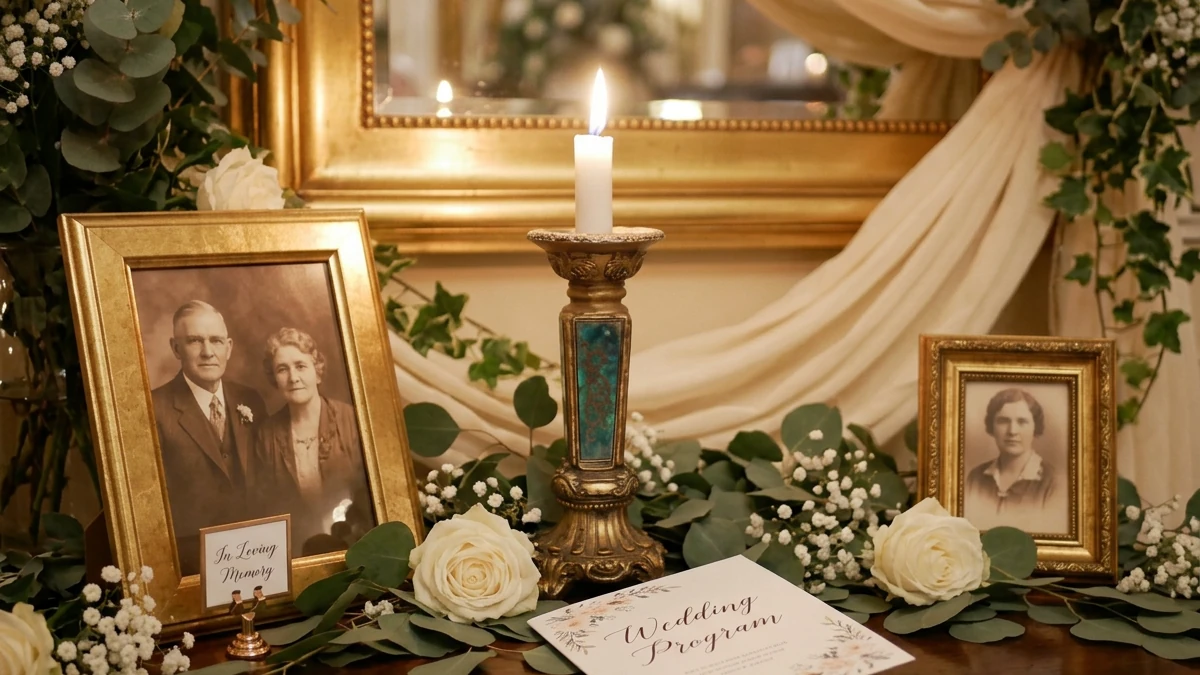
A program tribute is the warmer way of honoring a parent who has died than the invitation’s host line.
In loving memory of Rosa Santos, whose love is woven into this day.
We remember Michael Reyes, father of the groom, and carry him with us today.
The candle on the altar is lit in memory of the grandparents who could not be here.
Forever in our hearts: Daniel Whitfield and Eleanor Okoro.
Some of the people we love most are watching from a better seat than the front row.
Thank-you notes
Thank you for sharing this day with us. Love, Maya and Jordan
To our parents, for every Sunday dinner that led us here, and to all of you, for coming.
Thank you to Father Reilly, our families and every one of you for being part of our wedding.
Your love and support brought us here. Thank you for celebrating with us.
Thank you for the advice we took, the advice we didn’t, and for being here.
Unplugged notes
We invite you to be fully present with us. Please turn off your phones and cameras during the ceremony.
Our photographer has the photos covered. Please keep phones away until we’ve said “I do.”
The best view of today is the one without a screen in front of it. Thank you for being unplugged.
Explanations of traditions
Keep each to one line, taken from a source inside the tradition.
The chuppah: The canopy represents God’s presence and the couple’s new home, open to family and friends.
Breaking the glass: A reminder of loss and of the fragility of marriage, followed by shouts of “Mazel tov!”
The Peace: The couple greets each other first, and guests may then greet the people around them.
Reception details line
Please join us for dinner and dancing at The Willow Room, immediately following the ceremony.
Cocktails on the terrace from 4:30, dinner at 5:30. Follow the lanterns.
Wedding program ideas: which format fits your ceremony?
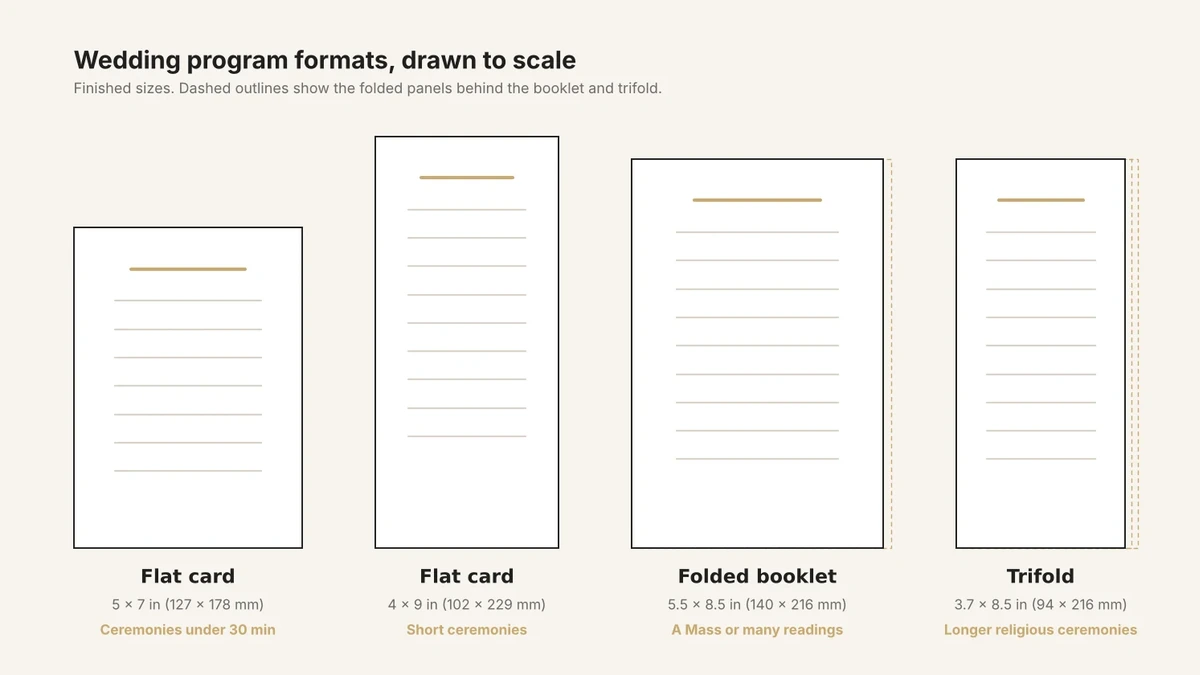
Match the format to the length of your ceremony. A flat card holds anything under about 30 minutes, and a folded booklet holds a Mass or several readings. Fans, newspaper-style programs and a single large sign each solve a more specific problem. Here is what each one holds.
Format | Size (inches) | Best for | What fits |
Flat card | 5 x 7 or 4 x 9 | Ceremonies under about 30 minutes | Order on the front, wedding party on the back |
Folded booklet | 5.5 x 8.5 | A Mass or many readings | Everything, including responses |
Trifold | 3.7 x 8.5 | Longer religious ceremonies | Six narrow panels |
Fan | Any flat card on a handle | Outdoor summer ceremonies | A short order and the wedding party |
Newspaper or magazine | Varies | Relaxed weddings | Your story, a crossword, party notes |
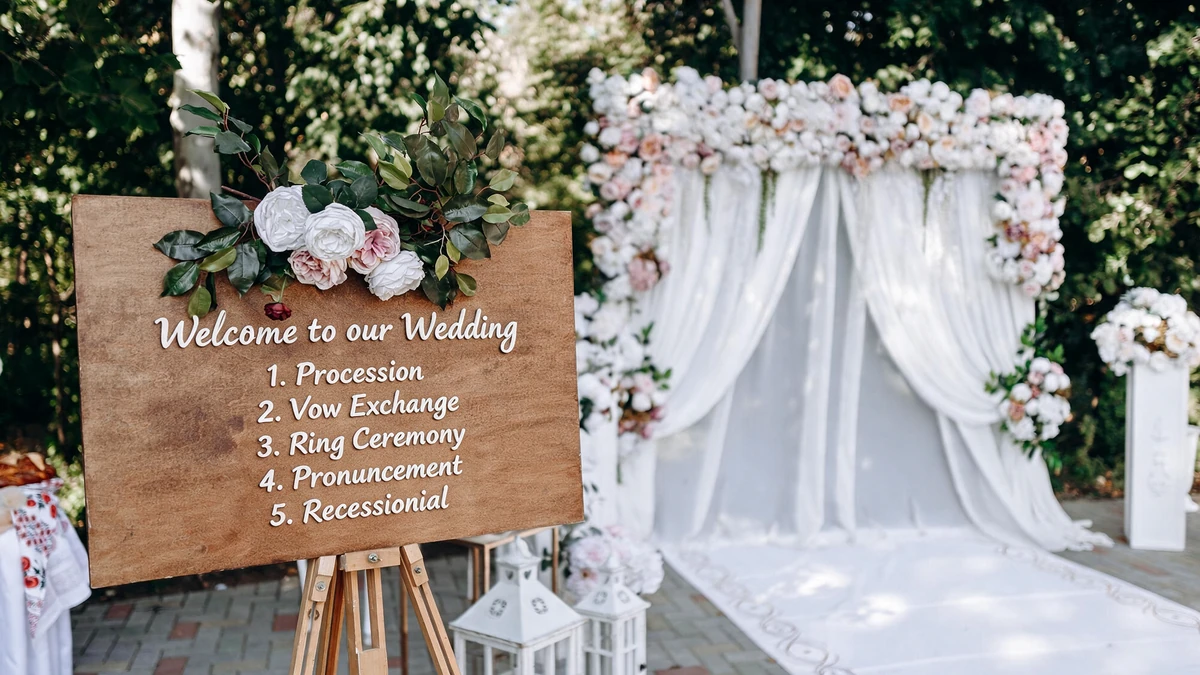
Order-of-ceremony sign | Large poster | Short civil ceremonies | The order only |
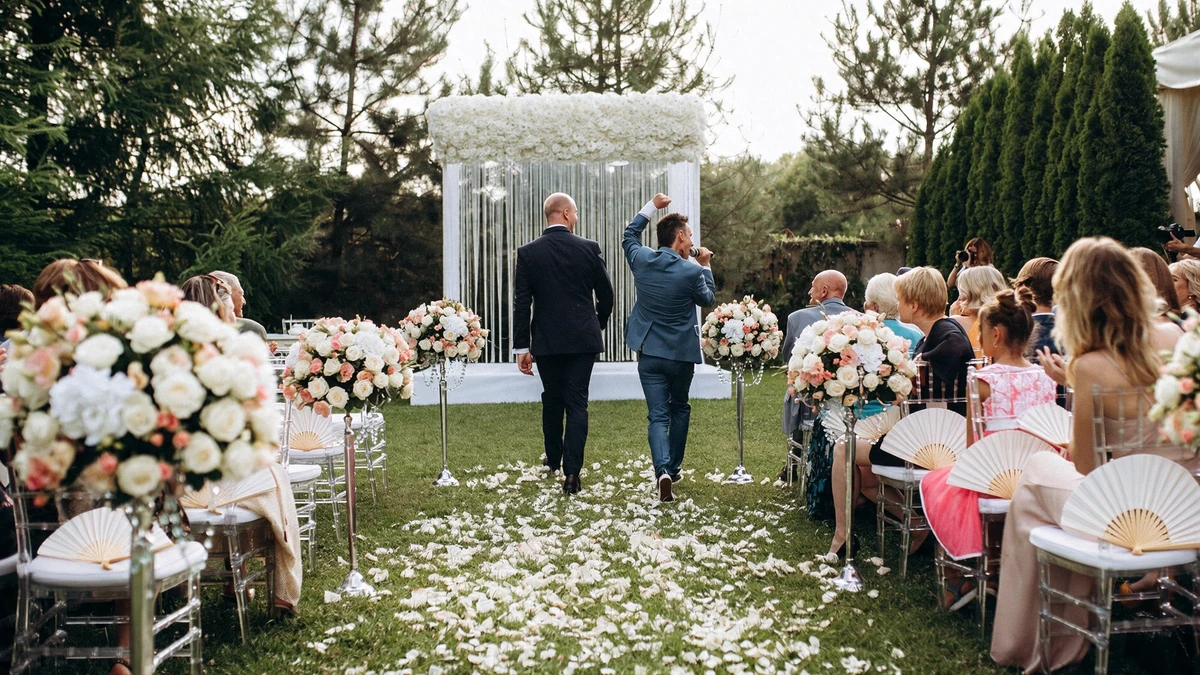
A fan doubles as a program and a kindness on a hot afternoon. A newspaper or magazine program keeps guests reading before the ceremony: a short “how we met,” a crossword built from inside jokes, and a paragraph on each member of the wedding party.
One large sign at the entrance can replace programs for a short civil ceremony, but not for any service where guests say or sing something, because the words have to be in their hands.
Put the reception timeline on the back
A short reception timeline on the back of a flat card answers what every guest eventually asks: when’s dinner?
THE CELEBRATION 4:30 PM | Cocktail hour on the terrace 5:30 PM | Dinner is served 6:45 PM | Toasts 7:00 PM | First dance 7:15 PM | Dancing 9:45 PM | Sparkler send-off |
How do you make your own wedding program?
Start from the final order your officiant gives you, choose a format sized to your ceremony, write each part in order, and check every name before printing two to four weeks out. Most of the work is gathering names and titles; layout is the quick part.
Get the final order from your officiant. Ask for it in writing, and share your draft about four weeks before the wedding.
Pick the format by length. Our wedding program templates come as flat cards, folded booklets and trifolds.
Write the parts in order. Cover, welcome, order of ceremony with names, wedding party, notes, thank-you.
Check every name and title. Spell each name the way its owner does. Our addressing guide covers titles such as The Reverend or The Honorable.
Credit every text correctly. Works published in 1930 or earlier entered the US public domain on January 1, 2026, so the King James Version and Shakespeare can be printed in full. For newer poems, songs and modern Bible translations, print the title, author and citation only. Our guide to wedding readings covers choosing them.
Print two to four weeks before the wedding. Use 80 to 100 lb cardstock for flat cards; booklets and trifolds need double-sided printing.
Print one per couple or household, plus 10 to 15 percent. That’s about 60 programs for 100 guests.
Add a few large-print copies. The American Council of the Blind’s large print guidelines call for 18 point Arial body text, 20 to 22 point bold headings, and black text on off-white or cream paper. An usher can offer them at the door.
Translate where your families need it. Emily Post calls translations “a nice touch.”
Song lyrics follow the same rule: print them only if the sheet music was published in 1930 or earlier. Otherwise credit the title and artist, the same format that works for all your ceremony music.
Key Takeaways
Print one program per couple or household plus 10 to 15 percent, which comes to about 60 programs for 100 guests.
Readings and songs published in 1930 or earlier can be printed in full; newer ones get a title, author and citation only.
A Catholic wedding Mass program should carry the US bishops’ Guidelines for the Reception of Communion.
Large-print copies for low-vision guests use 18 point Arial, black on off-white or cream paper.
Programs go to print two to four weeks before the wedding, once the officiant has approved the final order.
Frequently Asked Questions
What should a wedding program include?
Your names, the date and venue, the order of ceremony, the officiant and wedding party, and the titles and authors of readings and music, plus the words of anything guests say or sing. A welcome, explanations of traditions, a tribute and a thank-you are optional.
How to write a program for a wedding?
Start from your officiant’s final order. Write the cover, then the order of ceremony with the name of everyone taking part, then the wedding party, any notes for guests and a thank-you. Check every name against how each person spells it, and print two to four weeks before the wedding.
Do people still do programs for weddings?
Yes, though they’re optional; the Emily Post Institute says programs aren’t required. They help most at religious, interfaith or unfamiliar ceremonies, where guests follow responses or rituals, and with a large wedding party. One large order-of-ceremony sign is the simplest alternative.
How do I make my own wedding program?
Choose a design sized to your ceremony, fill in each part in order, then print at home on 80 to 100 lb cardstock or send the file to a print shop. Flat cards print easily at home, while booklets and trifolds need double-sided printing. Print one full-size test copy before the rest.
What are some cool wedding programs?
Fans for outdoor summer ceremonies. Newspaper or magazine programs with your story and a crossword. Short “meet the wedding party” lines that turn a list into something guests read. And a reception timeline on the back, which answers the question every guest asks: when’s dinner?
What should a Catholic wedding program include?
It should list the parts of the Order of Celebrating Matrimony your parish uses, with or without Mass, the readings by citation with each reader’s name, the psalm and cantor, and the music. At a wedding Mass, add the US bishops’ guidelines for receiving Communion. Confirm the order with your parish first.
How many wedding programs do I need?
One per couple or household, plus 10 to 15 percent for extras, which is about 60 programs for 100 guests. Round up toward one per guest if the program carries responses or hymns everyone must follow, as at a wedding Mass.
What do you write in the thank-you section of a wedding program?
Write one or two sentences thanking guests for coming, and your parents if you like, signed with your first names. For example: “Thank you for being part of today. Love, Maya and Jordan.” Or: “To our parents, for every Sunday dinner that led here, and to you, for coming.”
Ready to lay out your program?
Once your officiant signs off on the order, the rest is layout. Pick a program that matches your menus and table numbers, drop in the wording from the example closest to your ceremony, and print a full-size test copy before you order the rest.
Make it yours
Give your ceremony a thoughtful introduction.
Try your wording in the editor. Pay when you download.