How to Address Wedding Invitations: 25+ Envelope Examples
The outer envelope carries formal names and the mailing address. The inner envelope names exactly who is invited, and leaving a name off is how you signal who is not. Send one invitation per household, with exceptions for anyone 18 or older, unmarried couples who live apart, and adult roommates.
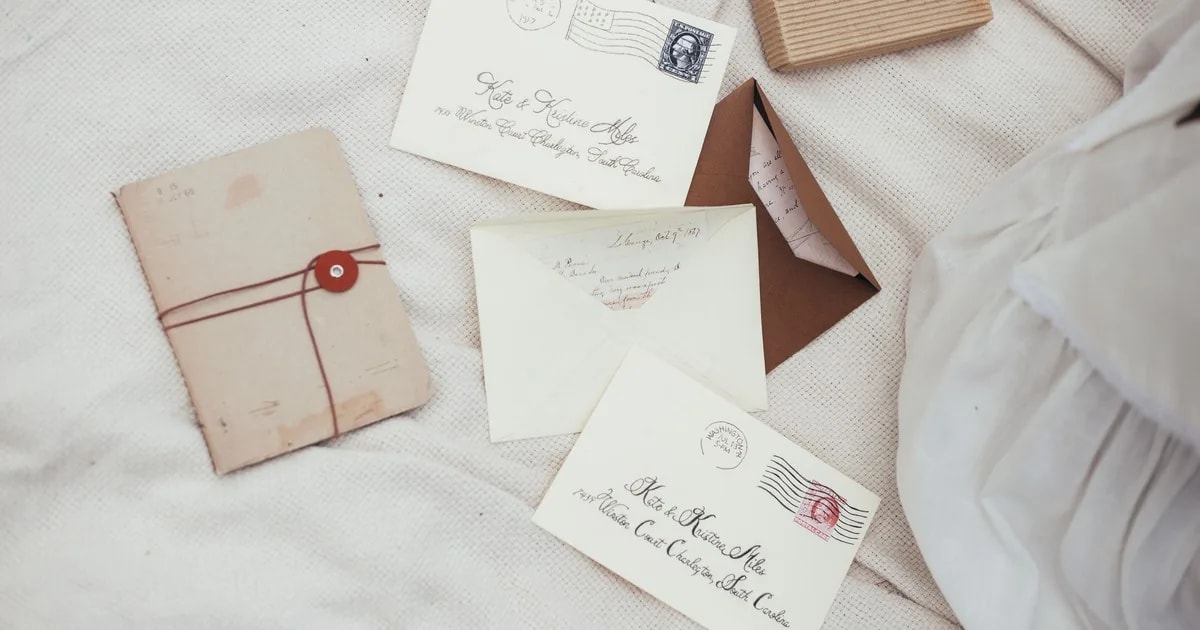
Knowing how to address wedding invitations is the difference between a guest list of 120 and one that quietly becomes 138. The envelope is not a decoration. It is the document that tells each household exactly who is invited, and when it is vague, people bring their children.
This guide covers the names and addresses on the envelopes. For the wording printed on the card itself, including host lines and request lines, see our separate guide to wording your wedding invitations. The two jobs are different and the conventions do not overlap.
What follows is organized by guest scenario, because that is how these questions arrive. Find your situation, copy the format, and move on.
How many invitations do you actually need?
One invitation goes to each household, not each guest. Your guest count and your invitation count will be different numbers, and the gap is usually larger than couples expect.
Three exceptions to the one-per-household rule:
Anyone 18 or older gets their own invitation, even if they live with their parents, college students included. Expecting a 22 year old to read themselves into a family envelope is how people get left out.
Unmarried couples who live apart each receive one at their own address, assuming both are invited in their own right rather than as one person’s guest.
Adult roommates each receive their own invitation, since they are separate guests who happen to share a mailbox.
Count households first, then address. It saves reprinting a dozen envelopes when you realize the Reynolds household has two adults over 18 in it.
Do you need both an inner and an outer envelope?
No, it is optional, and plenty of modern suites use a single envelope. But the inner envelope is the traditional mechanism for making clear exactly who is invited, and there is no equally graceful substitute.
The outer envelope travels, carrying the mailing address and the most formal version of your guests’ names. The inner envelope is unsealed, tucks inside, and carries only names. Because it never meets a sorting machine, it can be as informal as your relationship allows.
Outer: Mr. and Mrs. Jonathan Reynolds
418 Magnolia Avenue
Savannah, Georgia 31401
Inner: Mr. and Mrs. Reynolds
Ava and Noah
The Emily Post Institute puts the purpose plainly: it lets the host be clear about who is invited and, by omission, who is not. That omission is the whole point. It sets a limit without anyone writing “adults only” on anything.
With a single envelope, use the outer format for everyone invited, children and plus ones included. Most wedding invitation suites offer both configurations, so decide before you order.
How formal should the addressing be?
Match the envelope to the invitation inside it. A letterpress card with a spelled-out date deserves an envelope with no abbreviations; a casual backyard invitation does not.
Formal addressing means everything is written out in full:
Full first and middle names, never initials
Streets, avenues, and boulevards spelled out
States spelled out: Georgia, not GA
Numbered streets written as words where they fit: Forty-Second Street
Apartment and suite numbers on the same line as the street where possible
Compare the same household addressed two ways:
Formal:
Mr. and Mrs. Jonathan Reynolds
418 Magnolia Avenue
Savannah, Georgia 31401
Modern:
Jonathan and Priya Reynolds
418 Magnolia Ave.
Savannah, GA 31401
Both are correct. The formal version signals a formal wedding; the modern one signals a relaxed wedding. What you should not do is mix them within one mailing.
Which title goes with which guest
Mr. for any adult man, married or not.
Mrs. for a woman who is married or has been married and uses that title.
Ms. for a woman who is unmarried, kept her own surname, or simply prefers a title that says nothing about her marital status. When in doubt, Ms. is the safe default.
Mx. for guests who do not use a gendered title. It is pronounced “mix.”
Miss for a girl under 18. Above that, use Ms.
Master for a boy under 13. This one is genuinely dated, and most couples now drop titles for children entirely and just use first names. Either is defensible.
If you do not know what a guest prefers, ask. A text saying you want their name right on the envelope is a compliment, not an imposition, and better than guessing wrong in calligraphy.
How do you address a wedding invitation to a married couple?
Traditionally, a married couple sharing a surname is addressed as one unit using the husband’s full name. Modern practice uses both first names. Both are in current use, and the right choice depends on the guest.
Shared surname
Traditional: Mr. and Mrs. Jonathan Reynolds
Modern: Mr. Jonathan Reynolds and Mrs. Priya Reynolds
Casual: Jonathan and Priya Reynolds
The traditional form omits the wife’s first name entirely, which is why many couples have moved away from it. Use it for guests who would expect it, and a modern form for everyone else.
Different surnames
Both full names on one line, joined by “and.” The “and” is what signals marriage, so it stays.
Ms. Priya Anand and Mr. Jonathan Reynolds
418 Magnolia Avenue
Savannah, Georgia 31401
If the names will not fit on one line, split them across two and keep the “and.” Traditionally the woman’s name comes first when surnames differ. Where one partner has hyphenated and the other has not, list the unhyphenated name first.
Same-sex married couples
Identical conventions, and the only question is name order. There is no traditional default, so choose alphabetically, by who you know better, or by what sounds better aloud. Apply it consistently across your list.
Mrs. Rebecca Lindqvist and Mrs. Amara Lindqvist
Mr. Kevin Ortiz and Mr. Henry Truman
When one or both are doctors
One doctor: Doctor Maya Patel and Mr. Jordan Lee
Two doctors: The Doctors Lee
or Doctors Maya and Jordan Lee
Doctor is spelled out on the outer envelope and may be abbreviated on the inner one. The doctor’s name comes first regardless of gender, because the title outranks the convention.
How do you address a wedding invitation to a family?
Address the outer envelope to the parents only, then use the inner envelope to name every person invited, children included. This is the most useful thing the two-envelope system does, and it is why families are hardest to address with one envelope.
Children are invited
Outer: Mr. and Mrs. Jonathan Reynolds
418 Magnolia Avenue
Savannah, Georgia 31401
Inner: Mr. and Mrs. Reynolds
Ava, Noah, and Celeste
List children by age, oldest first, on the line below their parents. First names alone are fine on the inner envelope.
Children are not invited
Outer: Mr. and Mrs. Jonathan Reynolds
Inner: Mr. and Mrs. Reynolds
Nothing else changes. The children’s absence from the inner envelope is the message. Do not add a note, do not write “adults only” on the envelope, and do not hint.
Omission works on guests who know the convention and sails past everyone else. Back it up on your website and your RSVP cards, which should print the number attending rather than leave a blank the guest fills in optimistically.
If you are not using an inner envelope
Everyone invited goes on the outer envelope, on a second line beneath the parents.
Mr. and Mrs. Jonathan Reynolds
Ava, Noah, and Celeste
418 Magnolia Avenue
Savannah, Georgia 31401
“The Reynolds Family” is the warm informal alternative, but understand the cost: it implies everyone in the household is invited, adult children included. Use it only when that is true.
Blended families and different surnames under one roof
Where a household holds more than one surname, name people rather than families. A single family name always leaves someone wondering whether it means them.
Outer: Ms. Priya Anand and Mr. Jonathan Reynolds
Inner: Ms. Anand and Mr. Reynolds
Ava Reynolds and Celeste Anand
Adding the children’s surnames on the inner envelope is unusual, but here it removes real ambiguity, which matters more than the convention does.
Unmarried couples living together
One invitation goes to the household with both names on it. How those names are laid out is the one point in envelope etiquette where the major sources genuinely disagree, so here are both.
The Emily Post Institute puts both names on a single line joined by “and,” treating an established couple at one address the same way it treats a married couple with different surnames.
Ms. Rebecca Wright and Mr. Jacob Martin
1120 Chestnut Street
Portland, Oregon 97205
The competing convention, held by protocol writers such as Holly Holden, puts each name on its own line with no “and” at all, on the reasoning that “and” is what signals marriage. The stacked format is the quiet cue that the couple is not married.
Ms. Rebecca Wright
Mr. Jacob Martin
1120 Chestnut Street
Portland, Oregon 97205
Neither is a mistake. If your guests are the sort to notice, the stacked format is the more precise signal. If you would rather not distinguish between married and unmarried guests, the single line reads warmer and nobody will object.
For name order, list the person you know better first, or go alphabetically if you know them equally. If the couple lives apart, send two invitations to two addresses.
How do you address a plus one?
Use the guest’s actual partner name whenever you know it, and reserve “and guest” for when you genuinely do not. Naming the partner is warmer, and your seating chart stops being a guessing game.
A single guest with no plus one
Outer: Ms. Rebecca Wright
Inner: Ms. Wright
A guest whose partner you know
Outer: Ms. Rebecca Wright and Mr. Jacob Martin
Inner: Ms. Wright and Mr. Martin
A guest bringing someone you have not met
Outer: Ms. Rebecca Wright
Inner: Ms. Wright and guest
Emily Post is specific: “and guest” belongs on the inner envelope, because addressing a mailing envelope to a named person and an anonymous one is impersonal. With one envelope, it goes there, lowercase, since it is not a name.
Decide before you write whether a plus one is being extended at all. A guest who is not offered one should see only their own name, with nothing to interpret.
Guests with professional or honorary titles
Use the title if the guest uses it, and spell it out on the outer envelope. Titles are a courtesy, not a formality requirement, and getting one right is noticed by exactly the person who cares.
Physician: Doctor Maya Patel
Judge: The Honorable Alana Reyes
Clergy: The Reverend Michael Chen
Military officer: Colonel James Hargrove
United States Army
For military guests, rank replaces the social title and the branch is spelled out below it. Senior officers take rank before the name; junior officers take the name first with rank and branch beneath. Retired officers keep the title, with “Retired” after the branch.
Where a couple holds different titles, the higher-ranking one comes first regardless of gender. If you are unsure whether a guest uses a title socially, ask or leave it off.
Widowed, divorced, and separated guests
Ask when you can, and default to the most neutral form when you cannot. This is the category where an envelope can genuinely hurt someone, and the conventions have shifted enough that guessing is risky.
A widow traditionally keeps her husband’s full name: Mrs. Jonathan Reynolds. Many widows now prefer their own: Mrs. Priya Reynolds. Both are correct and only she knows which she wants.
A divorced woman who kept her married surname is usually Ms. Priya Reynolds. One who returned to her maiden name is Ms. Priya Anand.
A separated couple who are not divorced should be addressed separately, each at their own address, unless you know they would prefer otherwise.
If you are close enough to invite them, you are close enough to ask. If not, Ms. with her own first name is least likely to land badly.
Where does the return address go on a wedding invitation?
USPS wants it in the upper left corner on the front of the envelope. Their addressing guidance is explicit about this, and Publication 25 repeats it: the return address belongs in the upper left of the address side, because that is where automated equipment looks for it.
The wedding convention is different. Formal invitations have long carried the return address centered on the back flap, often blind embossed, which looks better and keeps the front clean for calligraphy. Both work in practice: a back-flap address will not stop mail being returned, it simply takes a human a moment longer to find. Front placement is the safer choice if much of your list is at addresses you are unsure about.
Whose address should it be?
Use the address of whoever is handling RSVPs, not necessarily the couple’s. If a parent is managing replies, their address goes on the return line and on the reply envelope too, so both point to the same mailbox.
Get this right and undelivered invitations come back while you still have time to fix the address. Get it wrong and they vanish, and you find out when someone does not show up. Many wedding invitation sets include pre-printed return addressing on both the outer envelope and the reply envelope, which removes the mistake entirely.
Envelope layout, briefly
Three zones on the front of a standard envelope, and only three:
Upper left: return address.
Center: delivery address, parallel to the long edge.
Upper right: postage.
Keep the bottom half inch clear. USPS reads its barcode there, and decoration in that strip causes misreads. Apartment and suite numbers go on the street address line where they fit, and directly above it where they do not. Use a PO box or a street address, never both.
Should you handwrite, print, or hire a calligrapher?
All three are acceptable, and the choice is a trade-off between cost, time, and how the envelope looks in someone’s hand. Nothing in etiquette requires handwriting, despite what you may have read.
Handwriting them yourself costs nothing and looks personal. Budget two to three minutes per envelope, so 120 invitations is about five hours, and order 15 percent extra for the ones you spoil.
Hiring a calligrapher gives the best-looking result at the highest cost, priced per envelope. Book six to eight weeks ahead and supply a proofread address list, since most charge to correct errors that were in your spreadsheet.
Printing directly onto envelopes is the fastest and most legible option, and modern script fonts get close to hand lettering. Run a test envelope through your printer first: thick or textured stock jams, and some envelope flaps will not feed.
One point in favor of printing: USPS equipment reads print more reliably than cursive, and the most beautiful calligraphy is the hardest for a machine to parse. If your list includes rural routes or complicated apartment numbers, legibility earns its keep.

How do you address wedding announcements?
Use the same name and title conventions as invitations. The differences are timing and who receives them.
Announcements go to people who were not invited, so they are mailed after the ceremony, traditionally within a few days. They carry no reply card and no inner envelope, since there is nothing to reply to and no attendance to specify.
One rule matters more than any formatting question: never send an announcement to someone who received an invitation. The same care applies to save the date cards, which use the outer envelope conventions above and go only to guests you are certain about. Our save the date wording guide covers what to write on them and when to send them.
A checklist before you mail
Every name spelled the way that person spells it, including surnames within blended households
Household count checked against the one-per-household exceptions, especially anyone 18 or older
Titles confirmed for doctors, judges, clergy, and military guests
Inner envelopes list every invited person by name, and nobody else
Plus ones decided deliberately, with partner names used wherever known
Return address points to whoever is handling replies
Bottom half inch of every envelope kept clear
One assembled suite weighed at the post office before you buy stamps
Then have someone outside the wedding read ten envelopes at random. They will catch the misspelled surname you have looked at forty times.

Key Takeaways
Spell everything out on a formal outer envelope: full first and middle names, no initials, no abbreviated streets, and no state abbreviations.
Use a guest’s actual partner name whenever you know it, and save “and guest” for the inner envelope when you truly do not.
USPS wants the return address in the upper left corner on the front, so the traditional back flap is a stylistic choice rather than a rule.
Professional titles are written out in full on a formal envelope, so Doctor rather than Dr. and The Honorable for a judge.
Handwriting envelopes takes roughly two to three minutes each, about five hours for 120 invitations, so order 15 percent extra for spoiled ones.
Anyone 18 or older receives their own invitation, even when they still live at their parents’ address.
Frequently Asked Questions
What is the modern way to address wedding invitations?
Use both partners’ full names rather than “Mr. and Mrs. Jonathan Reynolds,” which erases the wife’s first name. Ms. works for any woman regardless of marital status. Titles can be dropped entirely for casual weddings, leaving first and last names, which reads warmly and is completely correct.
Whose name goes first on a wedding invitation envelope?
Traditionally the husband’s name came first. Modern practice allows alphabetical order, listing whoever you know better first, or simple preference. For same-sex couples there is no traditional default at all, so pick one approach and apply it consistently across your whole guest list.
How do you address a wedding invitation to a family with children?
Put the parents’ names on the outer envelope and list the invited children by first name on the inner envelope, oldest first. If a child’s name is missing, that child is not invited. That omission is the traditional signal, so back it up on your website for guests who miss it.
How do you address a plus one on a wedding invitation?
Use the guest’s actual partner name whenever you know it, on both envelopes. Reserve “and guest” for when you genuinely do not know who they will bring, and place it on the inner envelope rather than the outer one. Write “guest” lowercase, since it is not a name.
How do you address a wedding invitation to an unmarried couple living together?
Sources disagree. Emily Post puts both names on one line joined by “and.” Other etiquette writers stack the names on separate lines with no “and,” on the reasoning that “and” implies marriage. Both are correct; the stacked version is the more traditional signal.
Do you need both an inner and outer envelope?
No, it is optional and many modern suites skip it. The inner envelope is the traditional mechanism for making clear exactly who is invited, which is difficult to communicate any other way. Without one, list every invited person on the single outer envelope instead.
What goes on the return address of a wedding invitation?
The address of whoever is handling RSVPs, which may be a parent rather than the couple. Traditionally it is centered on the back flap. USPS prefers the upper left corner on the front, where automated equipment looks for it, and that placement is the safer choice.
Should you handwrite or print wedding invitation envelopes?
Both are acceptable. Handwriting costs nothing and takes roughly two to three minutes per envelope. Printing is faster, cheaper than calligraphy, and easier for postal equipment to read. Many printable wedding invitation templates include matching envelope files, which keeps the type consistent.
Ready to address yours?
Work through your list household by household, decide the formality once, and apply it to everyone. Browse our wedding invitation and stationery templates to customize your suite, then download print-ready files for your printer or your calligrapher.
Make it yours
Your words. An invitation that feels like you.
Try your wording in the editor. Pay when you download.