
Floral Wedding Menus
Soft watercolor florals, hand-painted botanicals, and natural greenery define our floral wedding menu templates. Choose from peony-led romantic menus in dusty rose and ivory, watercolor menus with eucalyptus and sage greenery framing, garden menus with mixed wildflower borders, modern botanical menus with refined typography and corner accents, or romantic menus with full floral wreaths on the cover panel. Designed for couples whose wedding aesthetic centers on watercolor florals, every template is fully editable in our free browser-based editor and downloads as print-ready PDF, JPEG, and PNG files. Print at home as flat cards or fold them in half for bi-fold menus, or roll them as scrolls tied with twine.



About Our Floral Wedding Menus
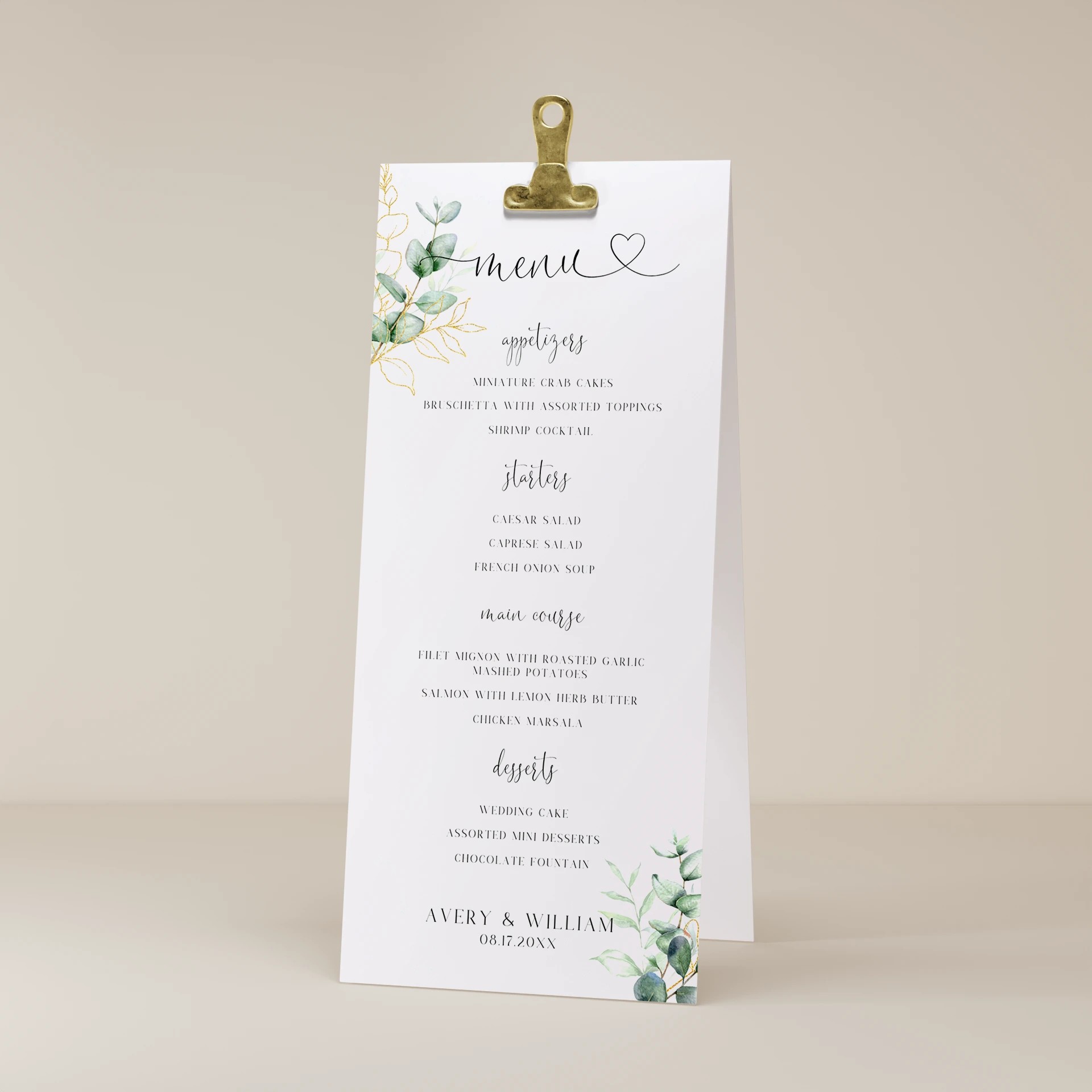
Our floral wedding menu templates feature soft watercolor florals, hand-painted botanicals, and natural greenery in romantic palettes. Choose from peony-led romantic menus in dusty rose and ivory, rose and eucalyptus garden menus, watercolor menus with loose hand-painted floral borders, modern botanical menus with refined typography and corner accents, greenery wedding menus in sage and cream, or romantic menus with full floral wreaths on the cover panel. Whether you are looking for a watercolor wedding menu that pairs with floral invitations, a garden wedding menu for outdoor spring and summer ceremonies, or a botanical menu with refined modern typography, every template is fully editable in our free browser-based editor and downloads as print-ready PDF, JPEG, and PNG files. Print at home as flat cards on cardstock, or fold them in half for bi-fold menus, or roll them as scrolls tied with twine for an elevated table-setting effect.
Floral Framing Solves the Menu Density Challenge Differently
A 4-course wedding menu has 15 to 25 lines of content - course headers, dish names, descriptions, dietary callouts, wine pairings - which creates real design tension on a small 5x7 menu card. Minimalist menus solve this with deliberate typographic hierarchy (course headers in caps, dish names in serif, descriptions in italic gray). Floral menus solve it differently - with floral framing as the design element, letting the watercolor do the visual work while keeping the course list in a clean centered column inside the floral border. The most effective approaches: a delicate floral border framing the entire menu with the course list centered inside (works for single flat cards), a floral wreath or arch at the top of the menu with the course list filling the space below (works for bi-fold front covers), or corner floral clusters (top-left and bottom-right) with the course list reading down the central column. The principle: floral imagery as frame or accent, not as background. Watercolor florals scattered behind the text reduce readability and undermine the elegance of the menu.
What Makes a Wedding Menu Floral
The floral aesthetic for wedding menus follows the same conventions as floral wedding stationery, scaled to the menu format:
Watercolor or hand-painted technique. Most floral menus are illustrated in watercolor for the soft, hand-painted look.
Specific flower motifs as borders or corners. Peonies, roses, eucalyptus, wildflowers, and seasonal greenery as framing elements.
Romantic, soft color palettes. Dusty rose, sage green, blush pink, ivory, and muted gold.
Strong course hierarchy. Course headers, dish names, and descriptions need to remain clearly distinguishable - floral framing supports this rather than competing with it.
Floral imagery as accent or frame. Borders, corner clusters, or wreaths preserve readability better than scattered or background-coverage floral elements.
Pairs With
Browse all wedding menus by aesthetic. For matching floral day-of wedding stationery, see our floral wedding place cards, floral wedding seating charts, and floral wedding programs.
Frequently Asked Questions
When should I order and print my floral wedding menus?
Print your floral wedding menus 1 to 2 weeks before the wedding. The menu depends on the final caterer's confirmed dishes, which typically lock in 3 to 4 weeks before the wedding. Allow extra time if you are using rolled scroll menus or other specialty assembly - watercolor florals printed on rolled scroll cardstock and tied with ribbon or twine require additional production time. With our free editor, you can update last-minute menu changes (a swapped dish, a clarified dietary note) without re-ordering. Plan to set the menus at each place setting 1 to 2 hours before guests arrive at the reception, ideally during the cocktail hour. For floral weddings specifically, the menu sitting at each place setting is one of the moments where guests notice the wedding's design language - the menu is held, examined, and often kept as a small keepsake.
Should the florals on my wedding menu match my invitation florals?
Yes - matching is essential for visual cohesion. If your wedding invitations featured watercolor peonies and dusty rose, your menus should use the same peonies and the same dusty rose. The flower types should match (the same peonies on every piece), not just the general floral aesthetic. Couples sometimes use "floral" as a general theme but switch flower types between pieces (peonies on the invitation, roses on the menu, eucalyptus on the seating chart) - this creates visual fragmentation. The strongest floral wedding suites use 1 to 3 specific flower types consistently across every piece - one anchor flower (peonies, garden roses, or anemones) plus 1 to 2 supporting elements (eucalyptus, wildflowers, baby's breath). The repetition becomes part of the design language guests notice.
Should I use a single card or bi-fold menu format for a floral wedding?
Choose based on course count and content density. Single flat cards work best for menus under 15 lines of content - typical 3-course meals (appetizer, main, dessert) with brief descriptions. Bi-fold menus work best for menus with 15 to 25 lines - typical 4-course meals with detailed descriptions, dietary callouts, and wine pairings. For floral weddings specifically, bi-fold menus offer additional design real estate for floral imagery - the front cover can carry a substantial floral wreath or arch while the interior holds the course list with subtler floral accents. This gives floral imagery a stronger visual moment without crowding the dish names. Single flat cards work beautifully too with corner or border floral framing - the choice depends on whether you want one strong floral statement (bi-fold) or integrated floral framing throughout (single card).
What if I want to include a dietary or allergen note on my floral menu?
Dietary callouts (V for vegetarian, VG for vegan, GF for gluten-free, DF for dairy-free, N for contains nuts) are now standard on wedding menus. The floral approach is to use small italic letters in a soft gray or sage tone aligned to the right of each dish name - visible to guests who need them, unobtrusive to guests who don't. Many couples also include a small legend at the bottom of the menu defining the abbreviations. For weddings with multiple guests with severe allergies, consider customized menus per place setting (with the guest's specific dish highlighted with a small floral mark) or a shared allergen note at the bottom of the menu. The floral aesthetic reads as warm and welcoming, which makes the dietary information feel hospitable rather than clinical - particularly important for guests who may already feel awkward about their dietary restrictions at a wedding.