
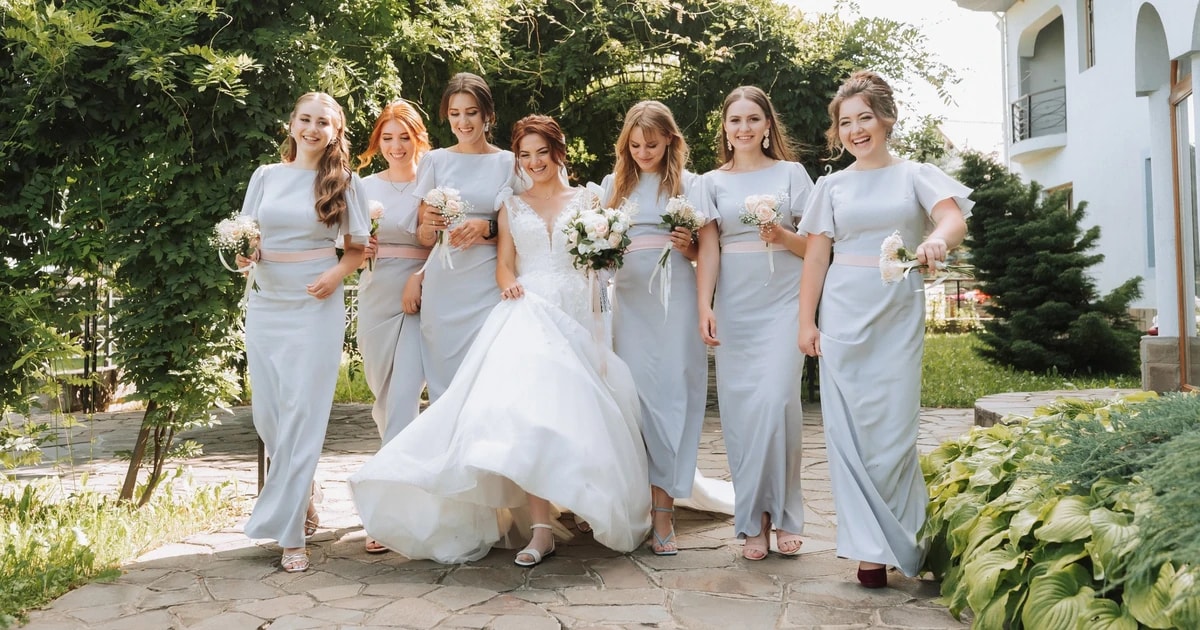
Wedding Processional Order: Who Walks When, for Every Kind of Ceremony
The traditional wedding processional order runs officiant, partner one with the best man, grandparents, the groom's parents, the mother of the bride, bridesmaids, the maid of honor, ring bearer, flower girl, then partner two with their escort. Every part of it can change to suit your family, your faith and your venue.
Most people can picture the start and end of a wedding processional order: someone walks in first, the music changes, and partner two comes down the aisle last. The middle is where families disagree: whose grandparents go first, and where a stepfather fits.
This guide answers those questions step by step, with the versions couples actually need and a list ready to copy into your program. The processional is one part of a longer service, and the full order of the ceremony covers the rest. Everything here is tradition rather than rule, so your officiant or house of worship can change any of it.
What is the traditional wedding processional order?
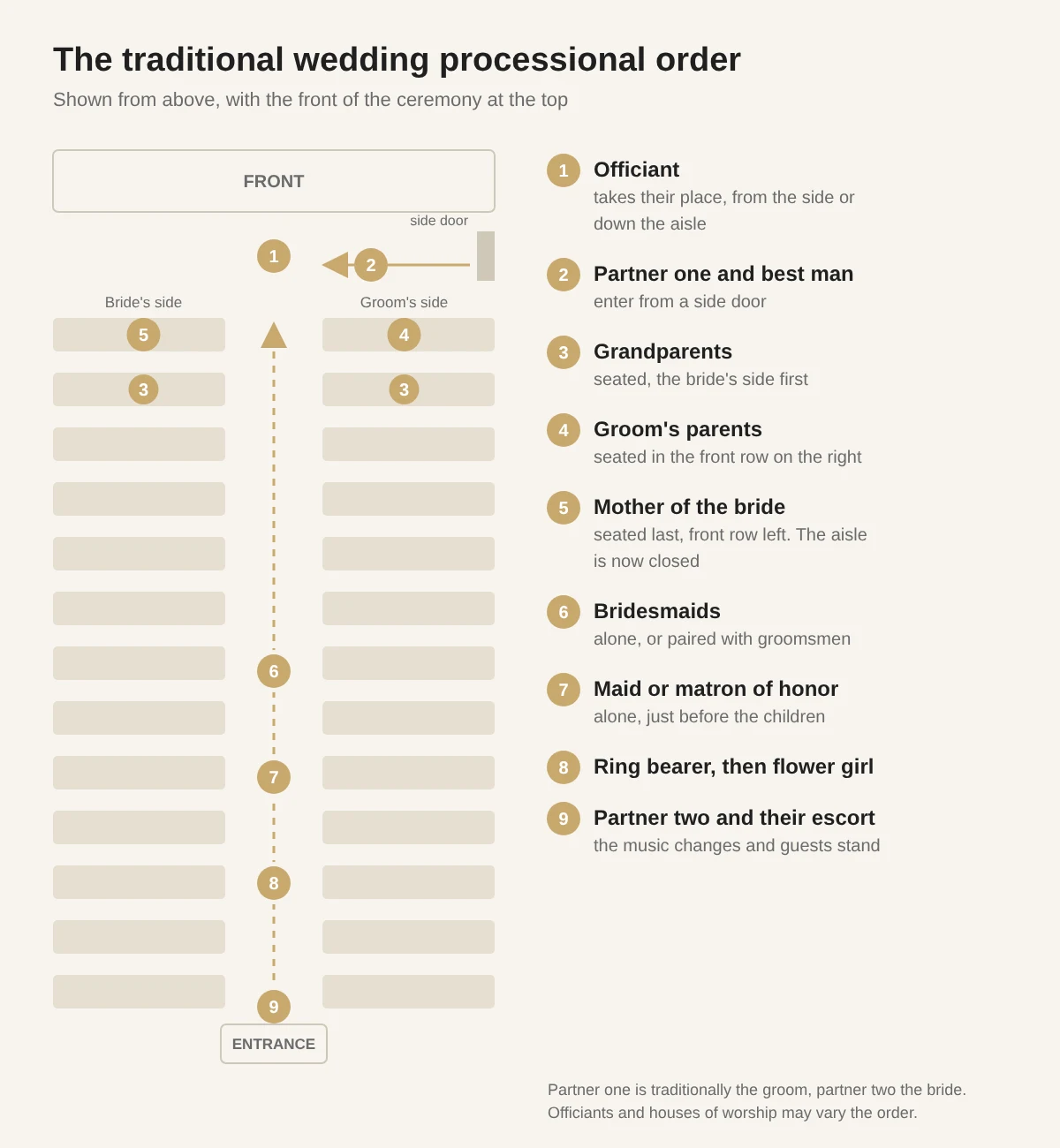
The traditional wedding processional order has nine steps. The officiant and partner one take their places at the front, the families are seated in a set order ending with the mother of the bride, the wedding party walks in, then the children, and partner two enters last with their escort as the music changes.
The officiant takes their place, from the side or down the aisle.
Partner one and the best man enter, usually from a side door, and stand at the front.
Grandparents are seated, the bride's side first, each escorted by an usher or a grandchild.
The groom's parents walk together and are seated in the front row on the right.
The mother of the bride is escorted in last, usually by an usher or a son, and seated in the front row on the left.
Bridesmaids walk alone, or paired with groomsmen.
The maid or matron of honor walks alone, immediately before the children.
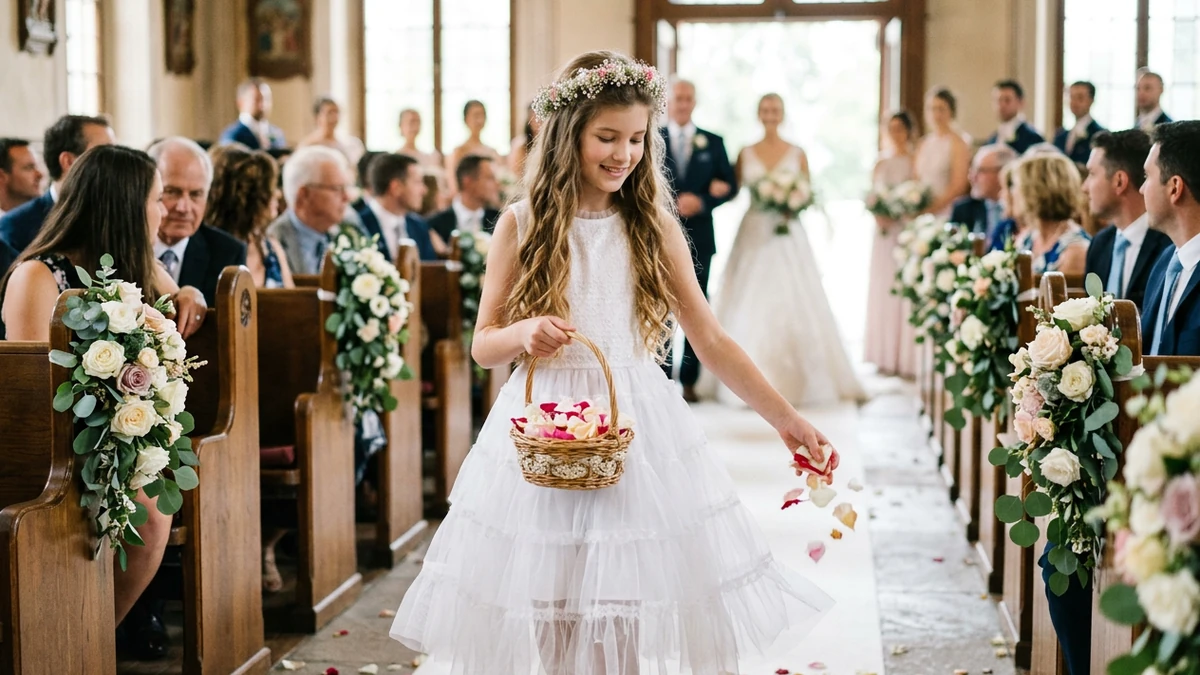
The ring bearer, then the flower girl.
Partner two enters with their escort, traditionally the father of the bride, as the music changes and guests stand.
If the groomsmen come in from the side with partner one, the bridesmaids walk alone. If they pair up, the groomsmen wait at the back instead.
Seating the mother of the bride is a signal, not just a courtesy. Once she sits, the aisle is closed, and late guests go to a side aisle or the back.
Some churches seat the families first and bring the officiant and partner one in afterwards. Some families also seat the groom's grandparents before the bride's, to match the order of the parents. Each version is correct, so follow your officiant.
Lining up and pacing
Line everyone up about 10 minutes before the start, in walking order, and give the line-up its own row in your wedding day timeline. Each person or pair starts when the one ahead is halfway down. The music usually changes for partner two, and our songs to walk down the aisle to come with running times so the song lasts as long as the walk.
Then walk the order once at a real pace the night before. That run-through is what the rehearsal and rehearsal dinner are for, and it is where the gaps show up.
How does the processional order work with parents?
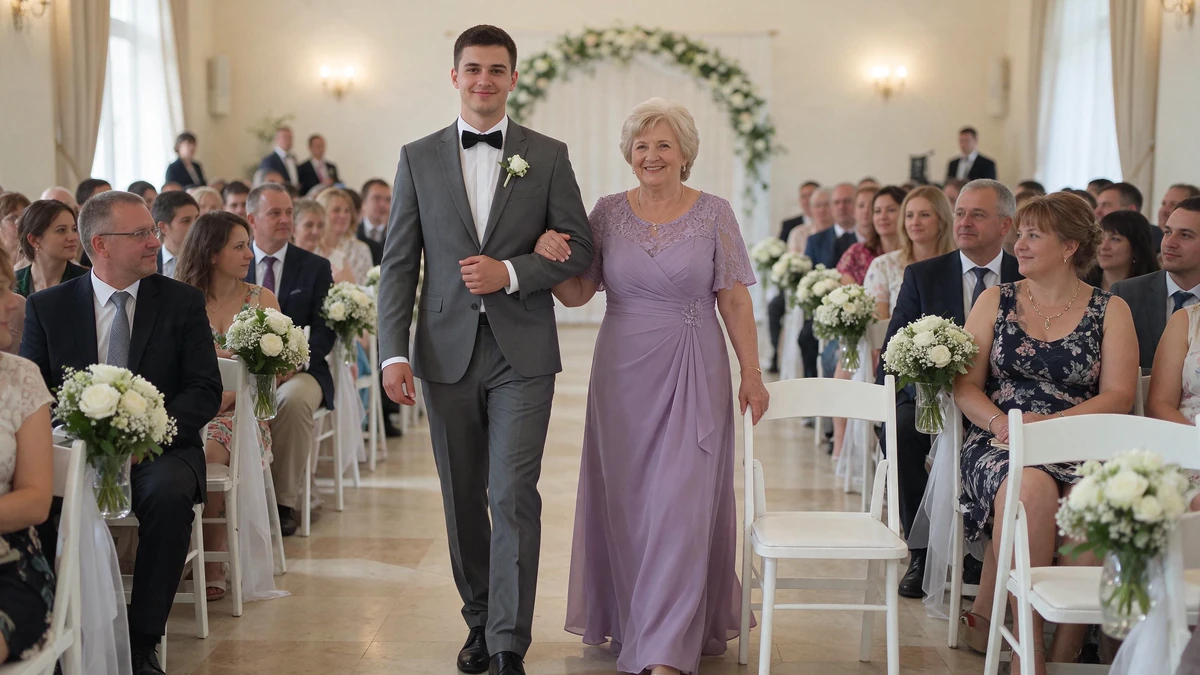
Parents change the processional order in three places: who escorts partner two, where divorced parents sit, and who walks in place of a parent who is not there. Emily Post seats divorced parents apart, accepts a mother or no one at all as the escort, and suggests splitting the walk between a father and a stepfather.
Divorced parents
If divorced parents get along, they can share the front row. If they don't, Emily Post's ceremony seating guidance puts the mother in the front row, with a stepfather if she has remarried and her family behind. The father escorts his daughter, then sits in the next row behind the bride's mother's family, usually the third or fourth. That holds even when he is hosting.
Both parents walking a partner in
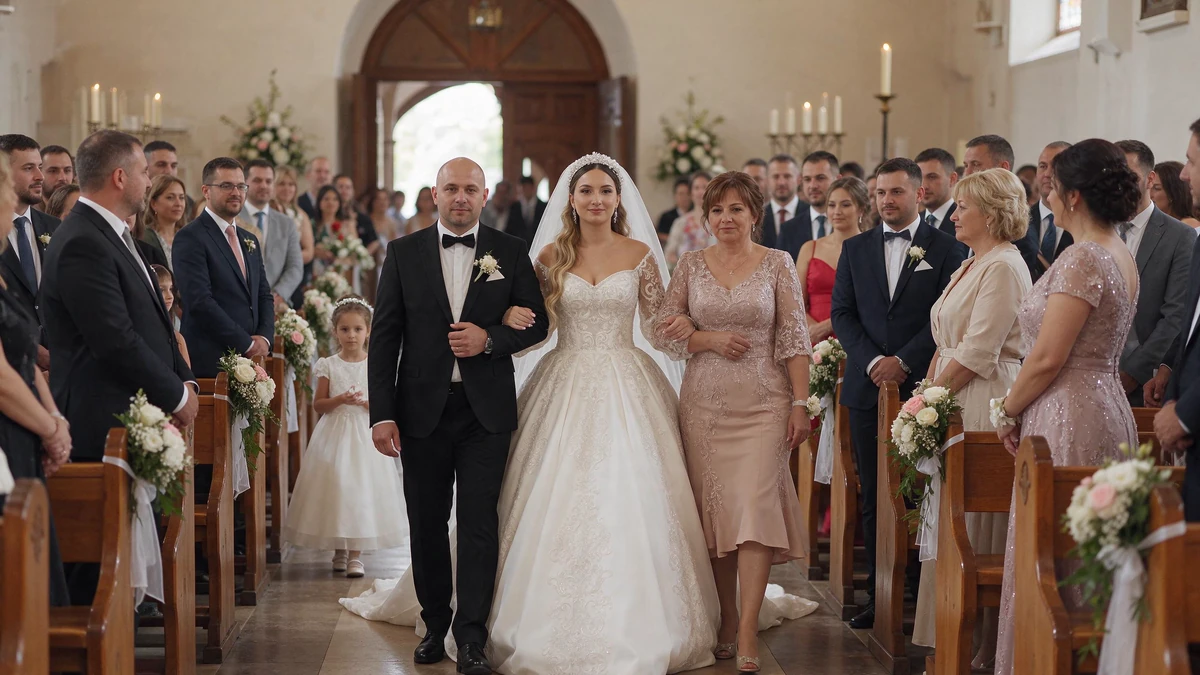
Walking in with both parents is common and has deep roots in Jewish tradition. A typical arrangement puts the father on the left arm and the mother on the right. Measure the aisle first, because three people side by side need far more room than two.
Stepparents and other escorts
Emily Post's answers on the aisle walk are direct: “These days, it's perfectly fine for a bride to have her mother escort her or to walk down the aisle alone.” For a bride who is close to both her father and her stepfather, it suggests sharing the walk: “Ask your biological dad to take you halfway, then meet your stepfather and walk with him to the altar.”
A sibling, grandparent or your own child can walk with you too.
When a parent has died
Anyone can walk with you, or no one. Many couples keep a front-row seat for the parent, marked with a single flower, and there are other quiet ways to honor someone who has died during the ceremony.
What does a modern wedding processional order look like?
A modern processional keeps the shape of the traditional one and changes who walks with whom. The couple walks in together, each partner walks with both parents, the wedding party enters as one group, or attendants of any gender stand on the side of the partner they are closest to.
Modern and non-traditional orders
The couple walks in together after the wedding party, so no one is given away.
Each partner walks with both parents, one after the other, so both families get the same moment.
The wedding party enters as one group, which suits a short aisle.
Attendants of any gender stand with the partner they are closest to, so a groom can have a best woman and a bride a man of honor.
A dog walks with the ring bearer on a short leash, with a named handler who takes it out after the vows, if the venue allows animals.
Same-sex couples
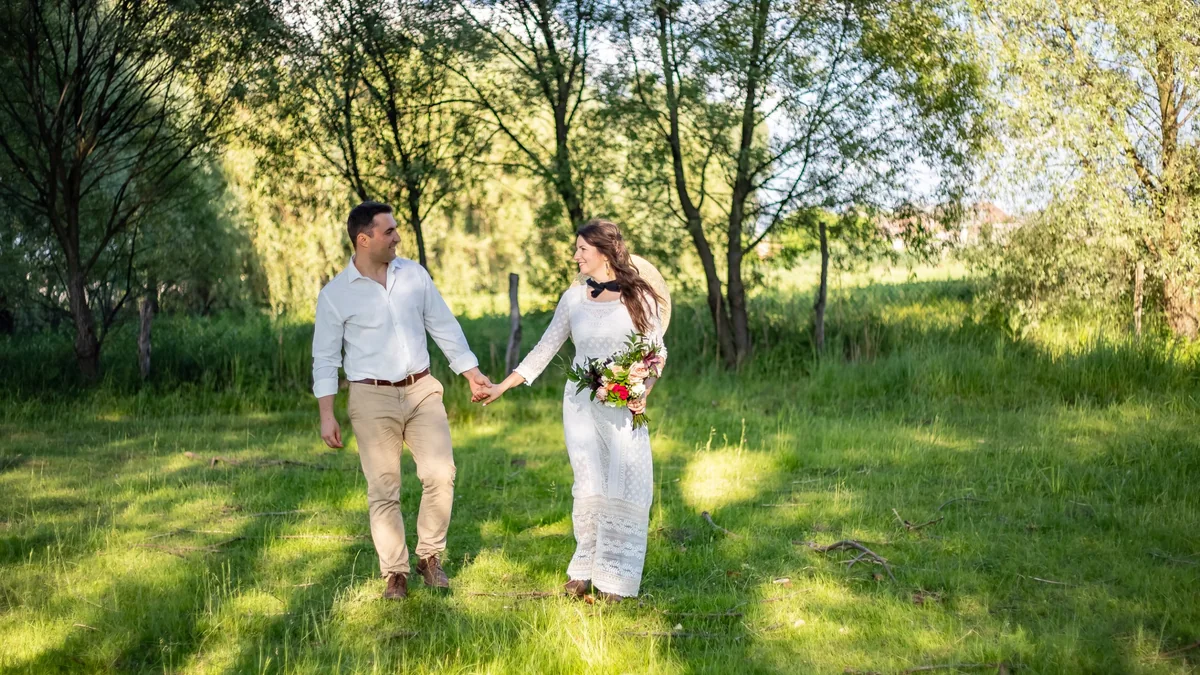
There is no traditional order to follow. Both partners can process separately, each with their own parents, walk in together after the wedding party, or have one wait at the front while the other processes. If you both process, decide together who enters last.
Small weddings with no attendants
With no wedding party, the processional shortens to three steps: the officiant takes their place, the families are seated, then the couple walks in, separately or together. At a courthouse there is often no aisle at all.
Children of the couple
Older children can walk a parent in or escort grandparents. Younger ones suit ring bearers or flower girls, with an adult in the front row to collect them. Under-fours often refuse to walk, so have a backup plan.
What is the Catholic wedding processional order?
The Catholic rite's preferred entrance has the priest meet the couple at the church door and lead the procession to the altar, with the attendants walking ahead and the parents accompanying the couple. Most dioceses also allow the familiar American custom of the father escorting the bride to meet the groom at the front.
According to the US Conference of Catholic Bishops, the preferred entrance runs like this:
The priest and those carrying the cross, candles and lectionary go to the door of the church and welcome the couple.
They lead the procession to the altar.
The canonical witnesses, the best man and maid of honor, walk ahead of the couple with the other attendants.
The bride and groom follow, accompanied by their parents, as the Rite recommends.
Many American Catholic weddings use the familiar version instead. The bishops note that “Policies generally allow the custom of the father of the bride to escort her to the front of the church,” where the groom waits with the priest.
Rules differ by diocese and parish, and the bishops' page summarizes a review of diocesan policies rather than setting one rule. Confirm the procession at your first meeting with the parish.
What is the Jewish wedding processional order?
In a Jewish processional the groom reaches the chuppah before the bride, and each partner is traditionally escorted by their parents. Beyond those two fixed points the order is custom rather than law, so the rabbi and the couple settle the details together.
Chabad's guide to the processional states that “The groom must arrive under the chuppah before the bride.” The tradition it describes has “both fathers accompanying the groom and both mothers the bride,” while the Zohar has each partner walk with their own parents. Beyond that, Chabad says, the order is not important to Jewish law.
A common American order, offered as practice rather than rule:
The rabbi and cantor
Grandparents
Groomsmen
The best man
The groom, with his parents
Bridesmaids
The maid of honor
The ring bearer and flower girl
The bride, with her parents
In many ceremonies the parents stay under or beside the chuppah rather than sitting, and in Ashkenazi tradition the bride circles the groom seven times on arrival.
Reform, Conservative and Orthodox communities differ, and the rabbi has the final say. Bring your draft order to your first meeting, not the rehearsal.
Interfaith couples often borrow this shape, each partner with both parents, because it gives both families an equal entrance.
Which side does the bride stand on?
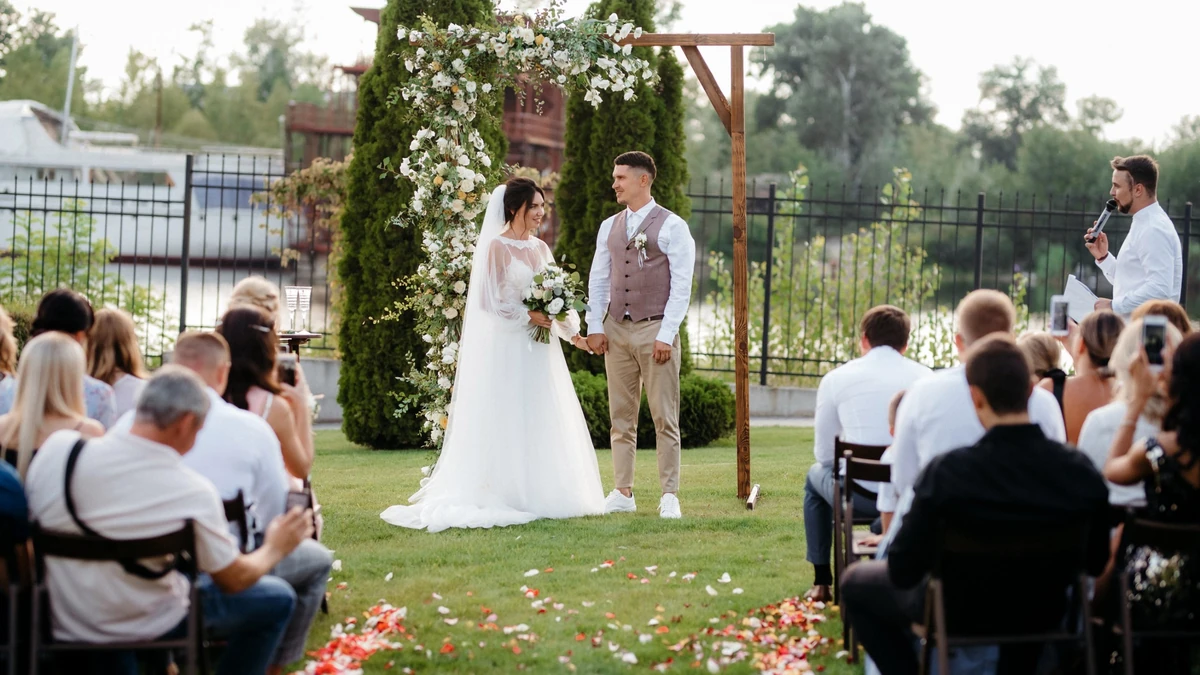
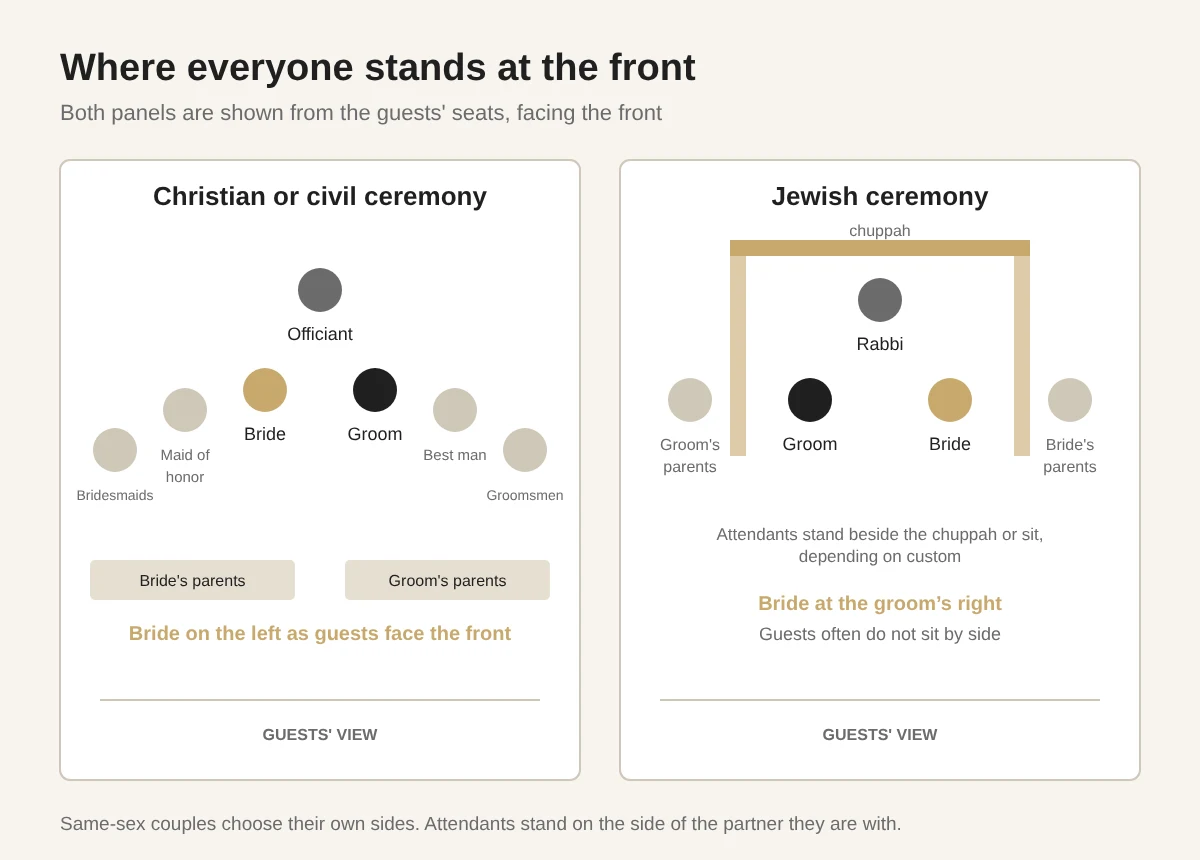
In most Christian and civil ceremonies, the bride stands on the left as guests face the front, on the same side as her family. In Jewish ceremonies it is reversed, and the bride stands at the groom's right. Attendants stand on their partner's side, and same-sex couples choose their own sides.
Emily Post puts it plainly: “The parents of the bride always sit in the first pew or row on the left,” and the groom's parents on the right. For Jewish ceremonies, Aish's guide to Jewish weddings says “The bride then settles at the groom's right-hand side.”
Attendants fan out on their partner's side, maid of honor and best man closest. You may hear that grooms stood on the right to keep a sword hand free. Treat that as a story, not history.
How families are seated
Ushers ask guests which partner they know and seat them on that side, with the first two or three rows held for close family. Jewish weddings usually skip sides, according to My Jewish Learning's guide for wedding guests, though at some Orthodox weddings men and women sit apart.
Choose a seat, not a side
Emily Post says it is fine not to have sides at all, with the front rows still kept for family. A line on one of your ceremony signs, such as “Choose a seat, not a side,” saves the ushers asking every guest.
What is the wedding recessional order?
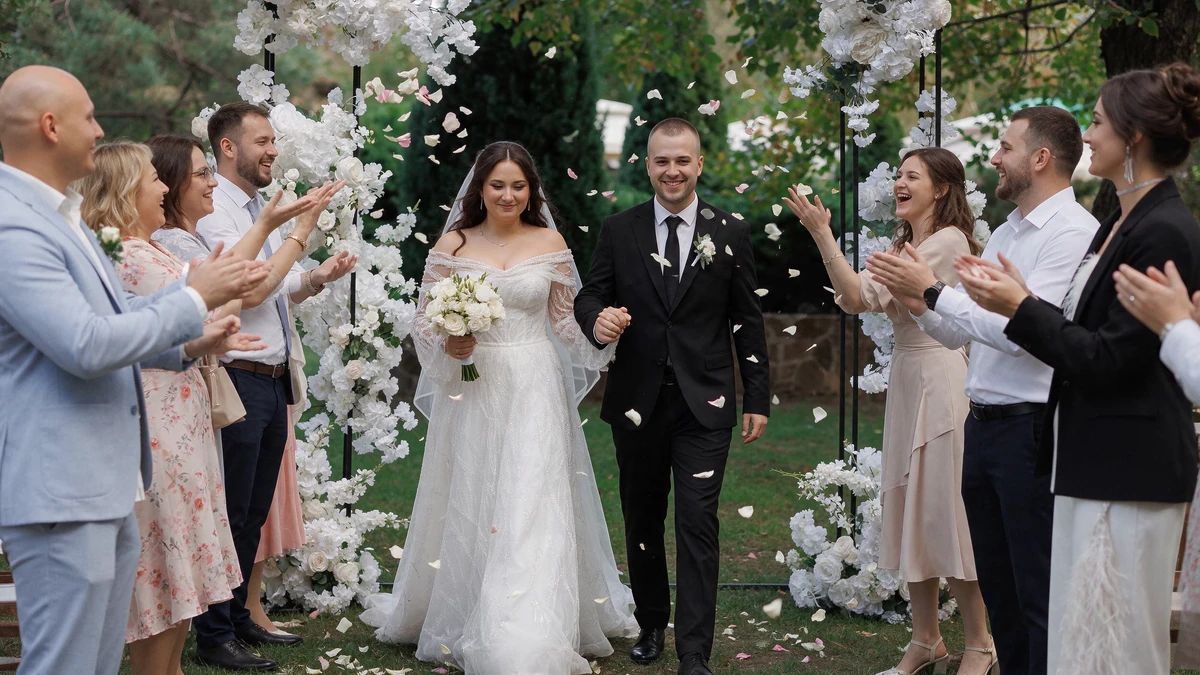
The wedding recessional order reverses the processional with one change: the couple leaves first. The children follow, then the maid of honor and best man, the rest of the wedding party in pairs, both sets of parents and the grandparents, before guests leave row by row from the front.
The couple, together.
The flower girl and ring bearer.
The maid of honor and best man, as a pair.
Bridesmaids and groomsmen, in pairs.
Both sets of parents.
Grandparents, then guests row by row from the front.
The officiant follows the families out or steps aside, and ushers release guests from the front so the family leaves first. The walk is quicker than the processional, so pick upbeat recessional songs. At a Jewish wedding the couple often goes straight to yichud, a few minutes alone together.
How do you put the processional order in your program?
List the processional in walking order, one line per person or pair, with each name followed by their role. Keep it to names and roles, since guests skim it while they wait, and check it against the rehearsal before printing so the paper and the aisle agree.
Here is the traditional wedding ceremony processional order, ready to copy. Replace each bracket and delete any line you don't need.
Processional
[Name], Officiant
[Name], Partner One, with [Name], Best Man
[Name] and [Name], Grandparents of the Bride
[Name] and [Name], Grandparents of the Groom
[Name] and [Name], Parents of the Groom
[Name], Mother of the Bride
[Name], Bridesmaid, and [Name], Groomsman
[Name], Maid of Honor
[Name], Ring Bearer
[Name], Flower Girl
[Name], Partner Two, escorted by [Name], Father of the Bride
Repeat the bridesmaid line for each pair. For other ceremonies, adjust a few lines:
Catholic. Attendants first, then “[Name] and [Name], with their parents,” or the father's escort line if your parish uses it.
Jewish. Rabbi and cantor first, the groom after the best man as “[Name], with his parents,” and the bride last “with her parents.”
Same-sex couples. A line for each partner with their escort, or one line: “[Name] and [Name], together.”
Our program examples show how to list the wedding party in your program, from names only to a line about each person, and our wedding program templates take the finished list.
Key Takeaways
Once the mother of the bride is seated, the aisle is closed, and late guests are shown to a side aisle or the back.
Emily Post seats a divorced father in the third or fourth row, behind the mother's family, even when he is hosting the wedding.
The Catholic rite prefers the priest to welcome the couple at the church door, though most diocesan policies allow the father to escort the bride.
A Jewish groom reaches the chuppah before the bride, and each partner is traditionally escorted by their parents.
In most Christian and civil ceremonies the bride stands on the left as guests face the front, the same side her family sits on.
The recessional runs in six steps, starting with the couple and ending with guests leaving row by row from the front.
Frequently Asked Questions
Who walks down the aisle in order?
The officiant and partner one take their places first, then the grandparents, the groom's parents and the mother of the bride are seated. Bridesmaids follow, alone or paired with groomsmen, then the maid of honor, the ring bearer and the flower girl. Partner two walks in last with their escort as the music changes.
Whose mom walks down the aisle first?
The groom's mother walks first, usually with the groom's father, and sits in the front row on the right. The mother of the bride comes last of all the family. Once she is seated the aisle is closed, and the wedding party begins to walk in.
In what order should families walk down the aisle?
Grandparents walk first, usually the bride's and then the groom's, escorted to their seats. The groom's parents follow and sit in the front row on the right. The mother of the bride walks last of all the family, to the front row on the left, and once she is seated the wedding party begins.
Who is the last person to walk before the bride?
The flower girl, who follows the ring bearer and walks just ahead of the bride. With no children in the wedding party, the maid or matron of honor is the last to walk before the bride. If the couple walks in together, it is the final member of the wedding party.
Who walks down the aisle first?
The officiant usually takes their place first, often from the side, followed by partner one and the best man. The first people to walk the full length of the aisle are usually the grandparents, escorted to their seats. In blended families and same-sex ceremonies, the couple sets the order.
Which side does the bride stand on?
On the left as guests face the front, in most Christian and civil ceremonies, which is the same side her family sits on. In Jewish ceremonies it is reversed, and the bride stands at the groom's right. Same-sex couples choose their own sides, and attendants stand beside the partner they are with.
Do bridesmaids walk with groomsmen?
Either way works. Bridesmaids can walk alone while the groomsmen enter from the side with partner one, or the two can walk in pairs. Pairs suit a large wedding party and a long aisle. The maid of honor traditionally walks alone either way.
Can both parents walk the bride down the aisle?
Yes. Each partner walking in with their parents is a long Jewish tradition, and many couples of every background now do it, often with the father on the left and the mother on the right. Emily Post also says a bride can walk in with her mother or walk down the aisle alone.
Ready to print your wedding program?
Once the processional is settled, the rest of the ceremony paper follows quickly. Our ceremony and reception stationery covers programs, signs and menus in matching designs, ready to customize in your browser and download to print.