



Eucalyptus Gold — RSVP Card
$9
4.7(55 reviews)

The template collection
Search by style, occasion or template type.
Soft watercolor florals, hand-painted botanicals, and natural greenery define our floral wedding RSVP card templates. Choose from peony-led romantic designs, rose and eucalyptus garden palettes, wildflower meadow illustrations, or modern botanical layouts in dusty rose, sage, blush, and ivory. Designed to coordinate with floral wedding invitations and travel together in the same envelope, every template is fully editable in our free browser-based editor and downloads as print-ready PDF, JPEG, and PNG files. Print at home or share digitally with guests.
1 template
Our floral wedding RSVP card templates feature soft watercolor florals, hand-painted botanicals, and natural greenery in romantic palettes. Choose from peony-led designs in dusty rose and ivory, rose and eucalyptus garden RSVP cards, wildflower meadow illustrations, watercolor wedding RSVP cards with loose hand-painted blooms, or modern botanical wedding RSVP cards with refined typography. Whether you are looking for greenery wedding RSVP cards in sage and white, romantic wedding RSVP cards with full floral borders, or garden wedding RSVP cards with single-stem accents, every template is fully editable in our free browser-based editor and downloads as print-ready PDF, JPEG, and PNG files.
The RSVP card travels in the same envelope as the wedding invitation. Guests open the invitation, see the floral aesthetic, then immediately see the RSVP card in the same envelope - any mismatch is jarring and visually disrupts the formal moment of receiving the wedding invitation. For floral weddings specifically, this coordination is especially important because the watercolor florals are the defining visual element. If your invitation features peonies and dusty rose, your RSVP card should use the same peonies and the same dusty rose. The same is true for the typography family, the layout style, and any decorative elements like deckle edges or foil accents. Most couples buy invitation suites that include matching invitation, RSVP card, and details card together specifically to ensure this coordination.
The floral aesthetic for RSVP cards follows the same conventions as floral wedding invitations:
Watercolor or hand-painted technique. Most floral RSVP cards are illustrated in watercolor.
Specific flower motifs. Peonies, roses, eucalyptus, wildflowers, and seasonal greenery. Match the flowers to the wedding invitation.
Romantic, soft color palettes. Dusty rose, sage green, blush pink, ivory, and muted gold.
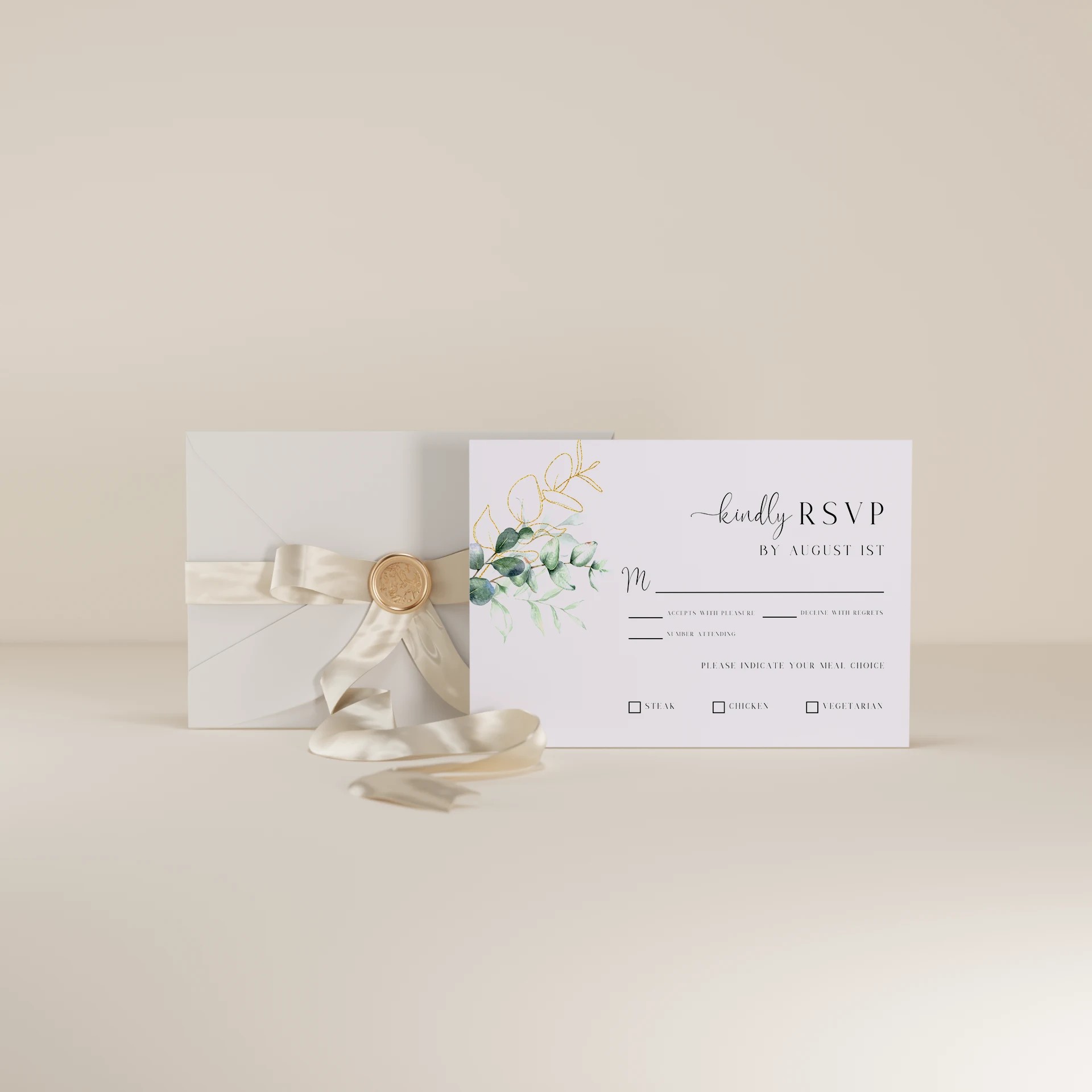
Single-stem accents preferred. RSVP cards have less space than invitations, so single-stem florals (one peony, one eucalyptus sprig) work better than full borders. The remaining space goes to the response checkboxes.
Functional layout. RSVP cards collect responses, so the checkboxes and write-in lines need to remain clear and unobstructed by florals.
Browse all wedding RSVP cards by aesthetic. For matching floral wedding stationery across the entire suite, see our floral wedding invitations, floral wedding invitation suites, and floral save the dates.
Set the RSVP deadline 3 to 4 weeks before the wedding date. This gives you time to follow up with non-respondents (always 10 to 20% of the guest list), finalize the headcount with the venue and caterer (most require final numbers 7 to 14 days before the event), and complete the seating chart. For destination weddings, set the RSVP deadline 6 to 8 weeks before the wedding to allow more time for guests to coordinate travel. Print the deadline clearly on the RSVP card itself - couples often phrase it as "Kindly respond by [date]" or simply "Please reply by [date]."
A standard wedding RSVP card includes 5 elements: a write-in line for the guest's name (M______ formatted line), checkboxes for accept and regret responses, optional meal selection (chicken, fish, vegetarian), optional song request line, and the RSVP deadline. For floral designs specifically, place the response checkboxes in the center where the design has the least floral interference, and use single-stem botanical accents in the corners or along one edge so the checkboxes and write-in lines remain clearly readable. Avoid full floral borders that crowd the response area.
Yes - this is essential because the RSVP card and wedding invitation are mailed in the same envelope. If your wedding invitation features watercolor peonies in dusty rose, your RSVP card should use the same watercolor peonies in the same dusty rose. The same is true for the eucalyptus type, the rose variety, the typography family, and the overall layout sensibility. Most couples buy invitation suites that include matching invitation, RSVP card, and details card together specifically to ensure cohesion. The unified design language is part of what makes a well-designed wedding stationery suite feel intentional.
Either works for floral designs, but each has tradeoffs. Stamped enclosed RSVP cards (the traditional format) come with a small return envelope inside the invitation envelope - this protects delicate watercolor designs in the mail and feels more formal. Stamped postcards skip the return envelope - guests fill out the postcard and mail it back directly. Postcards work well for casual or modern floral designs but are slightly riskier for watercolor cards because the design is exposed during mail handling. For more traditional floral weddings (full peony borders, ornate watercolor designs), enclosed RSVP cards in protective envelopes are the better choice. For minimalist floral designs (single-stem accents, restrained palette), postcards work fine.