
Classic Wedding Ceremony Signs
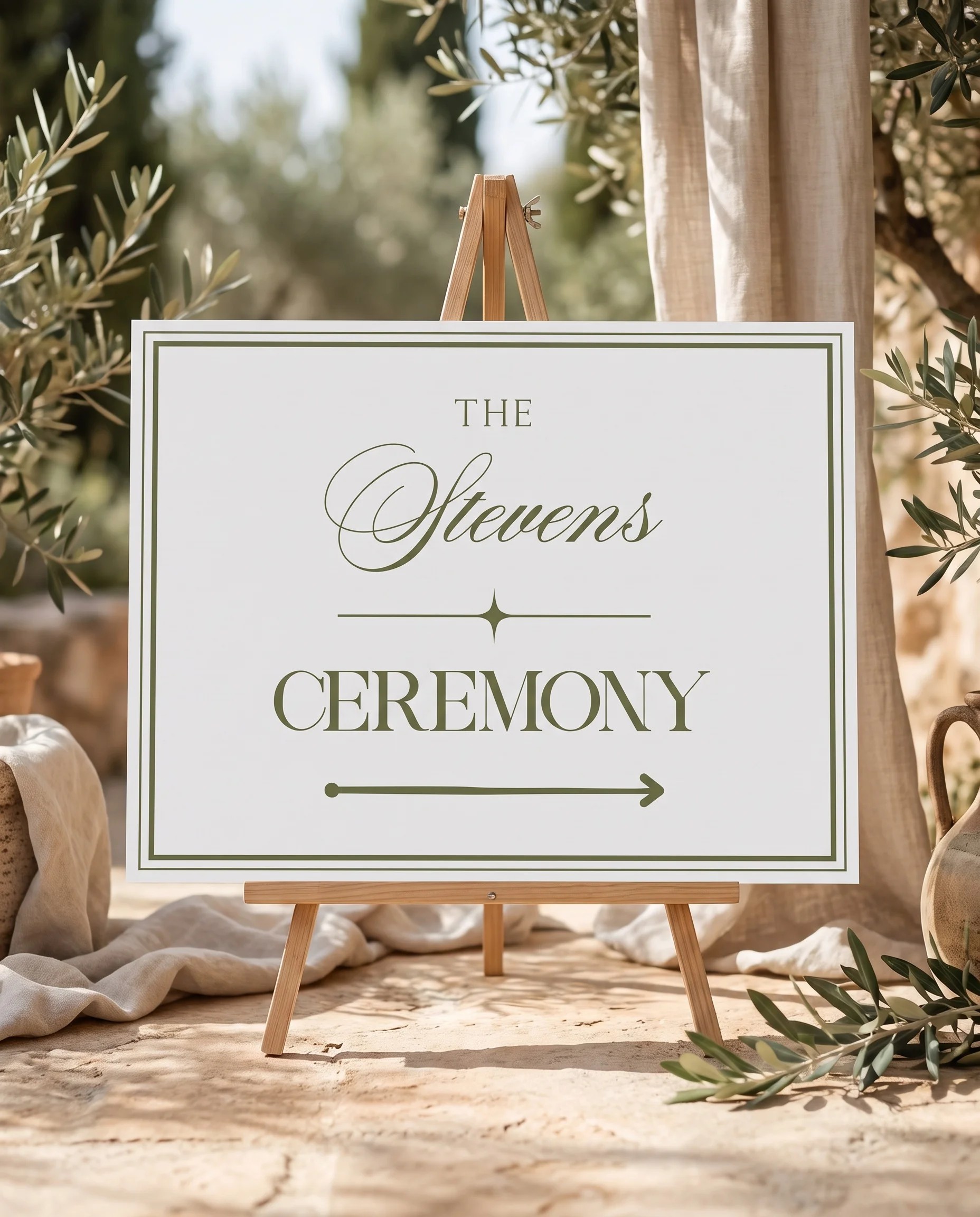
Formal typography, refined layouts, and timeless elegance define our classic wedding ceremony signs. Choose from traditional unplugged signs in serif and calligraphy type, formal entrance signs with monograms and gold accents, reserved seating signs in a black-and-white palette, and memorial signs with dignified, understated type. Available at both 24x18 and 36x24 inches on a single file, the typography stays legible from the back row. Every template is fully editable in our free browser-based editor and downloads as print-ready PDF, JPEG, and PNG. Print at home or send the files to a print shop for mirror or acrylic production. Filter by style below.





About Our Classic Wedding Ceremony Signs
Our classic wedding ceremony sign templates are built around formal typography, refined layouts, and timeless elegance, designed to set a dignified, traditional tone in the minutes before the vows. Choose from traditional unplugged signs in serif or calligraphy type, formal entrance signs with a monogram and gold accents, reserved seating signs in a crisp black-and-white palette, dignified memorial signs, or signs designed for printing on a framed mirror. No Canva account, no Photoshop, no software to install. Customize the wording, your names, colors, and layout in your browser, then download print-ready PDF, JPEG, and PNG files. Every design downloads at both 24x18 and 36x24 inches on a single file. Print at home for the smaller size or send the files to a print shop for mirror, acrylic, or heavy cardstock.
Mirror and Acrylic Are the Iconic Classic Substrates
A framed mirror with etched or vinyl script is the iconic classic substrate for wedding ceremony signs, with clear acrylic and gold-framed heavy cardstock as the natural companions, the same formal quality that runs through classic seating charts and table numbers, scaled to the ceremony sign format. Material options span a meaningful price range based on size and production method:
Framed mirror with etched or vinyl script. The most formal option, elegant and reflective. $120 to $250 for 24x18, $180 to $350 for 36x24.
Clear acrylic with gold or black calligraphy. A modern-classic crossover that survives outdoor conditions. $80 to $200 depending on size.
Foam board with a printed face in an ornate frame. The most affordable material that still reads as formal. $30 to $60 for 24x18, $40 to $80 for 36x24.
Heavy cotton or linen-finish cardstock in a gold frame. Reads as classic for indoor and formal venues but does not survive outdoor conditions. $20 to $40 for 24x18.
For any outdoor portion of the ceremony, choose acrylic. Foam board does not survive even brief rain, and cardstock warps in humidity. A framed mirror or acrylic sign also doubles as a keepsake many couples display at home after the wedding. Most classic couples show the sign on an ornate gold easel or a framed mirror on a stand at the entrance to the seating area, sometimes as a symmetrical pair flanking the aisle.
Formal Typography and Restraint Define the Classic Look
Classic ceremony signs read as formal through typography and restraint rather than decoration. A refined serif or formal calligraphy typeface, a centered and symmetrical layout, and a restrained palette of black, white, ivory, navy, or gold do the work. A monogram or the couple's initials adds a traditional touch, and a thin border or a subtle flourish frames the type without cluttering it. Avoid trendy fonts, bright colors, and heavy illustration, since restraint is what makes the sign read as timeless rather than of-the-moment. The same logic runs across the set: an unplugged sign can read “Unplugged ceremony, we invite you to be fully present,” a seating sign can read “Reserved for family,” and a memorial sign can read “In loving memory of those who could not be here today,” each in the same formal type. Carry the aesthetic into the display with an ornate gold frame, a framed mirror, or a classic easel, and the sign reads unmistakably formal from across the room.
Pairs With
Browse all wedding ceremony signs by aesthetic. For matching classic day-of stationery, see our classic wedding welcome signs, classic wedding seating charts, and classic wedding directional signs. The Wedding Signs (7-Piece) bundle includes all seven signs in one coordinated set.
Frequently Asked Questions
What size and material work best for a classic wedding ceremony sign?
Every design downloads at both 24x18 and 36x24 inches on a single file. Use 24x18 for intimate ceremonies under 80 guests or signs guests read from a few feet away, and 36x24 for larger ceremonies, ballrooms, or any sign that has to read from the back row. For material, a framed mirror with etched or vinyl script is the iconic classic substrate ($100 to $250 at sign shops), and clear acrylic with gold or black calligraphy is a modern-classic alternative ($80 to $200). Foam board with a printed face in an ornate frame is the affordable option ($35 to $65). Heavy cotton or linen-finish cardstock in a gold frame suits indoor and formal venues. For any outdoor portion, choose acrylic, since foam board and cardstock do not survive rain or humidity.
What makes a wedding ceremony sign look classic or formal?
Classic ceremony signs read as formal through typography and restraint. The defining elements are a refined serif or formal calligraphy typeface, a centered and symmetrical layout, and a restrained palette of black, white, ivory, navy, or gold. A monogram or the couple's initials adds a traditional touch, and a thin border or a subtle flourish frames the type without cluttering it. Avoid trendy fonts, bright colors, and heavy illustration. In the display, an ornate gold frame, a framed mirror, or a classic wooden easel completes the formal look. The effect should feel timeless rather than of-the-moment.
Where should I display a classic wedding ceremony sign?
Place the unplugged sign and any seating instruction sign at the entrance to the seating area, on a classic easel or an ornate stand at roughly eye level, so guests pass it before they choose a seat. Reserved seating signs sit on or beside the front-row pews or chairs. Memorial signs sit on a small side table near the front, often with a framed photograph and a candle. Classic signs suit churches, ballrooms, estates, and formal venues, so a gold easel, a framed mirror on a stand, or a symmetrical pairing of two signs flanking an aisle entrance all fit the aesthetic. Set signs up 1 to 2 hours before the ceremony so they are in place for early-arriving guests.
Should my classic wedding ceremony signs match my invitation suite?
Yes. Matching is essential for visual cohesion across the full wedding stationery suite. If your invitations used a formal serif, a monogram, and a black-and-gold palette, your ceremony signs should carry the same typeface, the same monogram, and the same palette so the day reads as one refined design. Guests calibrate their expectations from the first signs they read, so cohesion matters. Classic ceremony signs coordinate especially well with classic welcome signs, seating charts, and table numbers in the same formal type system, which is why many couples buy the invitation suite and the day-of stationery together to keep one design language across the entire wedding.