



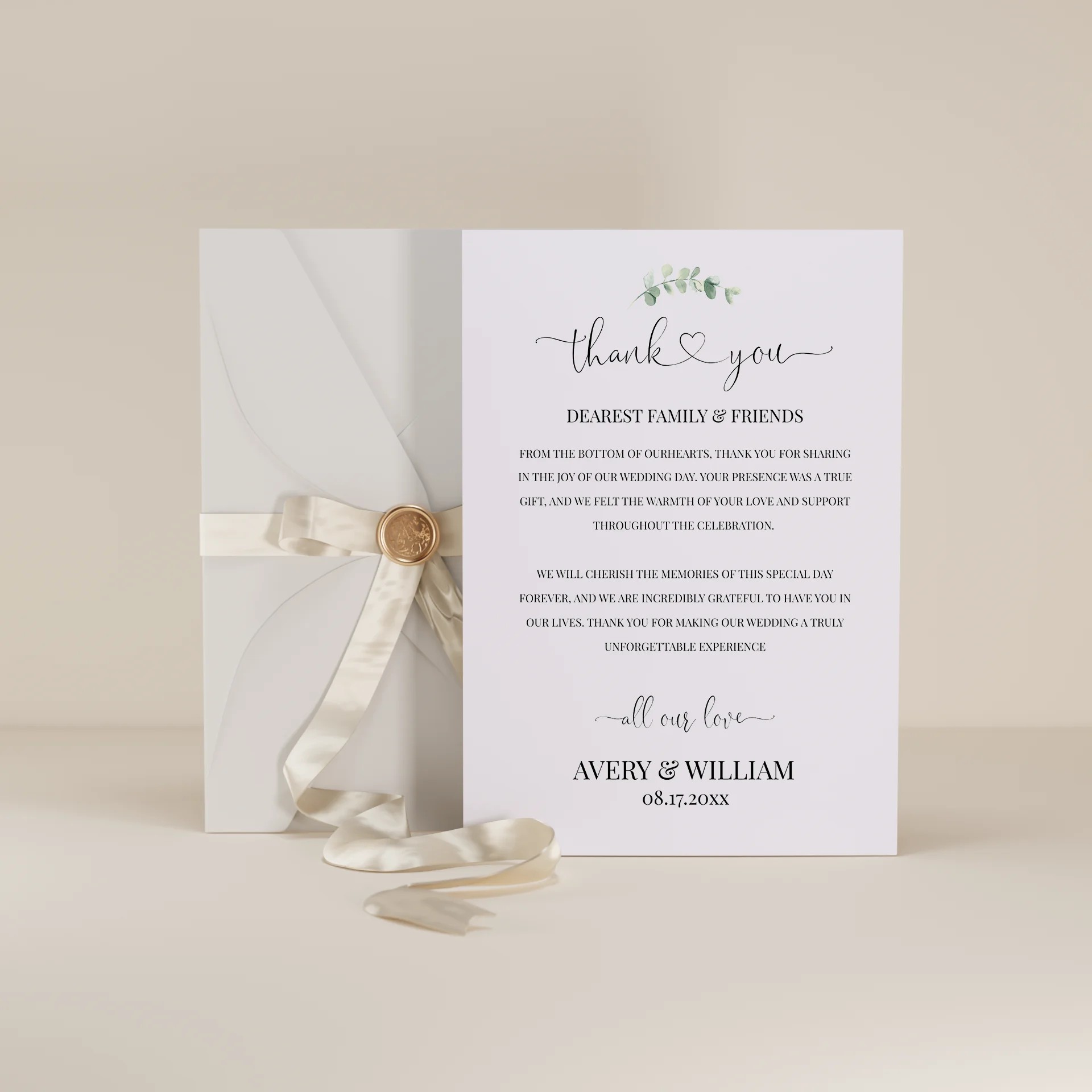
Eucalyptus Gold — Thank You Card
$9
4.8(93 reviews)

The template collection
Search by style, occasion or template type.
Soft watercolor florals, hand-painted botanicals, and natural greenery define our floral wedding thank you card templates. Choose from peony-led romantic designs, rose and eucalyptus garden palettes, wildflower meadow illustrations, or modern botanical layouts in dusty rose, sage, blush, and ivory. Designed to coordinate with floral wedding stationery and bookend the entire wedding journey, every template is fully editable in our free browser-based editor and downloads as print-ready PDF, JPEG, and PNG files. Print at home, send by mail, or share digitally with guests.
1 template
Our floral wedding thank you card templates feature soft watercolor florals, hand-painted botanicals, and natural greenery in romantic palettes. Choose from peony-led designs in dusty rose and ivory, rose and eucalyptus garden thank you cards, wildflower meadow illustrations, watercolor wedding thank you cards with loose hand-painted blooms, or modern botanical wedding thank you cards with refined typography. Whether you are looking for greenery wedding thank you cards in sage and white, romantic wedding thank you cards with full floral borders, or garden wedding thank you cards with single-stem accents, every template is fully editable in our free browser-based editor and downloads as print-ready PDF, JPEG, and PNG files.
The floral aesthetic for wedding thank you cards follows the same conventions as floral wedding stationery. Specifically:
Watercolor or hand-painted technique. Most floral thank you cards are illustrated in watercolor, which gives the flowers a soft, hand-painted quality.
Specific flower motifs. The most popular flowers are peonies (lush and romantic), roses (classic), eucalyptus (modern and soft), wildflowers (relaxed), and garden greenery. Match the flowers to the bride's wedding bouquet for maximum coordination.
Romantic, soft color palettes. Dusty rose, sage green, blush pink, ivory, and muted gold dominate. Match the wedding palette where possible for a coordinated stationery suite.
Florals as primary visual element. Unlike minimalist thank you cards where typography carries the weight, floral cards let the botanicals do the design work.
Layout variations. Floral thank you cards range from full-frame florals (botanicals around all four edges) to single-stem accents (a small spray of greenery in one corner).
The wedding thank you card is the last piece of stationery your guests receive - the bookend to the entire wedding journey that began with the save the date. For couples who chose floral wedding invitations, choosing matching floral thank you cards completes a unified design language across save the date, wedding invitation suite, and thank you note. The repeated peonies, the same dusty rose, the same script typography - guests notice the consistency, and the coordination signals an intentional, well-designed wedding from beginning to end. This is the strongest reason to choose floral wedding thank you cards specifically.
Floral wedding thank you cards work best for couples whose wedding aesthetic was floral, garden, or romantic, and whose wedding stationery (invitations, save the dates) featured watercolor florals. The aesthetic also works for couples who simply love botanical illustrations and want their thank you cards to feel romantic regardless of whether the wedding stationery matched. For couples whose wedding leans modern or minimalist, choose minimalist or contemporary thank you cards that match the wedding stationery instead of switching to floral.
Browse all wedding thank you cards by aesthetic. For matching floral wedding stationery across the entire suite, see our floral wedding invitations, floral wedding invitation suites, and floral save the dates.
Send wedding thank you cards within 3 months of the wedding date. The traditional etiquette window is 2 to 3 months after the wedding, with 3 months being the absolute outer limit. For gifts received before the wedding (engagement gifts, shower gifts), send thank you cards within 2 weeks of receiving the gift. If you fall behind, send the thank you card with a brief acknowledgment of the delay - it is better to send a late thank you card than no thank you card at all. Many couples set aside dedicated time after the honeymoon to write all thank you cards in batches.
Yes, this is the strongest reason to choose floral wedding thank you cards specifically. If your wedding invitations featured watercolor peonies and dusty rose, choosing floral thank you cards with the same flowers and palette completes the coordinated stationery suite. The thank you card is the final piece of stationery your guests receive, and matching it to the save the date and invitation creates a unified design language across the entire wedding journey. Use the same flower types, the same palette, and the same typography family. The result is a cohesive stationery experience from the very first piece (save the date) to the very last (thank you card).
The most popular flowers for floral wedding thank you cards are peonies (lush and romantic), roses (classic), eucalyptus (modern and soft), and garden greenery. The dominant color palette is soft and romantic: dusty rose, sage green, blush pink, ivory, and muted gold. Match the flowers and palette to the bride's wedding bouquet and wedding stationery for maximum coordination. For thank you cards specifically, single-stem accents (one peony in a corner, an eucalyptus sprig along the bottom) often work better than full floral borders because the design needs to leave room for a personal handwritten message.
Photo thank you cards work best when you have a small selection of strong wedding photos that capture the day's emotion. The advantage is that the photo serves as a visual keepsake guests can display. Text-only floral thank you cards work better when professional wedding photos are still being edited (you want to send thank you cards within 3 months but professional photos may take 2-3 months to deliver), when sending to a wide range of guests, and when the floral design itself is the visual element. Many couples choose floral text-only thank you cards specifically because the watercolor flowers function as the visual interest in place of a photo, freeing up space for a longer handwritten message.