Wedding Invitation Etiquette: Who to Invite, Plus Ones, and the Awkward Situations
You are obliged to invite almost nobody. The one firm rule is that anyone invited to a shower, engagement party or bachelorette must also be invited to the wedding. Spouses, fiances and live-in partners are invited by name, and beyond that, plus ones are your choice.
Most wedding invitation etiquette guides tell you where the comma goes. Very few tell you what to say when your mother insists on inviting her book club, or when a coworker asks whether they can bring someone you have never met.
This guide covers the social half: who you are actually obliged to invite, who gets a plus one, and how to handle the conversations that follow. For the words printed on the card, see our separate guide to how to word your wedding invitations. For names and titles on the envelope, check our addressing guide.
One theme runs through all of it. Traditional etiquette answers most of these questions, but it answers them for a world where nobody could forward an invitation link to a group chat. Where the old rule still holds, this guide says so. Where it has quietly stopped matching how people behave, it says that too.
Who are you actually obliged to invite?
Almost nobody. There is no rule requiring you to invite an aunt, a colleague, or the friend whose wedding you attended last summer. A wedding guest list is a budget and a room, not a social debt to be repaid.
The one rule that is not negotiable
Anyone invited to a wedding-related party must also be invited to the wedding. The Emily Post Institute is unambiguous on this, with office showers the only exception. If someone attends your engagement party, your shower or your bachelorette, they receive an invitation. No exceptions for people who are fun at parties but expensive at dinner.
Couples break this rule by accident, when a friend organizes a shower and invites people they never intended to host. Agree on the guest list before anyone throws you a party.
Build the list in tiers, not in one sitting
Write three lists rather than one. Tier one is the people whose absence would change the day: immediate family, the wedding party, and the friends you cannot imagine getting married without. Tier two is extended family and close friends. Tier three is everyone else.
Apply your venue capacity to the top of the list and stop. This hurts far less than starting with a hundred and eighty names and cutting, because you never have to argue about who to remove.
Who you can leave off without apology
Colleagues, unless you genuinely socialize outside work. Inviting one person from a team and not the rest is the version that causes trouble.
Relatives you have not spoken to in years, particularly at a small wedding where nobody expects a full family turnout.
People whose wedding you attended. Reciprocity is not an etiquette rule, it is a feeling, and it usually belongs to whoever has the larger budget.
Your parents’ friends, unless your parents are hosting and have asked. That conversation is worth having early rather than at the printer.
Do you have to give every guest a plus one?
No. Plus ones are a courtesy you extend, not an entitlement your guests hold. What you do owe is consistency, because guests compare notes and an inconsistent rule is what causes offense rather than the rule itself.
Who is invited by name rather than given a plus one
Spouses, fiances and live-in partners are invited in their own right, regardless of how well you know them, and Emily Post applies this to all couples equally. These people are not plus ones. They go on the invitation by name, which is a different thing entirely and signals that you are inviting a specific person rather than an empty seat.
Long-term partners who do not live together sit in the same category in practice. Someone your guest has been with for three years is not a stranger you are being generous about.
Where the choice is genuinely yours
Beyond established couples, it is your call. Common approaches are to extend plus ones to the wedding party, to guests traveling a long distance, and to anyone who would otherwise know nobody in the room. Whichever rule you pick, apply it to everyone in that category. Signal it on the envelope rather than in conversation, which our guide to addressing your invitation envelopes covers in detail.
Remember what a plus one actually is
A plus one is an open invitation, not a seat reserved for a partner. Lizzie Post of the Emily Post Institute is clear that once you extend one, it is genuinely the guest’s choice who fills it, and that could be a friend, a sibling or a date you have never heard of. If you are not comfortable with a stranger at the table, invite the specific person by name instead.
Can you have an adults only wedding?
Yes, and it is common enough now that most guests will not blink. The etiquette question is not whether you may, it is how you tell people, because almost every complaint about adults-only weddings traces back to how it was communicated rather than the decision itself.
How to say it kindly
Tell people early and directly. A line on your wedding website, backed up by naming only the invited adults on the envelope, gives parents time to arrange care. Discovering the restriction three weeks out turns a reasonable decision into a grievance.
Wording that works: "We adore your little ones, but this celebration will be adults only." It is warm, it is unambiguous, and it does not apologize for a decision you are entitled to make.
The exceptions problem
If you invite some children and not others, expect questions. Immediate family only, or children in the wedding party only, are both defensible lines because they are easy to explain. "Children we like" is not a line, and someone will work out that it is what you did.
If the budget stretches, a supervised room with a sitter is the most appreciated thing you can offer traveling parents.
How do you handle an A list and a B list?
Carefully, and silently. Sending a second wave of invitations after early declines is extremely common and entirely acceptable, provided no guest ever discovers which list they were on. The etiquette lives entirely in the execution.
Make the timing work for you
Set your A list RSVP deadline early, around six weeks before the wedding, so second-wave invitations still land four weeks out rather than eight days out. An invitation arriving ten days before a wedding announces itself, no matter how gracefully it is worded.
Send in small batches as declines arrive, rather than one large second mailing. It reads as ordinary staggered sending rather than a queue clearing.
The save the date trap
Never send a save the date to someone on your B list. A save the date is a commitment, and anyone who receives one must receive an invitation. This is where couples most often trap themselves, months before the invitations are even ordered.
What do you say when someone assumes they are invited?
Be direct, be kind, and do it early. The conversation is uncomfortable for about ninety seconds, and every week you avoid it makes it worse, because the person is now telling other people they are going.
The conversation itself
Lead with the constraint, not with the person. "We are keeping it to fifty because of the venue, so we are having to leave out people we would love to have there" is true, is not personal, and does not invite negotiation. Do not offer a reason that could be solved, such as cost, because someone will offer to pay.
Resist the urge to over-explain. A short answer delivered warmly lands better than a long one delivered anxiously.
When the invitation link gets forwarded
Digital invitations and wedding websites travel in ways paper never did. A guest forwards the link to a sibling, and suddenly three people believe they are invited. Use a website that requires a name to RSVP, keep the address off public social media, and if a link does escape, correct it the day you hear about it rather than hoping it resolves itself.
When a guest RSVPs for people you did not invite
Contact them and correct it. Emily Post is unusually firm here: the invitation is not a negotiation, the names on it are the only people invited, and it is not rude to say so. Explain that the venue or the numbers will not stretch, and hold the line. Guests who ask for exceptions are the ones being impolite, not you.
The exception is the phrase "and family" or "and children," which does include everyone under that roof. If you wrote it, you invited them.
Where does registry information belong?
On your wedding website, and nowhere in the invitation suite. This is one of the few traditional rules that every major etiquette authority still holds, and the reasoning behind it has not weakened: an invitation asks for someone’s company, and mentioning gifts in the same envelope makes the request look conditional.
That includes enclosure cards. Registry details do not belong on the details card, the reception card, or anywhere else in your wedding invitation suites. Put them on your website, tell your parents and wedding party where to find them, and let word of mouth do the rest. Guests always ask.
Cash funds follow the same rule and attract more scrutiny, so keep the wording plain and never explain what the money is for in a way that reads as a target. If you would rather have no gifts at all, "your presence is the only present we need" belongs on the website too, not on the card.

How should a guest decline a wedding invitation?
Reply by the deadline, in the format the couple asked for, and keep it short. A prompt no is far kinder than a slow maybe, because the couple is working to a catering headcount and a seating chart.
Do not over-explain. "We are so sorry to miss it, and we cannot wait to hear about the day" is complete. A paragraph of justification invites the couple to solve a problem you have already decided about. If they send paper RSVP cards, use them rather than sending a text, because that card is how they are tracking numbers.
Send a gift if you would have given one anyway. There is no obligation, but declining and sending nothing reads colder than either one alone.
Is it acceptable to send digital wedding invitations?
Yes, and it is now unremarkable. The traditional objection was that paper signals effort and permanence, which is a genuine point rather than pure snobbery, but it applies to how the invitation looks and reads far more than to how it arrives.
When digital works well
Digital suits shorter timelines, guest lists spread across several countries, casual or outdoor weddings, and anyone who would rather put the paper budget into the day itself. It also tracks RSVPs automatically, which removes the most tedious part of the process. Well-designed online wedding invitations read as a deliberate choice rather than a shortcut.
When paper still carries more weight
A black tie wedding, a formal religious ceremony, or a guest list with a lot of older relatives are all reasons to send a paper. So is the simple fact that some people never see the email. A hybrid approach solves most of this: paper to the guests who will appreciate it, digital to everyone else, with the same design across both.
One firm rule either way. Whatever you send, send everyone in the same category the same thing. Paper for the family and a group text for the friends is the version that gets noticed.
Destination wedding invitation etiquette
Give more notice and more information than a local wedding needs. A destination wedding asks guests for money and vacation days rather than an afternoon, and the etiquette follows from that difference rather than from any separate rulebook.
Timing and transparency
Send save the dates eight to twelve months ahead and invitations twelve weeks out rather than the usual six to eight. Include a details card or website covering flights, hotel blocks, transfers, and what is and is not being paid for. Vagueness about cost is the most common complaint guests have, and it is entirely avoidable.
Nobody is obliged to come
Expect a lower acceptance rate and do not treat it as a verdict on the friendship. Emily Post’s wedding guidance is clear that guests are never obliged to accept, and that goes double when accepting costs two thousand dollars. Make declining easy, thank people who cannot come, and do not follow up asking whether they have reconsidered.
If your budget covers part of the trip, say so plainly on the details card. If it does not, say nothing rather than apologizing, which only draws attention to the cost.
Key Takeaways
Anyone invited to a shower, engagement party or bachelorette must also be invited to the wedding, with office showers the only exception.
Spouses, fiances and live-in partners are invited by name rather than as plus ones, so they are not a courtesy you can withdraw.
A plus one is an open invitation, and the guest chooses who fills it, which may be a friend or sibling rather than a partner.
Never send a save the date to anyone on your B list, because a save the date commits you to sending an invitation.
Registry and cash fund details belong on your wedding website and nowhere in the invitation suite, including enclosure cards.
Destination weddings need to save the dates eight to twelve months ahead and invitations around twelve weeks out.
Frequently Asked Questions
Is it rude not to invite aunts and uncles to a wedding?
No, particularly at a small wedding where nobody expects a full family turnout. It becomes noticeable at a large wedding where most of the extended family is present and a few are missing. If you are cutting, cut by category rather than by individual, and tell them before they hear it elsewhere.
Whose name should be first on a wedding invitation?
Traditionally the bride’s name, or the hosting family’s. It is now largely preference. Same-sex couples have no traditional default at all, so order alphabetically, by whose family is hosting, or by what sounds better read aloud, then apply that choice consistently. Our wording guide covers the full conventions.
Do people still put parents’ names on wedding invitations?
Yes, very often. The difference is what it signals. It once indicated who was paying, and now it usually indicates who is being honored. Couples hosting and funding the wedding themselves can still name their parents on the host line if they want to, and many do.
How much money do you put in a wedding card?
The Knot’s Guest Study puts the US average around $150 per guest, rising to roughly $160 for close friends and family. Adjust for how close you are and whether you are traveling. The old rule about covering the cost of your plate is no longer recognized by etiquette authorities.
Do you have to give every guest a plus one?
No. Spouses, fiances and live-in partners are invited by name and are not optional. Beyond that, plus ones are your choice. Common approaches extend them to the wedding party, to guests traveling far, and to anyone who would otherwise know nobody, applied consistently across each category.
Is it OK to have an adults only wedding?
Yes, and it is common. The difficulty is communication rather than permission. Say it early on your wedding website, name only the invited adults on the envelope, and use warm wording rather than a rule. Discovering the restriction late is what upsets people, not the decision.
Can you put registry information on the invitation?
No, and every major etiquette authority still advises against it, including on enclosure cards. An invitation asks for someone’s company, and mentioning gifts alongside it makes the request look conditional. Put registry and cash fund details on your wedding website, where guests will look for them anyway.
Is it rude to send a digital wedding invitation?
No, and it is increasingly normal. Digital works well for short timelines, international guest lists and casual weddings, and it tracks replies automatically. Paper still carries more weight for black tie weddings, formal religious ceremonies, and guest lists with many older relatives. A hybrid approach suits most couples.
Ready to send yours?
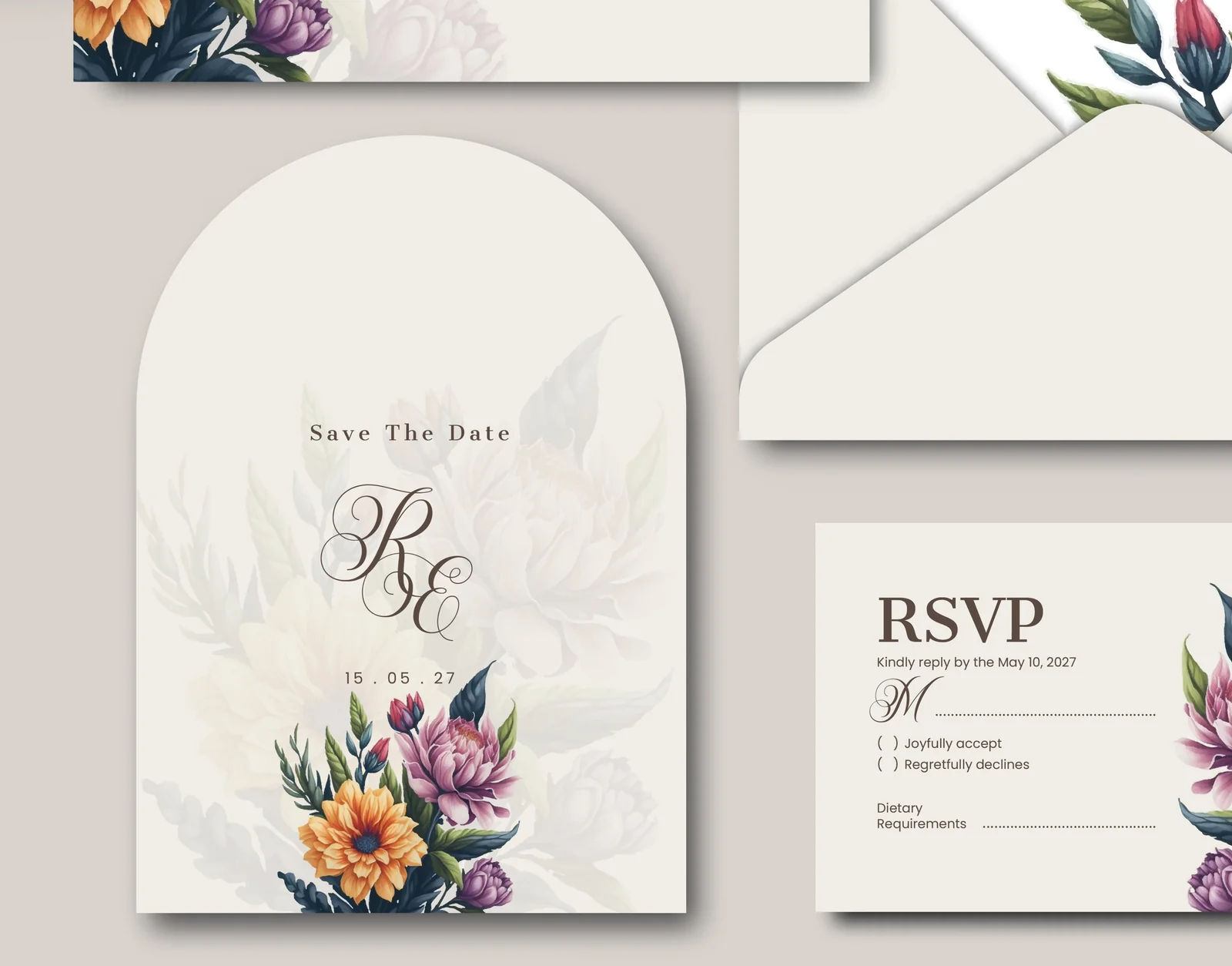
Once the guest list is settled, the design is the easy part. Browse our wedding invitation templates to customize your suite, add matching details and reply cards, and download print-ready files or share a digital version with the guests you decided on.